


Unlock the Editor’s Digest for free
Roula Khalaf, Editor of the FT, selects her favourite stories in this weekly newsletter.
Last month Alphaville wrote about how hard the forecasting lark is, especially when it comes to interest rates. And even if you know exactly what rates will do it’s no guarantee that you’ll be able to predict the implications, such as how bond yields might respond.
Belatedly we realised that we’ve just seen a great example of how tricky financial predictions are in the US Treasury market’s reaction to the fabled “Fed pivot” that finally materialised in September.
For almost two years investors and analysts had been anticipating the Fed cutting interest rates again. The view that this would mark an end to the bond market’s punishment and a peak in yields helped a record $600bn flow into bond funds last year.
And yet . . .

The 10-year Treasury yield has actually climbed by about 90 basis points since that first 50 basis point jumbo cut in September, despite the Fed trimming rates again at the two subsequent meetings, and two more quarter-point cuts being pencilled in for 2025.
Yes this is not new, it’s mostly just the scale that’s eye-catching. And it’s obviously a slightly facile argument, given that yields had already moved a fair bit lower in the months leading up to the widely-signalled September pivot. Long bonds move for all sorts of reasons that have little to do with the ebb and flow of interest rates.
However, most analysts still got it completely wrong even after it became clear that there was an element of “buy the rumour, sell the news” when yields bounced higher into the FOMC meeting and immediately after the cut.
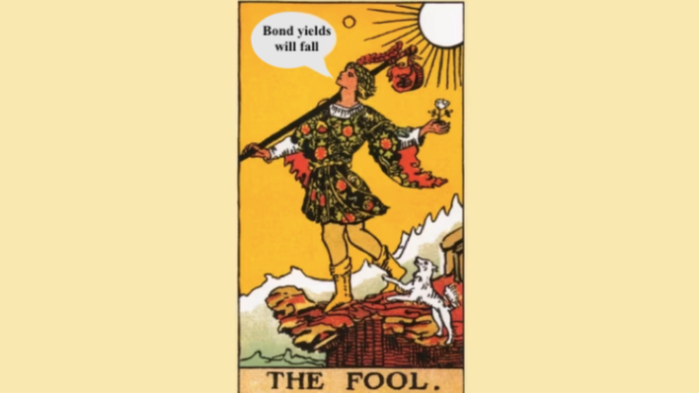
In late September the median Wall Street strategist forecast was that the post-FOMC yield bump would fade, and the 10-year Treasury yield would end 2024 at 3.74 per cent. It actually settled at 4.57 per cent. It’s almost tempting to paraphrase the old joke about FX analysts and say that God created fixed income strategists to make economists seem accurate.
In defence of fixed income strategists, there was obviously another high-profile event in November that subsequently changed the outlook for inflation. But that was hardly an unforeseeable event. And most of the 2025 outlook reports compiled and sent out in November and December still predicted that yields would gently fall into the year-end and through into next year.
That still holds, despite the occasional updated forecast trickling in. At pixel time, the median prediction of 51 fixed income analysts surveyed by Bloomberg is that the 10-year Treasury yield will fall back to 4.15 per cent by the end of 2025.
In fact, only three of them predict that it might rise from today’s 4.59 per cent level (of which, the forecast by ING’s James Knightley is the highest, at 5.5 per cent).
Interestingly, the markets-implied forecast derived from interest rate forwards indicate that investors are a smidgen more pessimistic, and think the 10-year yield will end 2025 at 4.67 per cent.

The only prediction that Alphaville is comfortable making is that everyone will probably be wrong, somehow, and that it will be a bumpy ride along the way. Please remember us in the Institutional Investor rankings.


