

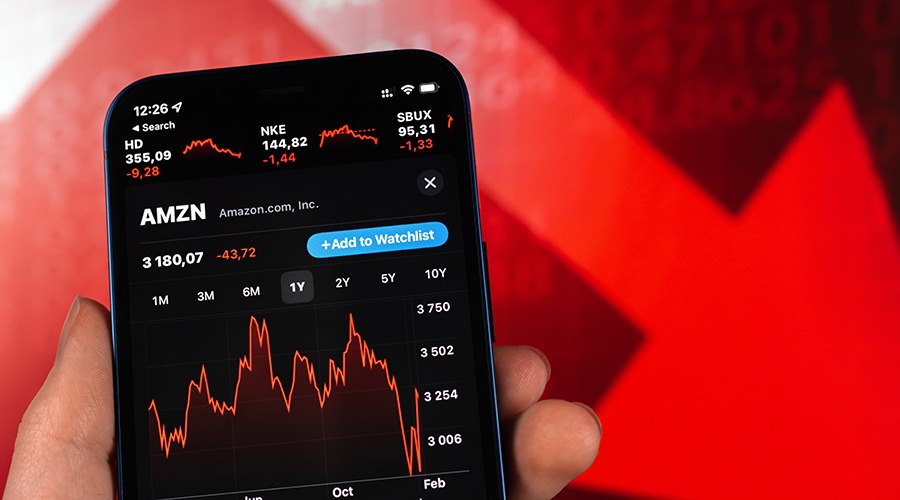

Amazon,
ticker symbol AMZN, is a powerhouse on the Nasdaq stock exchange, and its stock
price is a hot topic for investors worldwide. Amazon.com, Inc. isn’t just the
largest online retailer—it’s a juggernaut in e-commerce, cloud computing, and
artificial intelligence (AI).
Whether
you’re trading, investing, or just curious, this article dives into the latest
Amazon stock news, predictions for 2025 and 2026, and what’s driving its
performance. We’ll explore real-time data, analyst insights, and key factors
shaping its outlook, all based on the most current information available as of
February 24, 2025.
As of
February 24, 2025, Amazon’s stock price sits at approximately $216.58 per
share, according to latest market update from February 21. This figure reflects
daily fluctuations in trading volume, with the company’s market cap hovering
around $2.23 trillion—a testament to its massive scale. Amazon shares remain a
focal point in the stock market, listed on Nasdaq, where tech stocks often set
the pace.
The price
dropped significantly during Friday’s close, losing nearly 3% and testing lows
around $214.74, the lowest level since early December.
Why is Amazon stock going down? Source: Tradingview.com
The
following table summarizes Amazon’s stock performance in February 2025:
|
Date |
Closing |
Daily |
|
February 1, |
234.50 |
-1.2% |
|
February 7, |
228.20 |
-2.7% |
|
February 14, |
222.00 |
-2.7% |
|
February 21, |
216.58 |
-2.83% |
Why Amazon Is Going Down?
While Amazon.com, Inc. posted solid revenue of $187.79 billion, its Q1 2025 sales forecast of $151 billion to $155.5 billion fell short of Wall Street’s $158.5 billion expectation. Add in concerns over a $100 billion 2025 spending plan for AWS and AI—up from $83 billion in 2024—and a $2.1 billion foreign exchange headwind, and you’ve got a recipe for market unease. Analysts on Nasdaq note this volatility, alongside competition from Microsoft and Alphabet, has sparked bearish sentiment, even as the company’s market cap holds strong at $2.23 trillion.
Despite
this, Amazon’s long-term growth is undeniable. Since its IPO in 1997 at a
split-adjusted $0.07 per share, it has soared over 226,744%, per 24/7 Wall St.
That kind of stock performance keeps it on every investor’s radar.
- Current Price: $216.58 (as of February 24,
2025) - Market
Cap: $2.23 trillion
Amazon Results
Fourth Quarter 2024 Financial Highlights
In Q4 2024, Amazon reported net sales of $187.8 billion, a 10% increase
compared to the same period in 2023. Operating income rose to $21.2 billion, up
from $13.2 billion in the previous year, while net income doubled to $20.0
billion, or $1.86 per diluted share. The North America segment contributed
$115.6 billion in sales, and Amazon Web Services (AWS) saw a 19% year-over-year
increase, reaching $28.8 billion in sales.
Key financial metrics
for Q4 2024 are summarized below:
|
Metric |
Q4 2023 |
Q4 2024 |
Change (%) |
|
Net Sales ($ |
170.7 |
187.8 |
+10% |
|
Operating |
13.2 |
21.2 |
+60% |
|
Net Income ($ |
10.0 |
20.0 |
+100% |
|
AWS Sales ($ |
24.2 |
28.8 |
+19% |
Full Year 2024 Performance
For the entire year, Amazon’s net sales grew by 11% to $638.0 billion.
Operating income for 2024 was $68.6 billion, nearly doubling from $36.9 billion
in 2023. Net income reached $59.2 billion, or $5.53 per diluted share, compared
to $30.4 billion, or $2.90 per diluted share, in the prior year. AWS continued
its robust performance with annual sales of $107.6 billion, a 19% increase from
2023.
Annual financial
highlights for 2024 are as follows:
|
Metric |
2023 |
2024 |
Change (%) |
|
Net Sales ($ |
574.9 |
638.0 |
+11% |
|
Operating |
36.9 |
68.6 |
+86% |
|
Net Income ($ |
30.4 |
59.2 |
+95% |
|
AWS Sales ($ |
90.4 |
107.6 |
+19% |
How Has Amazon Stock
Performed in 2025?
Amazon
stock kicked off 2025 with mixed results. After a stellar 2024—where it climbed
44% and outperformed the S&P 500’s 23% gain—early 2025 brought challenges.
The Q4 2024 earnings, showed strong revenue of $187.79 billion (up 10%
year-over-year), but the company’s Q1 2025 sales forecast of $151 billion to
$155.5 billion fell short of the $158.5 billion analysts expected. This sparked
a bearish reaction, though many still see a bullish long-term outlook.
What does
the technical analysis indicate? Based on my assessment, the decline in
Amazon’s stock on Friday was one of the steepest in the past two months. The
stock price also reached its lowest level in this timeframe. However, it’s
worth noting that the devaluation halted precisely at the lows from early 2025,
which, together with the highs from November 2024, now serve as local support.
This could present an opportunity for a rebound following an almost 11%
correction from the historical high of $242.50, tested on February 4.
If this
support level fails, in my opinion, the stock price could drop below the $200
mark and test around $196, where the lows from November and the peaks from
September are located.
Amazon price technical analysis. Source: Tradingview.com
|
Amazon Price Support |
Amazon Price Resistance |
|
$216 – 2025 lows |
$233 – ATH from December 2024 |
|
$195 – November 2024 lows |
$242.15 – current ATH from |
Amazon’s
dominance in multiple sectors keeps it resilient. It holds a 37.6% share of
U.S. e-commerce, dwarfing competitors like Walmart, Apple, and eBay combined,
according to Statista. That market share, paired with its cloud computing arm,
Amazon Web Services (AWS), reinforces its status as a top stock to buy for many
portfolios.
A Look at Amazon Stock
History
Amazon’s
stock price history is a story of growth. From its humble start to acquisitions
like Whole Foods and the rise of AWS, the company has evolved into a
trillion-dollar giant. Stock splits, like the one in 2022, made AMZN more
accessible, boosting liquidity and attracting more shareholders. Its valuation
reflects decades of innovation—a key reason it’s a Wall Street favorite.
What Influences Amazon’s
Stock Price?
Several
factors drive AMZN’s stock price, from earnings to market trends. Let’s break
it down.
Earnings Reports and
Financial Performance
The Q4 2024
earnings were a mixed bag. Revenue hit $187.79 billion, surpassing the $187.30
billion forecast, while earnings per share reached $1.86, beating the $1.49
estimate (CNBC). AWS generated $28.8 billion, fueled by AI demand, and
advertising brought in $17.3 billion—slightly under the $17.4 billion expected.
Looking ahead, Amazon plans to spend $100 billion in 2025 on AWS and AI, up
from $83 billion in 2024, per Forbes. This investment has some worried about
short-term profitability, but analysts project 11% revenue growth and 23% EPS
growth for 2025.
Market Trends and Economic
Indicators
Broader
market conditions play a role too. Inflation and interest rates, guided by the
Federal Reserve, affect investor sentiment. Tech stocks like Amazon, Microsoft,
and Alphabet often move in sync. Right now, market volatility and a $2.1
billion foreign exchange headwind for Q1 2025 are creating uncertainty, though
the tech sector’s strength keeps AMZN in focus.
Amazon’s
Business Segments
Amazon’s
diverse operations power its stock:
- E-commerce: The amazon.com platform sells
merchandise and content, including products offered by third-party
sellers, purchased for resale, and more. - AWS: Commands 31% of the global cloud
computing market, ahead of Microsoft (25%) and Google (11%). Projected 21%
increase in AWS revenue due to enterprise workload migration and AI
services. - Amazon Prime: Drives loyalty with shipping
and streaming perks. - Physical Stores: Whole Foods and other outlets
expand its reach.
These
segments showcase why Amazon serves consumers internationally and remains a
retail and tech leader.
Amazon Stock Forecast for
2025 and 2026
What’s next
for AMZN? Analysts from TipRanks, Forbes, and MarketBeat have weighed in with
predictions.
Analysts
remain optimistic about Amazon’s long-term prospects, particularly in cloud
computing and AI. Predictions suggest that AWS revenue could grow by 21% due to
enterprise workload migration and generative AI offerings. Additionally,
Amazon’s focus on enhancing delivery speed and expanding its advertising
business is expected to contribute to future growth.
$AMZN I would like to see a bounce here
Amazon is retesting this important zone.
This zone was a previous resistance and is now a support.IF this can hold we should see amazon bounce and head back to $224-$226
One of my top watches for this week ❤️ pic.twitter.com/d8BFgjuWI5
— BRITT 🏝 (@BullishBritt) February 24, 2025
2025 Prediction
The
consensus price target for 2025 is $260.74, with a range from $145 to $280.
Bernstein predicts $280, citing an 11.4% operating profit increase, while TD
Cowen targets $265, driven by AWS’s AI growth (51% CAGR through 2030). Forbes
notes 41 analysts rate it a “Buy” (24 Strong Buy, 17 Buy), with no Holds or
Sells.
- High
Target: $280 - Low
Target: $145 - Average:
$260.74
2026 Forecast
By 2026,
Amazon could hit a $3 trillion market cap if AWS, AI, and ecommerce keep
thriving. Motley Fool calls it a top ETF pick, and projects like Kuiper
(satellite internet) and quantum computing could fuel further growth. The
long-term outlook remains robust despite short-term headwinds.
LongForecast
predicts that Amazon’s stock could rise to $415 by December 2025 and continue
to $521 by April 2026.
Is Amazon Stock a Good
Investment?
Should you
add AMZN to your portfolio? Here’s a balanced look at the pros and cons.
Reasons to Invest
- Growth Potential: AWS’s AI revenue is soaring
at triple-digit rates. - Market Dominance: Leads in e-commerce and cloud
computing. - Jeff Bezos Influence: His vision still guides the
company’s market cap. - Historical Returns: A proven winner for
shareholders.
Reasons to Pause
- Volatility: Price swings can unnerve
short-term traders. - High Spending: $100 billion in 2025 raises
ROI questions. - Competition: Microsoft, Alphabet, and
others challenge its segments.
Analysts
at Investopedia and TradingView lean toward “buy” for long-term investors.
Check the bid-ask spread and market indicators if you’re trading actively.
|
Factor |
Upside |
Downside |
|
Growth |
AWS and AI surging |
Big |
|
Market Position |
Top in key industries |
Faces Microsoft, Alphabet |
|
Sentiment |
Mostly bullish |
Some capex doubts |
Tracking Amazon Stock in
Real Time
Want to
stay updated? These tools help:
- Yahoo Finance: Real-time stock quotes and
charts. - Google Finance: Simple price tracking.
- TradingView: Advanced indicators for
trading and investing.
Stock price
charts reveal trends, while analytics help you decide—buy or sell? It’s a must
for navigating AMZN’s ups and downs.
Wrapping Up Amazon Stock
News
Amazon
stock (AMZN) remains a Nasdaq standout as of February 24, 2025, trading at $216.58
with a $2.23 trillion valuation. Despite a Q1 2025 forecast below expectations
and $100 billion in planned AI spending, its fundamentals are solid.
Amazon.com, AWS, Amazon Prime, and physical stores like Whole Foods keep it the
U.S. and global leader in online and physical retail. Analysts predict a climb
to $260-$280 by year-end, with a potential $3 trillion market cap by 2026.
Whether you’re an investor or trader, AMZN’s stock market journey is one to
watch.
Keep an eye
on earnings growth, AI projection, and market share. Despite volatility,
Amazon’s outlook and liquidity make it a favorite among many investors, from
hedge funds to ETF holders. What’s your take—time to invest in this
trillion-dollar retailer?
Amazon Stock News, FAQ
Why are
Amazon shares dropping?
Amazon
shares are dropping due to weaker-than-expected revenue forecasts for Q1 2025.
Investors are concerned about slowing consumer spending and cautious guidance
from the company. Another
factor is Amazon’s planned capital expenditures, exceeding $100 billion for AWS
and AI infrastructure. While beneficial long-term, these investments raise
short-term profitability concerns. Macroeconomic
conditions, including interest rate hikes and inflation fears, have also
contributed to market volatility, affecting Amazon and other large-cap tech
stocks.
Is
Amazon stock expected to rise?
Many
analysts believe Amazon stock has strong long-term potential. AWS continues to
drive growth, and Amazon’s investments in AI and cloud computing could increase
profitability. E-commerce
and advertising segments remain strong, with advertising becoming a key revenue
driver. Historically, Amazon stock has rebounded well from downturns, making it
a potential long-term investment opportunity.
What
will Amazon price be in 2025?
Stock price
predictions vary, but some analysts expect Amazon to trade between $350 and
$415 by the end of 2025. These forecasts are based on AWS growth, AI
advancements, and continued expansion in e-commerce and advertising. However, stock prices are subject to market conditions,
economic trends, and company performance, so investors should consider
potential risks.
Is Amazon a high-risk stock?
Amazon is considered a moderate-risk stock. It has
strong fundamentals, but short-term volatility remains due to economic
uncertainty and high capital expenditures. While Amazon’s long-term outlook is positive, risks include
regulatory scrutiny, competition from Microsoft and Alphabet in cloud
computing, and macroeconomic challenges. Investors should assess their risk
tolerance before investing.
Amazon,
ticker symbol AMZN, is a powerhouse on the Nasdaq stock exchange, and its stock
price is a hot topic for investors worldwide. Amazon.com, Inc. isn’t just the
largest online retailer—it’s a juggernaut in e-commerce, cloud computing, and
artificial intelligence (AI).
Whether
you’re trading, investing, or just curious, this article dives into the latest
Amazon stock news, predictions for 2025 and 2026, and what’s driving its
performance. We’ll explore real-time data, analyst insights, and key factors
shaping its outlook, all based on the most current information available as of
February 24, 2025.
As of
February 24, 2025, Amazon’s stock price sits at approximately $216.58 per
share, according to latest market update from February 21. This figure reflects
daily fluctuations in trading volume, with the company’s market cap hovering
around $2.23 trillion—a testament to its massive scale. Amazon shares remain a
focal point in the stock market, listed on Nasdaq, where tech stocks often set
the pace.
The price
dropped significantly during Friday’s close, losing nearly 3% and testing lows
around $214.74, the lowest level since early December.
Why is Amazon stock going down? Source: Tradingview.com
The
following table summarizes Amazon’s stock performance in February 2025:
|
Date |
Closing |
Daily |
|
February 1, |
234.50 |
-1.2% |
|
February 7, |
228.20 |
-2.7% |
|
February 14, |
222.00 |
-2.7% |
|
February 21, |
216.58 |
-2.83% |
Why Amazon Is Going Down?
While Amazon.com, Inc. posted solid revenue of $187.79 billion, its Q1 2025 sales forecast of $151 billion to $155.5 billion fell short of Wall Street’s $158.5 billion expectation. Add in concerns over a $100 billion 2025 spending plan for AWS and AI—up from $83 billion in 2024—and a $2.1 billion foreign exchange headwind, and you’ve got a recipe for market unease. Analysts on Nasdaq note this volatility, alongside competition from Microsoft and Alphabet, has sparked bearish sentiment, even as the company’s market cap holds strong at $2.23 trillion.
Despite
this, Amazon’s long-term growth is undeniable. Since its IPO in 1997 at a
split-adjusted $0.07 per share, it has soared over 226,744%, per 24/7 Wall St.
That kind of stock performance keeps it on every investor’s radar.
- Current Price: $216.58 (as of February 24,
2025) - Market
Cap: $2.23 trillion
Amazon Results
Fourth Quarter 2024 Financial Highlights
In Q4 2024, Amazon reported net sales of $187.8 billion, a 10% increase
compared to the same period in 2023. Operating income rose to $21.2 billion, up
from $13.2 billion in the previous year, while net income doubled to $20.0
billion, or $1.86 per diluted share. The North America segment contributed
$115.6 billion in sales, and Amazon Web Services (AWS) saw a 19% year-over-year
increase, reaching $28.8 billion in sales.
Key financial metrics
for Q4 2024 are summarized below:
|
Metric |
Q4 2023 |
Q4 2024 |
Change (%) |
|
Net Sales ($ |
170.7 |
187.8 |
+10% |
|
Operating |
13.2 |
21.2 |
+60% |
|
Net Income ($ |
10.0 |
20.0 |
+100% |
|
AWS Sales ($ |
24.2 |
28.8 |
+19% |
Full Year 2024 Performance
For the entire year, Amazon’s net sales grew by 11% to $638.0 billion.
Operating income for 2024 was $68.6 billion, nearly doubling from $36.9 billion
in 2023. Net income reached $59.2 billion, or $5.53 per diluted share, compared
to $30.4 billion, or $2.90 per diluted share, in the prior year. AWS continued
its robust performance with annual sales of $107.6 billion, a 19% increase from
2023.
Annual financial
highlights for 2024 are as follows:
|
Metric |
2023 |
2024 |
Change (%) |
|
Net Sales ($ |
574.9 |
638.0 |
+11% |
|
Operating |
36.9 |
68.6 |
+86% |
|
Net Income ($ |
30.4 |
59.2 |
+95% |
|
AWS Sales ($ |
90.4 |
107.6 |
+19% |
How Has Amazon Stock
Performed in 2025?
Amazon
stock kicked off 2025 with mixed results. After a stellar 2024—where it climbed
44% and outperformed the S&P 500’s 23% gain—early 2025 brought challenges.
The Q4 2024 earnings, showed strong revenue of $187.79 billion (up 10%
year-over-year), but the company’s Q1 2025 sales forecast of $151 billion to
$155.5 billion fell short of the $158.5 billion analysts expected. This sparked
a bearish reaction, though many still see a bullish long-term outlook.
What does
the technical analysis indicate? Based on my assessment, the decline in
Amazon’s stock on Friday was one of the steepest in the past two months. The
stock price also reached its lowest level in this timeframe. However, it’s
worth noting that the devaluation halted precisely at the lows from early 2025,
which, together with the highs from November 2024, now serve as local support.
This could present an opportunity for a rebound following an almost 11%
correction from the historical high of $242.50, tested on February 4.
If this
support level fails, in my opinion, the stock price could drop below the $200
mark and test around $196, where the lows from November and the peaks from
September are located.
Amazon price technical analysis. Source: Tradingview.com
|
Amazon Price Support |
Amazon Price Resistance |
|
$216 – 2025 lows |
$233 – ATH from December 2024 |
|
$195 – November 2024 lows |
$242.15 – current ATH from |
Amazon’s
dominance in multiple sectors keeps it resilient. It holds a 37.6% share of
U.S. e-commerce, dwarfing competitors like Walmart, Apple, and eBay combined,
according to Statista. That market share, paired with its cloud computing arm,
Amazon Web Services (AWS), reinforces its status as a top stock to buy for many
portfolios.
A Look at Amazon Stock
History
Amazon’s
stock price history is a story of growth. From its humble start to acquisitions
like Whole Foods and the rise of AWS, the company has evolved into a
trillion-dollar giant. Stock splits, like the one in 2022, made AMZN more
accessible, boosting liquidity and attracting more shareholders. Its valuation
reflects decades of innovation—a key reason it’s a Wall Street favorite.
What Influences Amazon’s
Stock Price?
Several
factors drive AMZN’s stock price, from earnings to market trends. Let’s break
it down.
Earnings Reports and
Financial Performance
The Q4 2024
earnings were a mixed bag. Revenue hit $187.79 billion, surpassing the $187.30
billion forecast, while earnings per share reached $1.86, beating the $1.49
estimate (CNBC). AWS generated $28.8 billion, fueled by AI demand, and
advertising brought in $17.3 billion—slightly under the $17.4 billion expected.
Looking ahead, Amazon plans to spend $100 billion in 2025 on AWS and AI, up
from $83 billion in 2024, per Forbes. This investment has some worried about
short-term profitability, but analysts project 11% revenue growth and 23% EPS
growth for 2025.
Market Trends and Economic
Indicators
Broader
market conditions play a role too. Inflation and interest rates, guided by the
Federal Reserve, affect investor sentiment. Tech stocks like Amazon, Microsoft,
and Alphabet often move in sync. Right now, market volatility and a $2.1
billion foreign exchange headwind for Q1 2025 are creating uncertainty, though
the tech sector’s strength keeps AMZN in focus.
Amazon’s
Business Segments
Amazon’s
diverse operations power its stock:
- E-commerce: The amazon.com platform sells
merchandise and content, including products offered by third-party
sellers, purchased for resale, and more. - AWS: Commands 31% of the global cloud
computing market, ahead of Microsoft (25%) and Google (11%). Projected 21%
increase in AWS revenue due to enterprise workload migration and AI
services. - Amazon Prime: Drives loyalty with shipping
and streaming perks. - Physical Stores: Whole Foods and other outlets
expand its reach.
These
segments showcase why Amazon serves consumers internationally and remains a
retail and tech leader.
Amazon Stock Forecast for
2025 and 2026
What’s next
for AMZN? Analysts from TipRanks, Forbes, and MarketBeat have weighed in with
predictions.
Analysts
remain optimistic about Amazon’s long-term prospects, particularly in cloud
computing and AI. Predictions suggest that AWS revenue could grow by 21% due to
enterprise workload migration and generative AI offerings. Additionally,
Amazon’s focus on enhancing delivery speed and expanding its advertising
business is expected to contribute to future growth.
$AMZN I would like to see a bounce here
Amazon is retesting this important zone.
This zone was a previous resistance and is now a support.IF this can hold we should see amazon bounce and head back to $224-$226
One of my top watches for this week ❤️ pic.twitter.com/d8BFgjuWI5
— BRITT 🏝 (@BullishBritt) February 24, 2025
2025 Prediction
The
consensus price target for 2025 is $260.74, with a range from $145 to $280.
Bernstein predicts $280, citing an 11.4% operating profit increase, while TD
Cowen targets $265, driven by AWS’s AI growth (51% CAGR through 2030). Forbes
notes 41 analysts rate it a “Buy” (24 Strong Buy, 17 Buy), with no Holds or
Sells.
- High
Target: $280 - Low
Target: $145 - Average:
$260.74
2026 Forecast
By 2026,
Amazon could hit a $3 trillion market cap if AWS, AI, and ecommerce keep
thriving. Motley Fool calls it a top ETF pick, and projects like Kuiper
(satellite internet) and quantum computing could fuel further growth. The
long-term outlook remains robust despite short-term headwinds.
LongForecast
predicts that Amazon’s stock could rise to $415 by December 2025 and continue
to $521 by April 2026.
Is Amazon Stock a Good
Investment?
Should you
add AMZN to your portfolio? Here’s a balanced look at the pros and cons.
Reasons to Invest
- Growth Potential: AWS’s AI revenue is soaring
at triple-digit rates. - Market Dominance: Leads in e-commerce and cloud
computing. - Jeff Bezos Influence: His vision still guides the
company’s market cap. - Historical Returns: A proven winner for
shareholders.
Reasons to Pause
- Volatility: Price swings can unnerve
short-term traders. - High Spending: $100 billion in 2025 raises
ROI questions. - Competition: Microsoft, Alphabet, and
others challenge its segments.
Analysts
at Investopedia and TradingView lean toward “buy” for long-term investors.
Check the bid-ask spread and market indicators if you’re trading actively.
|
Factor |
Upside |
Downside |
|
Growth |
AWS and AI surging |
Big |
|
Market Position |
Top in key industries |
Faces Microsoft, Alphabet |
|
Sentiment |
Mostly bullish |
Some capex doubts |
Tracking Amazon Stock in
Real Time
Want to
stay updated? These tools help:
- Yahoo Finance: Real-time stock quotes and
charts. - Google Finance: Simple price tracking.
- TradingView: Advanced indicators for
trading and investing.
Stock price
charts reveal trends, while analytics help you decide—buy or sell? It’s a must
for navigating AMZN’s ups and downs.
Wrapping Up Amazon Stock
News
Amazon
stock (AMZN) remains a Nasdaq standout as of February 24, 2025, trading at $216.58
with a $2.23 trillion valuation. Despite a Q1 2025 forecast below expectations
and $100 billion in planned AI spending, its fundamentals are solid.
Amazon.com, AWS, Amazon Prime, and physical stores like Whole Foods keep it the
U.S. and global leader in online and physical retail. Analysts predict a climb
to $260-$280 by year-end, with a potential $3 trillion market cap by 2026.
Whether you’re an investor or trader, AMZN’s stock market journey is one to
watch.
Keep an eye
on earnings growth, AI projection, and market share. Despite volatility,
Amazon’s outlook and liquidity make it a favorite among many investors, from
hedge funds to ETF holders. What’s your take—time to invest in this
trillion-dollar retailer?
Amazon Stock News, FAQ
Why are
Amazon shares dropping?
Amazon
shares are dropping due to weaker-than-expected revenue forecasts for Q1 2025.
Investors are concerned about slowing consumer spending and cautious guidance
from the company. Another
factor is Amazon’s planned capital expenditures, exceeding $100 billion for AWS
and AI infrastructure. While beneficial long-term, these investments raise
short-term profitability concerns. Macroeconomic
conditions, including interest rate hikes and inflation fears, have also
contributed to market volatility, affecting Amazon and other large-cap tech
stocks.
Is
Amazon stock expected to rise?
Many
analysts believe Amazon stock has strong long-term potential. AWS continues to
drive growth, and Amazon’s investments in AI and cloud computing could increase
profitability. E-commerce
and advertising segments remain strong, with advertising becoming a key revenue
driver. Historically, Amazon stock has rebounded well from downturns, making it
a potential long-term investment opportunity.
What
will Amazon price be in 2025?
Stock price
predictions vary, but some analysts expect Amazon to trade between $350 and
$415 by the end of 2025. These forecasts are based on AWS growth, AI
advancements, and continued expansion in e-commerce and advertising. However, stock prices are subject to market conditions,
economic trends, and company performance, so investors should consider
potential risks.
Is Amazon a high-risk stock?
Amazon is considered a moderate-risk stock. It has
strong fundamentals, but short-term volatility remains due to economic
uncertainty and high capital expenditures. While Amazon’s long-term outlook is positive, risks include
regulatory scrutiny, competition from Microsoft and Alphabet in cloud
computing, and macroeconomic challenges. Investors should assess their risk
tolerance before investing.


