



-
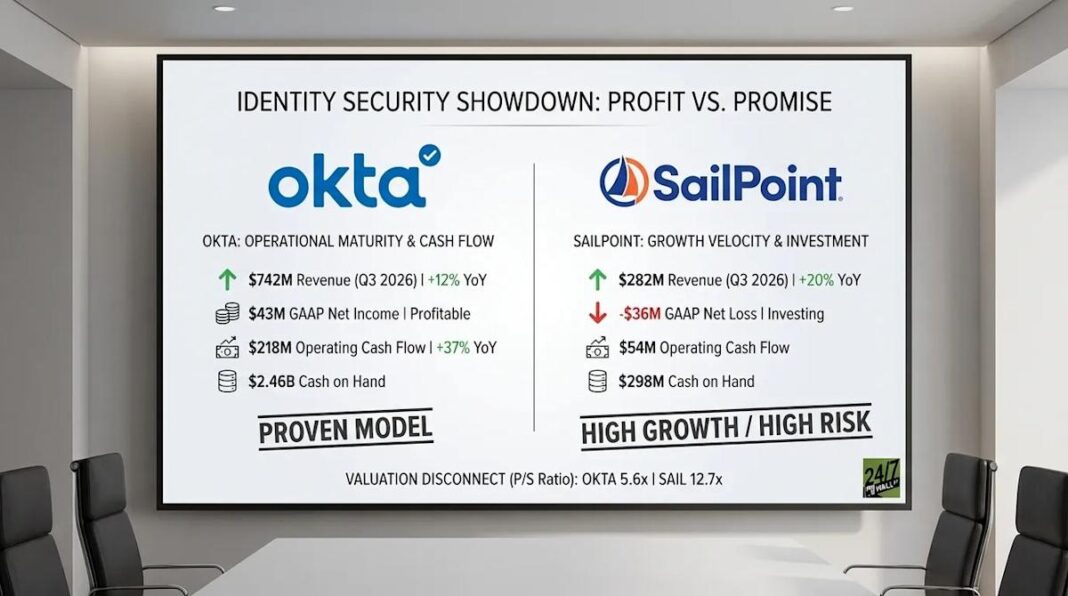
Okta generated $211M in free cash flow and turned profitable while SailPoint lost $36M despite 20% revenue growth.
-
Okta holds $2.46B in cash versus SailPoint’s $298M but trades at 5.6x price-to-sales compared to SailPoint’s 12.7x.
-
SailPoint crossed $1B in total ARR but required $98M in addbacks to show adjusted operating profit.
-
A recent study identified one single habit that doubled Americans’ retirement savings and moved retirement from dream, to reality. Read more here.
Okta (NASDAQ: OKTA) and SailPoint Technologies (NYSE: SAIL) both beat Q3 2026 earnings expectations, but their financial trajectories diverge sharply. Okta delivered $742 million in revenue with $43 million in GAAP net income. SailPoint posted $282 million in revenue while losing $36 million.
Okta’s quarter showed operational maturity. Revenue climbed 12% year over year, but operating cash flow surged 37% to $218 million. Free cash flow reached $211 million. The company turned a $16 million loss into $23 million in operating income. CEO Todd McKinnon highlighted “continued strength with large customers” and adoption of Okta Identity Governance and Auth0 for AI Agents. Large enterprise deals carry higher margins and stickier retention.
SailPoint grew faster at 20% revenue growth and 38% SaaS ARR expansion. The company crossed $1 billion in total ARR, a milestone CEO Mark McClain called proof of “the strength of SailPoint’s strategy and the durability of our business.” But SailPoint’s GAAP operating loss widened to $42 million from $24 million a year earlier. The company reports a 20% adjusted operating margin, but that requires adding back $98 million in stock compensation and other expenses. Okta doesn’t need those adjustments to show profit.
|
Metric |
Okta |
SailPoint |
|
Revenue Growth |
12% |
20% |
|
GAAP Net Income |
$43M |
-$36M |
|
Operating Cash Flow |
$218M |
$54M |
|
Cash on Hand |
$2.46B |
$298M |
Okta operates at nearly three times SailPoint’s revenue scale and generates four times the operating cash flow. That gap matters when both companies need to fund AI product development and compete for the same enterprise identity security budgets. Okta’s $2.46 billion cash position provides room to invest aggressively or weather margin pressure. SailPoint’s $298 million in cash leaves less margin for error, especially with a price-to-sales ratio of 12.7x compared to Okta’s 5.6x.
The valuation disconnect reflects market expectations. SailPoint trades at 119x forward earnings despite current losses, while Okta sits at 24x forward earnings with actual profit. Analysts favor SailPoint slightly more, with 86% buy ratings versus Okta’s 64%. The market believes SailPoint’s growth rate justifies the premium, but only if the company can convert revenue into cash flow without destroying margins further.


