

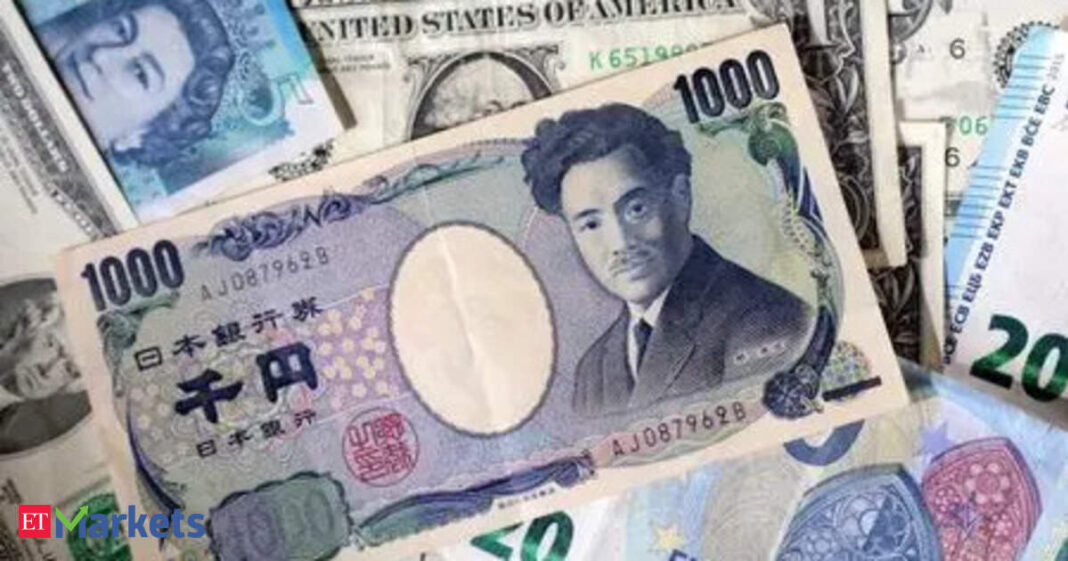

Losses in the Japanese currency extended after BOJ Governor Kazuo Ueda‘s post-meeting press conference, where he remained vague on the exact timing and pace of future rate hikes and said only that the door was open to further tightening.
The dollar rose as high as 157.67 against the Japanese yen, its strongest level in four weeks and on track for its largest one-day rise since early October. It was last up 1.23% at 157.535 yen.
The euro hit a record high of 184.71 yen while the Swiss franc hit an all-time high of 197.23 yen. Sterling rose by as much as 1.36% to its highest since 2008, at 210.96 yen.
“I think most of the currencies are consolidating but the big one, of course, is the yen,” said Marc Chandler, chief market strategist at Bannockburn Global Forex in New York.

“The BOJ delivered a rate hike like everybody expected and indicated that they will continue to raise should the economy evolve as they expect. The yen is weaker across the board. I think many people are saying that the BOJ was not hawkish enough,” Chandler added.
In Friday’s statement, the BOJ maintained its view that underlying inflation will converge around its 2% target in the latter half of its three-year projection period through fiscal 2027. It reiterated that real rates were at “significantly” low levels even after the hike, and pledged to continue tightening should the economy and inflation pan out as forecast. But none of this was enough to halt the slide in the yen.
Traders have started to consider the chances of official intervention to support the currency once the yen crossed the 155 level against the dollar in November.
The last time Tokyo authorities stepped into the market to intervene was July 2024, when the dollar/yen rate hit 161.96, the most since the mid-1980s.
Japanese Finance Minister Satsuki Katayama warned on Friday that Tokyo would take appropriate action to deal with any excessive volatility in the foreign exchange market. “We will respond appropriately to excessive moves, including those driven by speculators,” she said.
“We would fade that dovish BOJ narrative,” said Elias Hadad, global head of markets strategy at BBH in an investor note. “In our view, the bar for additional BOJ rate hikes is low. First, the BOJ warned that ‘the risk of firms’ active wage-setting behavior being interrupted is low’, implying that underlying wage and inflation pressure are likely to persist. Second, BOJ Governor Ueda pointed out the policy rate is still some distance from the lower end of the neutral rate range.”
EURO STEADIES European Union leaders decided on Friday to borrow cash to fund Ukraine’s defence against Russia for the next two years rather than use frozen Russian assets, sidestepping divisions over an unprecedented plan to finance Kyiv with Russian sovereign cash. The euro held steady at $1.1720. European Central Bank chief Christine Lagarde on Thursday offered no forward guidance and said all options were on the table, pushing back against more hawkish members. The ECB left its policy rate on hold at 2%, as expected. Sterling round-tripped to sit at $1.3388 after the Bank of England cut interest rates to 3.75%, as expected, but the decision was closer-run than the market had anticipated, which may limit the room for further easing. Overnight, the dollar had briefly weakened following a sharp and unexpected fall in U.S. inflation, but investors were not sure how far to trust the data since collection was interrupted by the U.S. government shutdown, and the move soon retraced.
Elsewhere, the Australian dollar strengthened 0.06% versus the greenback to $0.66175 while the kiwi weakened 0.23% versus the greenback to $0.57619.
The dollar was flat at 7.0342 versus the offshore Chinese yuan.
In cryptocurrencies, bitcoin gained 2.77% to $87,978.94. Ethereum rose 5.73% to $2,991.88.


