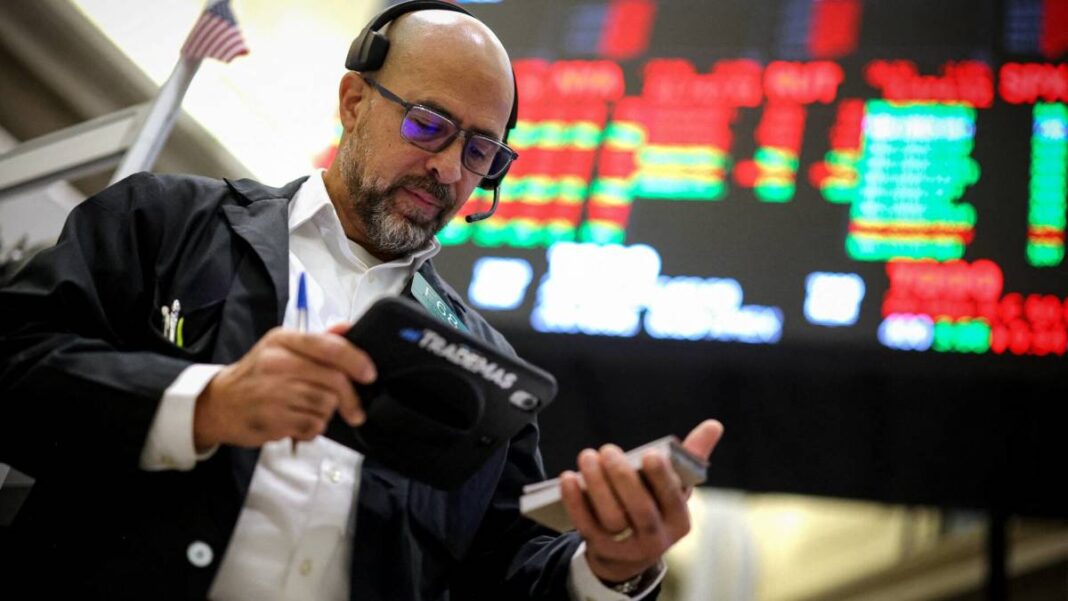
Stephen Guilfoyle has been navigating Wall Street longer than most. His career stretches back to working on the New York Stock Exchange floor in 1987, when the stock market got hit by Black Monday, the worst single-day drop in history (The Dow Jones Industrial Average [DJIA] tumbled 22.6% on October 19, 1987).
Guilfoyle’s “been-there-done-that” chops include navigating the savings and loan crisis, the internet boom and bust, the Great Recession, the Covid pandemic, and 2022’s bear market. He’s seen a lot of good and bad tapes and learned a lot about picking winning stocks and avoiding losers.
To be sure, like everyone who has been picking stocks for going on 40 years, he’s had his fair share of duds. Still, he has a knack for blending technical and fundamental analysis, and a finger on the market pulse that’s been remarkably accurate recently.
Every year, Guilfoyle picks one stock that he thinks is positioned for greatness in the coming year. In 2022, he selected CEO Lisa Su‘s Advanced Micro Devices as his favorite idea for 2024, and in 2023, when Palantir — this year’s AI darling — was trading in the teens, he predicted it would be the stock to own in 2024. Then, again, at the end of 2024, he did something he’d never done before. He picked Palantir yet again as his top stock, before another significant move higher.
Guilfoyle is still a Palantir fan and a devotee of Palantir CEO Alex Karp and AMD CEO Lisa Su. However, he has taken a different direction this year, backing another company led by a dynamic CEO, Anthony Noto’s SoFi Technologies, as his best idea for 2026.
SoFi CEO Anthony Noto is riding a digital banking wave. Wall Street analyst Stephen Guilfoyle has picked SoFi Technologies as his top stock pick for 2026.Briggs/TGL/Getty Images
When my dad was a banker in the 1980s, banks looked a lot different than today. All your checks were deposited and money withdrawn at local branches staffed by a long row of eager tellers. Bankers knew their clients and based loan decisions on personal relationships.
Today, most banking transactions are conducted online via mobile apps. Checks are uncommon, and most money passes from one place to another without us ever physically handling it. Bank tellers have been replaced with branch ambassadors, coffee stations, and workspaces. Most bankers couldn’t remember your name on sight if they tried.
55% of bank customers use apps on phones or other mobile devices as their top option for managing their bank accounts.
22% use online banking via laptop or PCs to conduct banking.
Only 8% of customers do most of their banking at a branch.
64% of Generation Z use mobile apps most often.
68% of Millennials use mobile apps most frequently.
41% of Baby Boomers most often utilize online banking via laptop or PC.
Only 13% of Baby Boomers do most of their banking in branches.
Just 4% of Gen Z and Millennial customers’ favorite choice is to visit a branch. Source: American Banking Association Consumer Banking Survey 2024
Whether the loss of those in-person banking relationships is a good or bad thing depends mainly on the generation to which you belong.
Nowadays, most customers are accustomed to e-commerce and, by extension, digital banking, and most increasingly expect and value the flexibility that comes with banking online. Sure, you can visit a branch to do your banking during the limited hours they’re open, but there’s increasingly less reason to do so.
More Wall Street:
As a result, most major national banks, including Bank of America and Wells Fargo, have adopted digital banking, closing branches and implementing online tools that enable people to perform an increasing number of tasks online, including opening accounts and borrowing money for education, a car, or a home.
Some banks have become popular despite not having any branches at all; they opt for an asset-light approach that is 100% geared toward those who are comfortable with banking online.
Of these digital fintech players, SoFi Technologies (SOFI) is one of the largest. Founded in 2011 as Social Finance, Inc., it initially focused on student loan refinancing. Since then, it’s expanded, offering high-interest savings and checking accounts, mortgages, personal loans, and other services, including brokerage and cryptocurrency services.
2011: Founded by Stanford graduate students as Social Finance, Inc.
2012: Became the first to offer student loan refinancing for federal and private loans.
2014: Expanded its business into mortgage lending.
2015: Began offering personal loans.
2018: Named ex-investment banker Anthony Noto as CEO.
2019: Launched SoFi Money (banking) and SoFi Invest (investing).
2020: Reached the 1 million member mark.
2021: Listed its shares on the Nasdaq via a SPAC merger (Social Capital Hedosophia V).
2022: Acquired Golden State Bank (now SoFi Bank) to get its bank charter. Source: SoFi Technologies
SoFi Technologies has grown from a niche player to a nationally recognized brand with a market capitalization of $35 billion, $45 billion in total assets, and $3.3 billion in revenue over the past 12 months.
While SoFi has grown into a significant financial institution, it still has considerable room to grow. According to the Federal Reserve, it’s only the 53rd largest bank by assets in the United States. For perspective, total assets would need to approximately quadruple for it to break into the top 25 banks in America.
Capturing a larger share of customers’ wallets is a significant focus for the company.
“We now expect to add over 3.5 million members on the year and generate $3.54 billion of adjusted net revenue, which represents about 36% growth,” said CFO Chris LaPointe at UBS Global Technology and AI Conference on Dec. 3.
“Home loans where we don’t have a meaningful market share right now, we’re less than 0.1% of the overall market is a huge opportunity for us.”
The growth, and importantly, potential for it to accelerate in 2025, thanks partly to artificial intelligence, has caught the attention of Guilfoyle, who has long been a fan of the company, recommending it in posts on TheStreet Pro to members since it was trading below $10 per share.
“I also fully believe that the financials, in particular, the banks, large and small, will realize notable increases in abilities to maximize profitability in this environment,” wrote Guilfoyle in a recent TheStreet Pro post.
As with AMD and Palantir, Guilfoyle has a lot of admiration for SoFi CEO Anthony Noto.
“The man was a middle linebacker for Army’s football team and remains one of those players that fans of the team do not forget. He served with the now-retired 24th Infantry Division and was Ranger-qualified. He went on to graduate from Wharton School of Business and cut his business teeth at Goldman Sachs (GS), the NFL, and also at Twitter,” noted Guilfoyle.
Before joining SoFi in 2018, Noto served as Twitter’s COO, and before that, as Twitter’s CFO. He joined Goldman Sachs in 1999, becoming a managing director in 2003 and a partner in 2004. From 2010 to 2014, he served as Co-Head of Global Technology, Media, and Telecom Investment Banking at Goldman Sachs.
SoFi continues to expand its banking footprint by investing in growth to increase its market share. In the third quarter, it reported $962 million in revenue, up 38% year over year, and, importantly, posted a profit of $0.11 per share, 120% higher than the same period one year ago.
“There’s more happening at SoFi today than at any other time in my 8 years with the company,” said Noto on SoFi’s Q3 earnings call. “We are stepping on the gas to accelerate the investment in our existing businesses and entering new areas, like crypto and blockchain, AI, SoFi Pay, providing fiat and crypto banking services and so much more.”
The strong results prompted Noto to boost SoFi’s full-year 2025 guidance.
Management is now targeting $3.54 billion in full-year revenue, $165 million more than it expected at the end of the second quarter. It’s also forecasting net income of $455 million, up from $370 million previously, and earnings per share of 37 cents, up from the prior forecast of 31 cents per share.
“Of the 13 sell-side analysts that I know of that cover SOFI, all 13 have revised their earnings estimates for the quarter higher since the start of the period. Huzzah,” said Guilfoyle.
Wall Street’s consensus view for the fourth quarter is for EPS of $0.12 on revenue of $986.5 million.
In 2026, analysts think revenue will grow to $4.44 billion, resulting in EPS of $0.57.
Guilfoyle is optimistic that this is a good time to buy SoFi Technologies stock. In addition to the fundamental backdrop, Guilfoyle employed technical analysis to assess what’s next for SoFi stock and establish a price target.
He says SoFi’s stock price chart, relative strength, and moving average convergence divergence (MACD) currently have a “bearish posture.” However, he says that he’d use any short-term weakness to buy shares for gains down the road.
“This is a year-long call, mind you. We actually (though I am already long) don’t mind seeing the share price depressed ahead of the New Year,” said Guilfoyle. “That would put my optimal “buy zone” in the $23 area. I would happily add to my long all the way down to the 200-day simple moving average (SMA), which currently stands at $20.60.”
If SoFi stock finds its footing, Guilfoyle has set a price target of $36. Further out, however, he thinks SoFi stock could go substantially higher.
“End of year? I really don’t know,” said Guilfoyle. “Down the road? $100.”
He’s not the only one on Wall Street who is optimistic. JP Morgan raised its price target to $31 from $28 on Dec. 3.