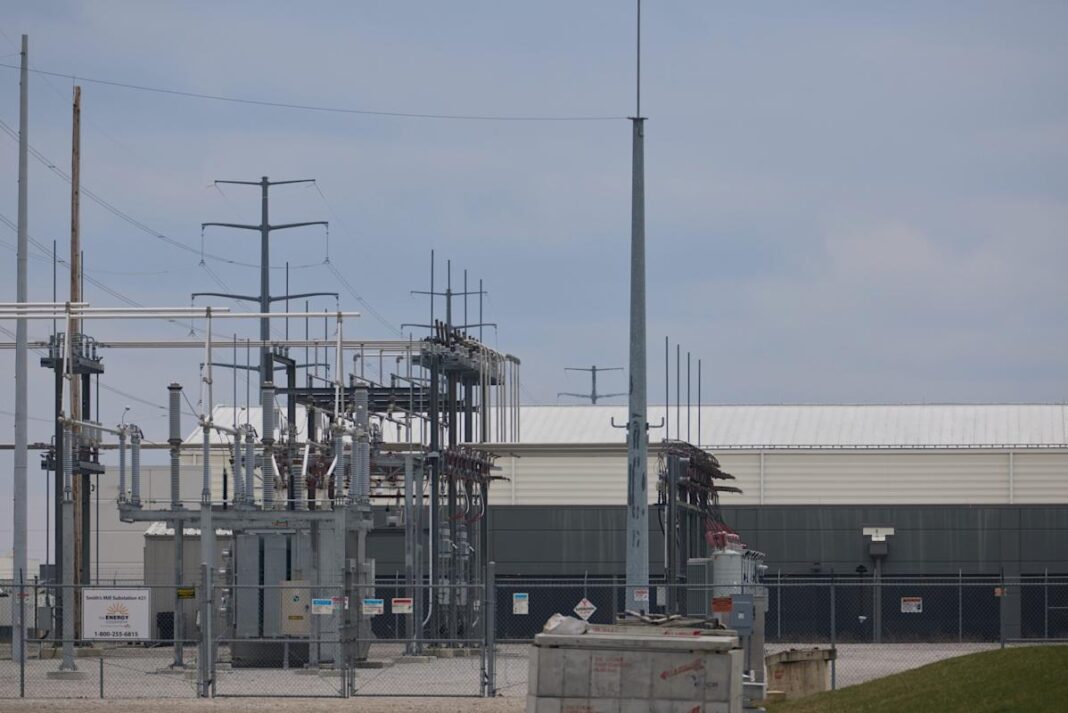
(Bloomberg) — The great artificial intelligence boom that’s fueling US economic growth now depends heavily on credit markets to finance the investments, and utilities are among the key borrowers.
In the process, they could potentially turn one of the safest parts of the corporate-bond market into a slightly riskier one. Companies will borrow more, boosting the supply of the bonds and potentially weighing on valuations. At the same time, industry profits could face pressure as regulators try to keep a lid on rate increases.
Most Read from Bloomberg
Bond sales by US utilities grew 19% this year to a record $158 billion, funding rampant growth in power demand driven by the artificial-intelligence boom. A lot more is coming: electric companies are expected to spend more than $1.1 trillion on power plants, substations, and other grid infrastructure over the next five years, according to industry group Edison Electric Institute, up about 44% from the previous period. Debt will help fund it.
Investors aren’t expecting utilities to struggle financially, for a simple reason: generating and delivering electricity in the US is by and large a regulated industry, and that determines how much the companies can charge their customers. Electric companies usually don’t start building projects until they have regulatory approval to recoup costs from customers, along with a healthy rate of return.
But the industry might become at least a little riskier for investors because so much more debt is coming. JPMorgan Chase & Co. recently forecast an 8% rise in utility-bond issuance next year, citing new data centers as well as investments to make the electric grid more resilient. The upshot of more sales might be lower valuations in the form of wider spreads.
Investor fears of an AI bubble have also increased in recent months, sparking concern that power-sector investments might not be as safe as they once were. While utilities have some protection from a tech pullback because of power contracts that require minimum payments and termination fees, a significant slowdown or contraction in AI-related spending would undermine the growth story they’ve been telling investors.
And there is a political risk for investors: Nationwide, electricity prices rose 5.1% during the 12 months through September, hovering near a record, government data shows.
Politicians in multiple elections in November ran on promises to cut utility bills. Regulators are facing pressure to keep rate increases relatively low, which could cut into returns for investors instead, said Tim Winter, an equity portfolio manager at Gabelli Funds.
“It’s really easy to run on, ‘Let’s beat up the utility, they’re making life hard for you guys,’” he said. “The more the public is concerned and the more they’re unhappy customers, the more likely it is that it’ll be a challenging regulatory environment and then you don’t get the returns you want on your investment.”
For bond holders, the best bet way to insulate themselves against this kind of pressure might be to stick with buying notes issued by the regulated utilities themselves, and not the holding companies that are further away from the income-generating assets. Andy DeVries, an analyst at bond research firm CreditSights, said that debt issued by operating companies is secured by actual assets like power plants and transmission lines, as well as the franchise to service customers in a particular service territory.
“With operating companies, no bondholder has lost principal in 50 years,” DeVries said. “With holding companies, some people have.”
PG&E Corp., holding company for Pacific Gas & Electric, has filed for bankruptcy twice in the last 25 years.
There is an upside to this investment: it will likely fuel profit growth for utilities.
“The utility sector is investing way more money than the cash flow it’s generating,” said Brian Savoy, chief financial officer at Duke Energy Corp. “Investors are happy with the risk they’re buying into, knowing that utilities are growing.”
Big utility bond sales this year have seen strong demand. A $1.15 billion sale of 2066 bonds by Florida Power & Light, a unit of NextEra Energy Inc., earlier this month was five times oversubscribed, according to data compiled by Bloomberg.
Duke and Evergy Inc. saw demand for some notes they sold in November exceed offerings by more than six times. That compares with an average book coverage of 3.9 times for dollar-denominated high-grade bonds issued in 2025, the data showed.
Week In Review
Oracle Corp.’s aggressive artificial intelligence spending plan has put the cloud computing giant’s corporate bonds under a harsh spotlight as Wall Street searches for cracks in the AI boom.
Fannie Mae and Freddie Mac have added billions of dollars of mortgage-backed securities and home loans to their balance sheets in recent months, fueling speculation that they’re trying to push down lending rates and boost their profitability ahead of a potential public offering.
China Vanke Co. urged holders of a bond it’s trying to delay paying to give it more time for negotiations, with only four days until a grace period ends that could trigger a once-unthinkable default.
US prosecutors charged the founder of bankrupt subprime auto lender Tricolor Holdings with conspiring to defraud lenders and investors, in a sweeping indictment of the leadership of a used car dealer and financing company that collapsed in a wave of scandal in September.
First Brands Group has appealed to lenders for as much as $800 million in new financing to keep the auto-parts supplier afloat long enough to restructure in bankruptcy court.
First Brands founder Patrick James asked a judge to dismiss a lawsuit accusing him of misappropriating hundreds of millions of dollars, contending firms that provided his company with off balance-sheet financing engaged in “predatory” practices that helped tip the auto-parts supplier into bankruptcy.
Bankrupt Spirit Aviation Holdings Inc. is in revived discussions to merge with Frontier Group Holdings, people familiar with the matter said, in a deal that could rescue the deep-discount airline from insolvency at a time of stiff competition from larger US carriers.
Money managers have sold a record amount of bonds backed by portfolios of leveraged loans this year, profiting from heavy demand from investors for higher-yielding loans funding buyouts in a form that offers extra protections.
Carlyle Group Inc. has lost more than $100 million on a loan it provided to now-bankrupt Roomba maker iRobot Corp., according to an estimate based on filings and court papers.
Autokiniton US Holdings Inc., an auto-parts manufacturer, has scrapped its planned $1.14-billion leveraged loan deal, according to people with knowledge of the matter.
On the Move
Steve Thom will retire as head of global credit trading at Bank of Montreal. Thom joined the bank as a managing director five years ago and worked at Royal Bank of Canada for 27 years before that.
Natixis recruited Tony Versaci as head loan trader. Versaci, who most recently was a senior relationship manager at loan-data provider Versana, has also been named a managing director.
Juergen Pinker, a senior managing director in Blackstone Inc.’s private equity group in Europe, is moving to the investment firm’s credit and insurance business.
Scotiabank has hired Eric Witte as director for leveraged loan trading. Most recently he was a credit trader at Natixis for over four years, and prior to that, also held a trader position for about four years at Edward Jones.
Brian Beggans is joining RBC Capital Markets as a senior investment-grade salesperson in March after a 17-year stint at Barclays Plc.
Performance Trust Capital Partners launched its first office in Europe and hired two seasoned bankers as it seeks to expand its collateralized-loan obligations and asset-backed desks. The investment bank launched a new unit, PTUK Limited, according to Eric Brown, president of Performance Trust’s institutional group. Managing directors James Gray and Dan Bates will oversee PTUK’s securitized products team in London and report to Brown.
–With assistance from Taryana Odayar and Rheaa Rao.