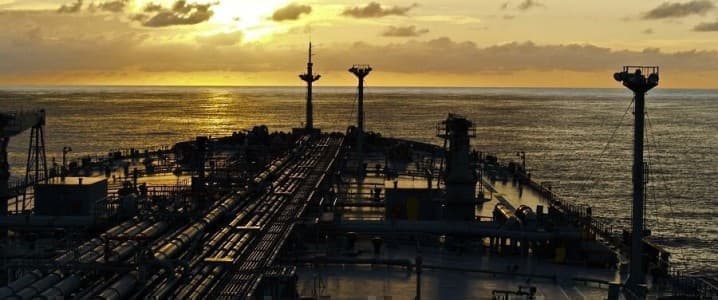
Oil tankers are diverting from their route to Venezuela; some are sitting idle at ports instead of setting off for Asia; discounts on Venezuelan crude are deepening; and PDVSA may soon start shutting down wells for lack of storage space. President Trump’s military campaign against Venezuela is threatening an $8-billion market.
It started with one tanker seizure, a week ago. Then Trump escalated the rhetoric, threatening a blockade on Venezuelan tanker traffic and demanding that Venezuela returned “Oil, Land, and other Assets that they previously stole from us,” most likely referring to oil assets nationalized by the Hugo Chavez government back in the 90s. The U.S. president also wrote on his social network that U.S. military presence off the Venezuelan coast would “only get bigger, and the shock to them will be like nothing they have ever seen before.”
In response, Venezuela assigned Navy escort to oil tankers, with several vessels setting off this week, hours after President Trump issued his latest threats, carrying urea, petroleum coke, and other petroleum by-products, according to the New York Times, which cited ship-tracking data and unnamed sources.
According to the Wall Street Journal, however, as many as 75 tankers are idling off the Venezuelan coast, even though only half of these are on the U.S. sanction list, per data from TankerTrackers.com. Some, as mentioned already, have turned away from their original course to Venezuela to avoid seizure. According to one Venezuelan economist that the Wall Street Journal cited, the clampdown on sanctioned tankers could cost Venezuela $8 billion in oil revenues.
Related: Ukraine Hits Russian Shadow Tanker in Mediterranean for First Time
Sanctioned tankers, which media like to call “shadow fleet” because they use different tactics to either conceal the origin of the crude or their location at any given time, account for as much as 70% of Venezuelan oil trade, the WSJ report noted. In absolute numbers, the tanker fleet carrying Venezuelan crude abroad—mainly to Asia—stands at some 900 vessels.
These vessels employ moves first tested by Iran, after Trump reinstated U.S. sanctions on Tehran during his first term. Ship-to-ship transfers at sea are one such move to avoid sanctions; sailing under a false flag is another. Turning off transponders to conceal locations is also a tactic used by sanctioned vessels to avoid detection. However, with the U.S. Navy right off the Venezuelan coast, all of this has become more difficult—and so has trade in Venezuelan crude.
The International Energy Agency estimated Venezuela’s oil production at 860,000 barrels per day last month. That was down from 1.01 million bpd in October and a similarly above 1-million-bpd level in September, when Venezuela’s crude oil output hit its highest since February 2019. Output is about to decline further amid the U.S. president’s sanction push, because the country is running out of storage space.
Currently, about 11 million barrels of Venezuelan oil are stuck at sea, according to a Reuters report this week. Bloomberg, meanwhile, cited unnamed sources as saying that Venezuela’s biggest oil storage hub and available tankers could fill up with unsold crude within 10 days. This would prompt well shut-ins and a further production decline. Again, per Reuters, Venezuela could suffer a hit of 500,000 barrels daily in lost production. Meanwhile, sanction-exempt oil produced by Chevron and PDVSA in Venezuela stands at some 143,000 barrels daily, per the AP.
“There are already ships that have decided not to leave Venezuela for fear of being seized, and there are also ships headed to Venezuela to load crude oil that decided to turn back,” one Venezuela oil analyst from Rice University told the AP. According to other analysts, this will not lead to a broader disruption on oil markets—although it would certainly disrupt Venezuela’s market.
“Volatility or uncertainty around Venezuela is not new, it’s not a shock,” S&P Global Energy’s head of oil markets and mobility, Jim Burkhard, told the AP. “The market today is not tight. There’s plenty of oil.”
Some believe Trump’s campaign against Venezuela could backfire. According to energy analyst Cyril Widdershoven, the United States stands to make no strategic gain from its pressure campaign on Venezuelan oil. Instead, the analyst argued in a recent column for Oilprice that such pressure would only push Venezuela closer to China and Russia, compromise global supply chains, and fuel market volatility. In other words, Venezuela is not the only one that stands to lose from the situation if it escalates further.
Other analysts have argued that the U.S. will not suffer any adverse effects of a blockade—or a quarantine, as some in Congress insist on calling it—on Venezuelan tanker traffic. Gulf Coast refineries, these commentators claim, have largely quit Venezuelan crude, so they are insulated from any supply disruption. Yet analytical firms such as Kpler have warned that this is not the case, and a disruption in Venezuelan oil trade would be a disruption for Gulf Coast refineries as well. That $8-billion market that is being disrupted right now may only be part one of a longer oil market disruption show.
By Irina Slav for Oilprice.com
More Top Reads From Oilprice.com
Oilprice Intelligence brings you the signals before they become front-page news. This is the same expert analysis read by veteran traders and political advisors. Get it free, twice a week, and you’ll always know why the market is moving before everyone else.
You get the geopolitical intelligence, the hidden inventory data, and the market whispers that move billions – and we’ll send you $389 in premium energy intelligence, on us, just for subscribing. Join 400,000+ readers today. Get access immediately by clicking here.