


Nvidia (NVDA) is trading around $189, attempting to bounce from its brutal December selloff, but the technical picture reveals a more concerning story than the price action alone suggests.
The semiconductor giant is now trapped within a descending channel that began at the November highs near $212, with multiple layers of resistance overhead threatening to cap any recovery attempt.
Now the question is:
Can NVDA break free from its bearish channel structure and reclaim $195, or will the combination of overhead resistance and extreme overbought momentum send the stock spiraling back toward $170?
NVDA (Nvidia): 4-Hour Chart

Trend and Structure
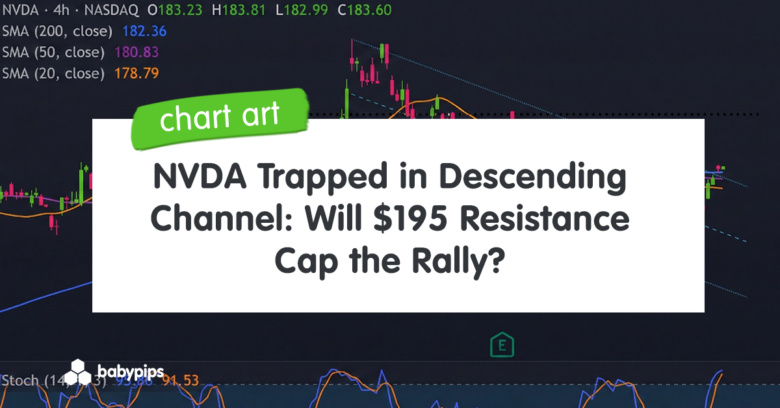
The 4-hour chart paints a technically challenging picture: NVDA is caught in a well-defined descending channel that has governed price action since the November peak at $210, with the stock now testing the upper boundary of this bearish structure.
The descending channel, marked by a series of lower highs and lower lows, represents a clear downtrend that began after the November euphoria faded.
The upper trendline of this channel runs from the $210 peak through subsequent resistance points around $200 and now converges near the $185-$187 zone, right where the current price is stalling.
A horizontal resistance level around $195-$197 sits above the current price, representing a zone where sellers have consistently overwhelmed buyers during the decline.
This creates a “double ceiling” effect: the descending channel resistance meets this horizontal barrier, forming a formidable obstacle for any bullish breakout attempt.
Price is currently trading above all three key moving averages, with the 20-period SMA at $178.79, the 50-period SMA at $180.83, and the 200-period SMA at $182.36.
The tight compression of these MAs within a $3.50 range indicates a period of consolidation, but their positioning below the descending channel suggests the bears still maintain control.
The recent recovery from the $170-$172 December lows has traced a path along the lower channel boundary, suggesting support is holding for now.
Momentum and Stochastic Analysis
The Stochastic oscillator currently reads an overbought condition that contradicts the bearish channel structure.
This reading above 90 indicates that the short-term bounce from oversold conditions may possibly be exhausted from a momentum perspective.
Historical patterns on this chart reveal a troubling precedent: previous Stochastic readings above 90 (visible in early November and mid-October) both preceded significant selloffs.
The November overbought extreme marked the exact top before the major correction that led to the current descending channel formation.
This creates a dangerous divergence: while price has staged an impressive bounce from the December lows, momentum is screaming exhaustion. The Stochastic is warning that buyers have pushed too hard, too fast within a structure that remains bearish.
The oscillator’s position suggests one of three outcomes:
- Either it rolls over immediately, and price follows (most likely given the channel resistance).
- It consolidates sideways to cool off while the price treads water,
- Or in the bullish scenario, price breaks the descending channel convincingly and momentum confirms with sustained readings above 50.
The weight of evidence from the Stochastic, combined with the descending channel structure, suggests caution for bulls and opportunity for bears looking to fade strength.
Key Support and Resistance Levels
Resistance levels to watch:
- Immediate resistance: $185-$187 (descending channel upper boundary, critical breakout level)
- Major horizontal resistance: $195-$197 (black dotted line, multiple rejection zone)
- Secondary resistance: $200-$205 (psychological round number and channel intersection)
- Ultimate resistance: $210 (November peak, would require complete channel breakdown)
Critical support levels:
- First line of defense: $180-$182 (SMA cluster and ascending support trendline intersection)
- Dynamic support: $178-$180 (20 SMA, near-term pivot)
- Strong support zone: $175-$177 (December consolidation area, lower channel boundary)
- Major support: $170-$172 (December low, absolute line in the sand)
- Channel projection: $165-$168 (if lower channel boundary breaks)
The $185-$187 zone represents the most critical battle line. This is where the descending channel resistance converges with current price. A convincing break above this level with strong volume would be the first signal that the bearish structure might be failing.
However, even a break above $187 would immediately face the $195-$197 horizontal resistance, a zone that has rejected multiple rally attempts. Only a decisive close above $197 would signal that bulls have regained control.
On the downside, the $180-$182 support cluster is where the ascending support trendline meets the moving average convergence. A break below this level would suggest the bounce has failed and likely trigger a rapid decline back toward the lower channel boundary at $175 or even the December lows at $170.
Trading Outlook and Risk Assessment
NVDA looks to be trapped between descending channel resistance overhead and ascending support below, with momentum flashing extreme overbought warnings.
The current setup is high-risk for both bulls and bears, requiring precise timing and strict risk management.
Risk-reward strongly favors either waiting for a clear channel break or fading the rally at resistance rather than chasing at current levels.
Bullish Scenario (Lower Probability)
For bulls to take control, NVDA must accomplish two tasks: first, break decisively above the descending channel resistance at $185-$187, and second, clear the horizontal resistance at $195-$197.
A break above $187 on strong volume accompanied by a Stochastic pullback to the 50-70 range, followed by a renewed push higher, would be the healthiest bullish setup. This would indicate genuine buying conviction rather than a short-covering spike.
The fundamental backdrop of AI infrastructure demand and Nvidia’s market dominance supports the bull case, but technicals must confirm before chasing. A true breakout above $197 would target the $205-$210 range and completely invalidate the descending channel structure.
Bulls should wait for either:
- A successful breakout above $187 with a pullback retest that holds.
- Or a deeper pullback to the $175-$178 zone that allows the Stochastic to reset before attempting fresh longs.
TLDR: NVDA’s 4h chart shows a short‑term bounce off channel support into layered resistance, with price still contained in a broader descending channel and Stochastics stretched, so risk‑reward favors caution pressing fresh longs here
Bearish Scenario (Higher Probability)
The technical evidence favors the bears: a well-defined descending channel, horizontal resistance overhead, extreme overbought momentum, and a pattern of lower highs all point to continued downside pressure.
The highest probability outcome is a rejection at the current $185-$187 channel resistance, especially with the Stochastic at 95.76.
Historical precedent shows that similar setups (overbought momentum meeting channel resistance) have resulted in sharp reversals.
Bears could look to fade strength at $185-$187 with stops above $190, targeting a return to $178-$180 initially and potentially $175 or the December lows at $170 on a confirmed breakdown.
If NVDA breaks below the $180-$182 support zone and the ascending trendline, it would trigger a likely cascade toward the lower channel boundary. The descending channel projects to the $165-$168 area if the structure remains intact, suggesting significant downside risk if support fails.
The pattern of lower highs within the channel suggests each rally should be sold rather than bought until proven otherwise by a decisive channel break.
Longer-Term Considerations
The descending channel that has contained price action since November represents a clear intermediate-term downtrend. Until this structure is broken with conviction, the path of least resistance remains lower.
The 200-period SMA at $182.36 sits right at the current consolidation zone, making it a critical long-term trend indicator. Consistent closes above this level with a channel breakout would signal a potential trend reversal.
The December low at $170-$172 established a higher low compared to earlier corrections, which is mildly constructive. However, the descending channel and horizontal resistance at $195 create significant obstacles to any sustained recovery.
The real question is whether institutional buyers view these levels as accumulation opportunities or if distribution continues at each bounce. The Stochastic extremes and channel resistance suggest the latter until proven otherwise.
For swing traders, the best approach may be to wait for a clear resolution: either a decisive break above $187-$190 that would flip the script bullish, or a failure at current levels that offers lower-risk short entries. The middle ground carries too much risk given the compressed technical setup.
Watch the $185-$187 zone closely in the coming sessions. Acceptance above signals bulls are in control, while rejection confirms bears maintain dominance within the descending channel structure.


