

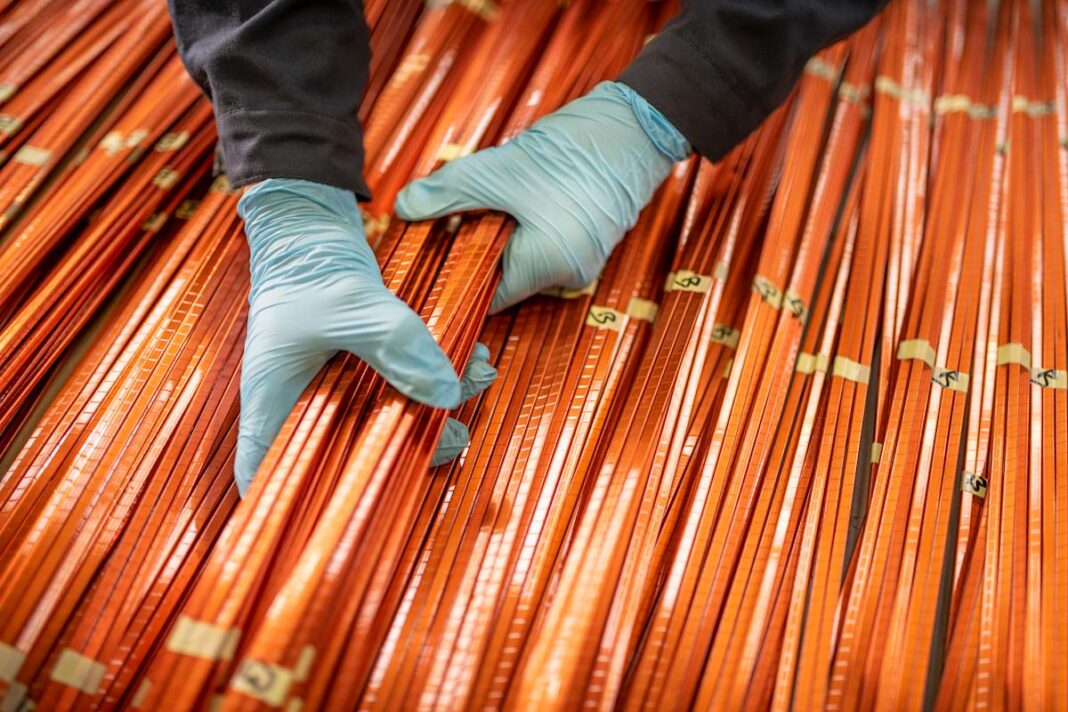

Metals have had a record year with recent surges in gold (GC=F) and silver (SI=F) prices, but there’s a third metal hitting its own record highs. Copper prices have rallied by more than 35% this year, poised for the biggest annual gain since 2009, driven higher by rising tech demand, supply constraints, and tariff uncertainty.
Global copper (HG=F) prices officially surpassed $12,000 per ton on the London Metal Exchange on Tuesday for the first time ever and continued to march higher on Wednesday.
Each type of metal reacts slightly differently to economic conditions, and copper is no exception. However, unlike gold and silver, copper isn’t so directly influenced by investor sentiment or economic expectations. Its price movements can typically be attributed to physical growth and expansion.
Copper is often viewed as a barometer for the economy. It plays a central role in power grids, construction, industrial machinery, and more. When there’s a demand for those types of goods or services, it’s typically a good sign that the economy has a clean bill of health — giving copper its nickname: Doctor Copper.
Rising copper prices often signal strong industrial demand and a rapidly growing economy, while falling prices may indicate an economic slowdown, according to Goldman Sachs Research. Copper is “a major beneficiary of investments in grid and power infrastructure globally, as AI and defence heighten the need for robust and secure energy networks,” wrote Goldman Sachs Research analyst Eoin Dinsmore in a note.
Gold is seen as more of a “safe-haven” asset and a hedge against inflation. Silver straddles the line between gold and copper and has both investment and industrial purposes. Copper, however, is predominantly industrial. It’s not typically purchased to be stored like gold or silver but meant to be used, which is why it’s usually the strongest indicator, of the three metals, that the economy is moving in the right direction.
Read more: Why is silver outperforming gold? What to know before you invest.
There are a few key reasons that copper is experiencing a surge right now. Major copper-producing regions such as Chile and Indonesia have faced supply challenges and environmental disasters that have contributed to a global copper shortage and a tighter market.
“After essentially flat mine supply growth expected this year, our 2026 mine supply growth estimates have fallen to only around +1.4%, or about 500 kmt lower than our estimates at the beginning of the year,” said Gregory Shearer, head of base and precious metals strategy at JPMorgan, in a statement.
A dip in supply isn’t the only factor that’s pushing prices higher. In July, the Trump administration issued tariffs on several categories of copper imports, putting additional pressure on the market. At the same time, heavy investment in the AI sector is significantly boosting demand because of its reliance on copper for data centers.
One source estimates that hyperscale AI data centers can use up to 50,000 tons of copper per facility.
As far as where prices are headed, JPMorgan Global Research expects copper prices to reach $12,500 a ton in the second quarter of 2026, ultimately averaging around $12,075 a ton for the full year.
While researchers are optimistic that copper prices will continue on an upward trend, experts say the long-term implications of recent price surges remain uncertain.
“The intersection of tariffs and copper prices in July 2025 highlights the complex dynamics of global trade and commodity markets,” said David Koch, CFP and director of portfolio management at Halbert Hargrove. “While the immediate effect has been a sharp rise in copper prices, the long-term consequences will depend on how markets, governments, and industries adapt to this new trade environment.”
Click here for in-depth analysis of the latest stock market news and events moving stock prices
Read the latest financial and business news from Yahoo Finance


