I’ve been at this for a while. Back in 1997, I was lucky enough to convince the partners at a Wall Street boutique investment research firm to give me a shot. It panned out. I became a partner and eventually launched my own sell-side firm in 2003.
The timing was, to say the least, instructive. I got to witness the Internet bubble boom and bust firsthand. I made and lost a lot of money, and had a direct line to working with the largest, most influential mutual and hedge fund managers at the time. I also benefited from a mentor who cut his teeth in the 1970s, during a similar boom-and-bust period.
I learned a lot, including the value of listening to the market, something that is much easier said than done.
Over the years, I’ve made my fair share of mistakes. Sticking to my guns by owning Nvidia hasn’t been one of them. I bought Nvidia in 2017, long before ChatGPT emerged in 2022, sparking a tidal wave of demand for its graphics processing units, or GPUs.
The rationale for buying all those years ago was simple: a dynamic CEO dominating gaming with a rising cryptocurrency mining opportunity. Over the years, my reasoning evolved as AI took hold, but my conviction remained unwavering. Find a great company with a great CEO and stay the course. It’s a good model that worked with Apple (Steve Jobs) and Microsoft (Bill Gates). It has also worked very well with Nvidia and its dynamic CEO, Jensen Huang.
My cost? Less than $20 per share. I’m not alone in having done a nice job buying and holding Nvidia. Plenty of others also took note and have made money betting on Nvidia, including Stephen Guilfoyle, a Wall Street veteran analyst whose career began on the NYSE floor in 1987, just as Black Monday struck.
Guilfoyle isn’t afraid to be wrong. And he’s perfectly fine sticking by winners. He’s a fan of Jensen Huang’s ability to navigate what, historically, is a notoriously boom-and-bust industry. Guilfoyle recently updated his Nvidia stock price target after the shares’ volatile ride in 2025. Given his nearly forty years of experience, you might want to consider what he thinks will happen as we flip the calendar to 2026.
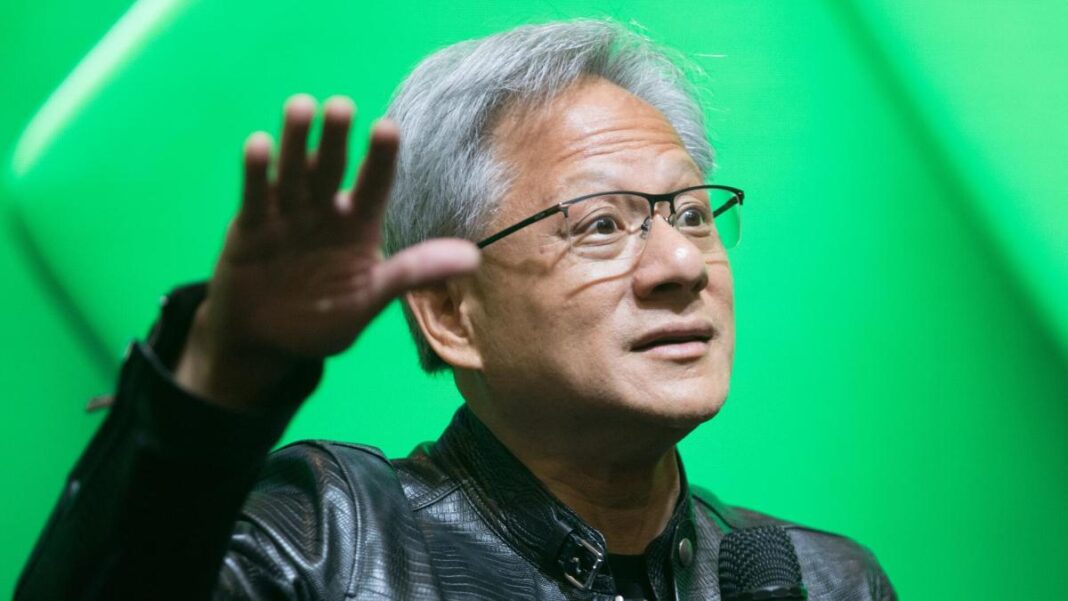
Nvidia CEO Jensen Huang is riding a wave of AI demand into 2026.Shutterstock
It wasn’t too long ago that enterprises were laser-focused on internal data centers walled off from prying eyes. A lot has changed over the past decade, though. Nowadays, most enterprises have shifted their focus, jettisoning expensive siloed data centers for cloud-managed networks that require less upfront investment in infrastructure.
The shift from private to public didn’t happen overnight. Still, it has happened, and the biggest beneficiaries are massive companies like Amazon’s AWS, Alphabet, and Microsoft – companies with massive underused compute capacity that they realized could be monetized by ‘renting’ space to other companies.
More Nvidia:
These once-niche businesses have become profit gravy trains for these companies, particularly after ChatGPT broke the Internet by becoming the fastest app to ever reach one million users in 2022. ChatGPT’s success unleashed a surge of artificial intelligence research and development, leading to a slate of AI chatbots from deep-pocketed rivals.
Microsoft integrated OpenAI’s ChatGPT into its AI ambitions, contributing to the development of Copilot. Alphabet, afraid OpenAI would undermine its Google search dominance, responded with Gemini. Amazon invested billions to support the growth of Anthropic’s Claude LLM. Others also joined the race, including Meta Platforms, Mark Zuckerberg‘s company, which developed Llama.
It didn’t stop with generative AI, though. Recognizing the potential for AI to transform many operational roles, companies across most industries have begun investing in AI applications, or agentic AI – agents that can assist and sometimes replace workers.
The flurry of activity has meant an insatiable appetite for Nvidia GPUs.
In 2007, Jensen Huang developedCUDA, a software that optimizes the performance of GPUs. He probably didn’t realize it fully at the time (perhaps he had guessed), but that move, coupling high-powered processors with software, gave it a significant advantage in managing the substantial computing demands associated with AI.
It didn’t take long for hyperscalers, the biggest cloud data providers, to realize prior investments in servers packed with CPUs weren’t up to the job. Since ChatGPT’s launch, hundreds of billions of dollars have been poured into retrofitting data centers with the computer chips most suited to crunch AI workloads – providing Nvidia with a torrent of demand (and cash) that accelerated its GPU development.
First, Nvidia had the H100 and H200, built on the Hopper architecture. Then, it developed the Blackwell lineup. Soon, it will launch Vera Rubin, its fastest, most efficient AI chip architecture yet. It’s moving fast, and hundreds of billions in revenue are up for grabs, with Nvidia by far in the lead to continue capturing it.
Guilfoyle has been a fan of Nvidia since before its blowout 2024 and 2025 rally, when sales and profits first started rocketing higher, thanks to hyperscalers’ shift from CPUs to GPUs.
For instance, I wrote about Guilfoyle’s bullishness on Nvidia in August 2023, when shares were trading below $50 (split-adjusted), and Guilfoyle said prices would rise even higher. At the time, he called Nvidia’s balance sheet “beast-like.”
Total assets: $161 billion, according to its 10-Q quarterly SEC filing. Current assets: $116.5 billion Short-term cash, equivalents, & investments: $60.6 billion.
Total liabilities: $42.2 billion Short-term liabilities: $26.1 billion
Current ratio (current assets/current liabilities): 4.47
Guilfoyle has revisited his price target many times since then, including recently, when he shared updated thoughts on what could happen to Nvidia in 2026 following its $20 billion deal with Groq.
“News broke on Christmas Eve that Nvidia had entered into a non-exclusive licensing agreement with “Groq” for that nine-year-old private firm’s inference technology. Groq, not to be confused with Grok, which is an AI assistant and chatbot developed by Elon Musk‘s xAI, is a designer of high-performance artificial intelligence accelerator chips,” wrote Guilfoyle in a TheStreet Pro post. “If completed, this would be Nvidia’s largest acquisition ever, far surpassing the $7 billion purchase of Mellanox in 2019. Is this a smart purchase? Sounds like it.”
“We envision future NVDA platforms where GPU and LPU co-exist in a rack, connected seamlessly with NVDA’s NVLInk networking fabric. Groq’s LPU employ a large amount (hundreds of MB) of fast on-chip SRAM memory as primary storage for AI model weights and working data,” wrote Bank of America analyst Vivek Arya to clients in a research note shared with me. “Longer-term, we think the potential Groq deal could be strategic, similar to NVDA’s Apr’20 Mellanox acquisition that is now the foundation of NVDA’s networking/AI scaling moat.”
The deal may help Nvidia technology work even better at AI inference, a fancy term used to describe the use of AI apps and models. Nvidia CEO Jensen Huang thinks inference will be a much bigger market than training AI models, driving substantially more demand for infrastructure, including its chips, software, and networking gear.
“The amount of computation necessary to do that reasoning process is 100 times more than what we used to do,” Huang told CNBC earlier this year.
Nvidia shares have taken a breather since August, soaring in late October to new all-time highs before retreating through early December. Last week, however, Nvidia shares started climbing again, recovering its 50-day moving average for the first time since mid-November.
On Dec. 9, Guilfoyle said Nvidia had “survived a short-term sell-off,” prompting him to put a $225 stock price target on its shares. Nvidia’s shares have strengthened since then, leading him to update his thinking.
“The shares are engaged in an attempt to take and hold the $188 pivot created by the newly formed bullish double bottom pattern,” wrote Guilfoyle. “The stock’s reading for relative strength and its daily Moving Average Convergence Divergence are both also in a better place at this time.”
Guilfoyle’s new Nvidia stock target: $235. He plans to buy more shares on any retreat to $169 and wouldn’t hit the panic button unless it closes below its 200-day moving average, which, at the time of his writing, sits at $159.
He’s not alone in thinking Nvidia shares are poised to head higher in 2026. Bank of America rates Nvidia a “buy” with a $275 price target. Meanwhile, Cantor Fitzgerald ranks Nvidia a top pick, with a $300 target price.