

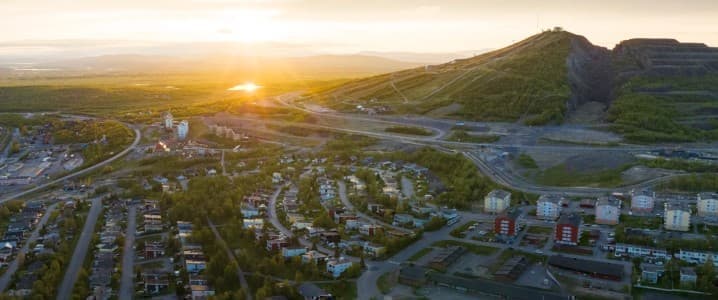

Over two days during the short 2025 summer beyond the Arctic Circle, a mining company moved a 113-year-old timber church building in its entirety nearly two miles away, in an engineering feat that made international headlines.
The moving of the Kiruna Church from the Swedish town of the same name, created by the iron ore mining industry, wasn’t a solitary feat. The relocation of the church is part of a decades-long project by Sweden-based mining company LKAB, which is relocating the entire town of Kiruna to expand iron ore mining and tap recently discovered rare earth deposits.
Years ago, LKAB announced plans to move the town from its current location due to mining expansion and ground subsidence.
The world’s most ambitious urban transformation project will take more than a decade to complete, with residents being offered monetary compensation to move or a new house.
About 90% of residents have elected to take a new house, Niklas Johansson, senior vice president of public affairs and external relations at LKAB, told CNBC in a recent interview.
While some residents are sad they would have to leave their homes, everyone in the mining town knows that Kiruna depends on the industry, Mats Taaveniku, Chairman of the Municipal Council in Kiruna, told CNBC.
“Kiruna is built on the minerals, so every resident in Kiruna knows that we have to move from our homes sooner or later because we are dependent on this mining industry,” Taaveniku said.
Related: OPEC+ Set to Keep Oil Production Policy Despite Saudi-UAE Spat
LKAB has been mining iron ore in Kiruna since the early 20th century, and the Kiirunavaara mine is currently the world’s largest underground mine for iron ore.
In Kiruna, LKAB is also exploring the new deposit, Per Geijer, an iron ore deposit that contains high levels of phosphorus and is one of Europe’s largest known deposits of rare earth elements.
LKAB announced in 2023 that it had identified significant deposits of rare earth elements in the Kiruna area, which is the largest known deposit of its kind in Europe. After a successful exploration stage, LKAB found that mineral resources of rare earth elements in the area exceed 1 million tons of rare earth oxides.
“This is the largest known deposit of rare earth elements in our part of the world, and it could become a significant building block for producing the critical raw materials that are absolutely crucial to enable the green transition,” Jan Moström, President and Group CEO at LKAB, said at the time.
“We face a supply problem. Without mines, there can be no electric vehicles.”


