

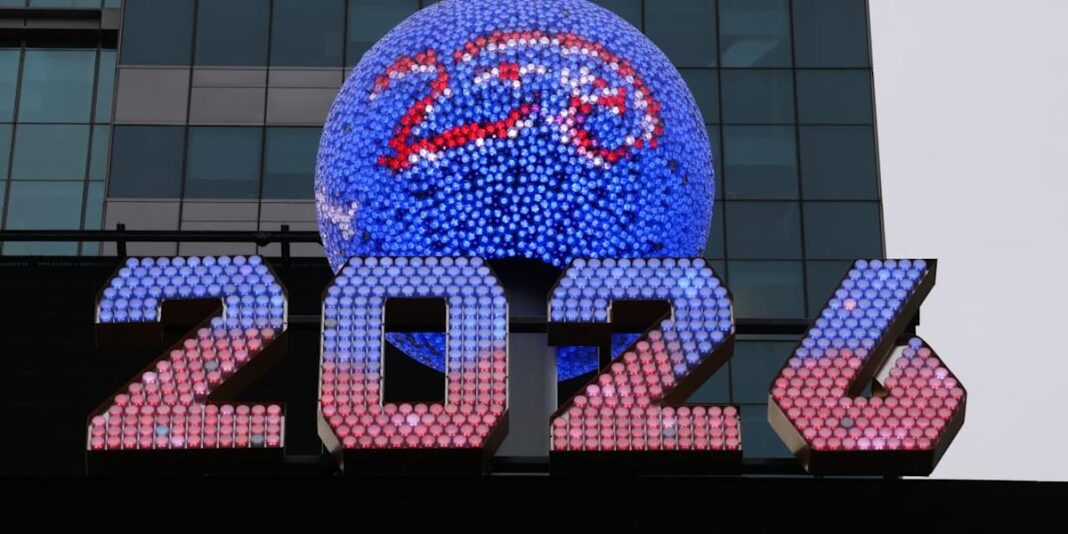


The Christmas holiday has come and gone, but the annual “Santa Claus rally” period won’t wrap up until the closing bell rings on Monday.
This year, investors look set for yet another disappointment. For the third straight year, the S&P 500 index SPX is on pace to decline during the traditional Santa rally period. That has never happened before.
Does this mean the wheels are about to come off for the bull market? Not necessarily, said Jeffrey Hirsch, editor-in-chief of the Stock Trader’s Almanac. Hirsch’s father, Yale Hirsch, founder of the Stock Trader’s Almanac, popularized the Santa Claus rally indicator back in the early 1970s.
The Santa period includes the final five trading sessions of the previous year, and the first two of the new one. This year, it began on Christmas Eve; since then, the S&P 500 has fallen by 0.9%, according to FactSet data.
“It’s an early warning indicator for us to start looking at other things,” Hirsch told MarketWatch in an interview. “It doesn’t mean the bull market is over, or that it’s the end of the world.”
To be sure, a team of analysts at Ned Davis Research pointed out that the Santa Claus rally period has been unusually weak since 2013. During this time, it has only produced positive returns 66.7% of the time, compared with a 76% win rate going back to 1950.
“Post-Christmas seasonal strength has not been as consistent in recent years. In general, poor post-Christmas returns over the past 12 years have not foreshadowed a bear market the following year,” the Ned Davis analysts said in a report shared with MarketWatch.
Hirsch said he thinks recent strong stock-market performance has led to more profit taking after New Year’s Day.
Along with the Santa Claus rally test, Hirsch monitors how stocks perform during the first five trading days of January, and for the month as a whole.
Since 1950, the S&P 500 has posted an average full-year gain of 14.2% after a positive first five trading sessions of the year, with an 83.3% accuracy rate, according to the Stock Trader’s Almanac.
And later this month, investors will turn to the “January barometer,” another indicator built around the idea that market strength or weakness early in the year can carry forward.
Since 1928, the S&P 500 has delivered a median full-year gain of 11.8% when the S&P 500 ends January on a positive note, with the index finishing the year higher nearly 80% of the time, according to Dow Jones Market Data (see table below).


