Moneywise and Yahoo Finance LLC may earn commission or revenue through links in the content below.
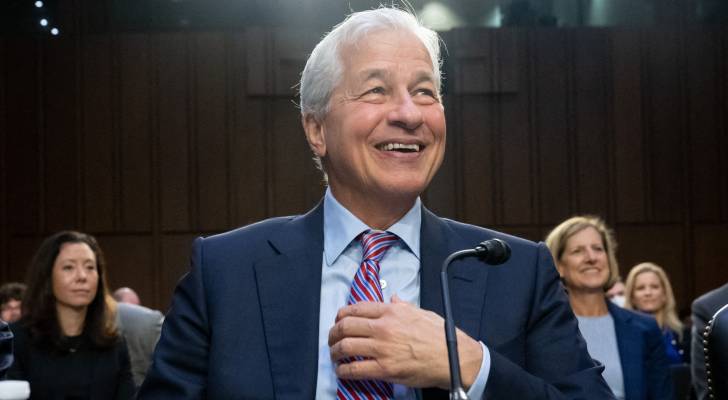
JPMorgan CEO Jamie Dimon isn’t known for making bold price calls. Yet, Dimon made punchy claims during an interview at Fortune’s Most Powerful Women conference in Washington when asked whether he thought gold was overvalued or undervalued.
Dimon started by saying, “I don’t know. I mean, I’m not a gold buyer — it costs 4% to own it (1).”
What he means is simple: Physical gold can come with additional carrying costs, such as storage, vaulting fees and insurance. For the unwary, this can come as a surprise and undercut the precious yellow metal’s value — especially during periods of slow growth.
But despite his initial quip, Dimon didn’t dismiss gold outright.
“It could easily go to $5,000, $10,000 in environments like this,” he said. “This is one of the few times in my life it’s semi-rational to have some in your portfolio.”
His comments come at a time when economic uncertainty has pushed many investors toward traditional safe havens. For instance, Dimon expressed concerns over the U.S.’s floundering job market, which is a key indicator of a slowing economy.
In an interview with CNN, Dimon was crystal clear, saying, “There’s weakening in the job market. There’s no question. It’s not recessionary, it’s just weakening. But it’ll continue to weaken. (2)”
Gold tends to perform well during periods of heightened economic certainty — conditions the U.S. is currently facing.
Gold prices have already surged more than 70% over the past 12 months, recently topping $4,500 an ounce in December (3). Based on spot prices from early January, a move to $10,000 would mean a 131% jump from current levels.
“Asset prices are kind of high,” Dimon added. “In the back of my mind, that cuts across almost everything at this point.”
His remark echoes a growing unease among market watchers: valuations across multiple asset classes have swelled after years of easy money and resilient investor appetite. Federal Reserve chair Jerome Powell recently cautioned that stock prices “are fairly highly valued (4).”
And with Americans now holding a record share of their wealth in equities, economists are warning of a possible downshift in returns ahead.
One of the biggest reasons investors turn to gold is its reputation as a hedge against inflation — a force that’s been quietly eroding the purchasing power of Americans’ money for decades. According to the U.S. Bureau of Labour Statistics, $100 in late 2025 had the same buying power as just $12.28 did in 1970 (5).
Gold is considered a natural hedge because, unlike paper currency, it can’t be printed at will by central banks. That scarcity is part of what gives the metal its enduring appeal.
It’s also widely viewed as the ultimate safe-haven asset. Gold isn’t tied to any single country, currency or economy and when financial markets turn volatile or geopolitical tensions flare, investors often flock to it — driving prices higher.
Dimon isn’t the only one pointing to gold’s potential. Prominent investors have long highlighted the metal’s role in building a resilient portfolio.
Ray Dalio, founder of the world’s largest hedge fund, Bridgewater Associates, told CNBC that “people don’t have, typically, an adequate amount of gold in their portfolio,” adding “when bad times come, gold is a very effective diversifier (6).”
Meanwhile, Goldman Sach predicts gold prices will climb another 14% to $4,900 per ounce by December 2026 (7).
One way to get into gold that can also provide significant tax advantages is to open a gold IRA with the help of Priority Gold.
Gold IRAs allow investors to hold physical gold or gold-related assets within a retirement account, which combines the tax advantages of an IRA with the protective benefits of investing in gold. This can make it an attractive option for those looking to potentially hedge their retirement funds against economic uncertainties.
To learn more, you can get a free information guide that includes details on how to get up to $10,000 in free silver on qualifying purchases. Just keep in mind that, as Dalio says, gold is often best used as just one part of a well-diversified portfolio.
But this is just one way to get away from a tumultuous market.
Beyond gold, art is another alternative asset that tends to appreciate over time — and often without a strong correlation with stocks. One reason is that supply is limited, and most famous pieces have already been snatched up by museums and collectors.
That scarcity can make art an attractive option for those looking to diversify and preserve wealth during periods of uncertainty and inflation.
However, this market has long been the domain of high-net-worth investors with access to a network of collectors, appraisers and curators. For instance, in 2022 — shortly after U.S. inflation hit a 40-year high — the art collection of Microsoft late co-founder Paul Allen sold for $1.5 billion at Christie’s New York, making it the most valuable collection in auction history (8).
Beyond being inflation-resistant, art can also be a way to protect yourself from a potential stock market tumble.
One standout example is post-war and contemporary art, which outpaced the S&P 500 by 15% from 1995 to 2025 while showing near-zero correlation to traditional equities.
Until recently, this world was off-limits to most investors.
Now, with Masterworks, you can buy fractional shares in multimillion-dollar works by icons like Banksy, Picasso and Basquiat. While art can be illiquid and typically requires a long-term hold, it offers unique portfolio diversification.
Masterworks has sold 25 artworks so far, yielding net annualized returns like 14.6%, 17.6%, and 17.8%.
And the best part? Moneywise readers can get priority access to diversify with art: Skip the waitlist here
Note that past performance is not indicative of future returns. Investing involves risk. See important Regulation A disclosures at Masterworks.com/cd.
Gold isn’t the only asset investors turn to during inflationary times. Real estate has also proven to be a powerful hedge, with the added benefit of generating passive income through rent.
When inflation rises, property values often increase as well, reflecting the higher costs of materials, labor and land. At the same time, rental income tends to go up, providing landlords with a revenue stream that adjusts for inflation.
For instance, according to RealPage, a real estate industry software provider, average effective asking rents for market-rate apartments in the U.S. are expected to grow in 2026 (9). Rents are forecast to climb 2.3% across the country this year. If true, that would be a stark contrast from the 0.7% rent price decline during 2024.
That said, high home prices can make buying a home more challenging, especially with mortgage rates still elevated. And being a landlord isn’t exactly hands-off work — managing tenants, maintenance and repairs can quickly eat into your time, not to mention your returns.
The good news? You don’t need to buy a property outright — or deal with leaky faucets — to invest in real estate today.
Mogul is a real estate investment platform offering fractional ownership in blue-chip rental properties, which gives investors monthly rental income, real-time appreciation and tax benefits — without the need for a hefty down payment or 3 a.m. tenant calls.
Founded by former Goldman Sachs real estate investors, the team hand-picks the top 1% of single-family rental homes nationwide for you.
Each property undergoes a vetting process, requiring a minimum 12% return even in downside scenarios. Across the board, the platform features an average annual IRR of 18.8%. Their cash-on-cash yields, meanwhile, average between 10 to 12% annually. Offerings often sell out in under three hours, with investments typically ranging between $15,000 and $40,000 per property.
Every investment is secured by real assets, not dependent on the platform’s viability. Each property is held in a standalone Propco LLC, so investors own the property — not the platform. Blockchain-based fractionalization adds a layer of safety, ensuring a permanent, verifiable record of each stake.
Another option is First National Realty Partners (FNRP), which allows accredited investors to diversify their portfolio through grocery-anchored commercial properties without taking on the responsibilities of being a landlord.
With a minimum investment of $50,000, investors can own a share of properties leased by national brands like Whole Foods, Kroger and Walmart, which provide essential goods to their communities. Thanks to triple net leases, accredited investors are able to invest in these properties without worrying about tenant costs cutting into their potential returns.
If you’ve got the capital on hand, simply answer a few questions — including how much you would like to invest — to start browsing their full list of available properties
We came across a bullish thesis on Clover Health Investments, Corp. on topsecretstocks’s Substack. In this article, we will summarize the bulls’ thesis...