Additionally, it plans to repurchase $5 billion in stock, bringing total cash returned to shareholders to $15 billion for the year.
For investors looking for steady passive income without taking on excessive risk, P&G checks all the boxes.
Procter & Gamble’s wide product portfolio supports a healthy dividend yield.Procter and Gamble
P&G isn’t exactly crushing it right now. The consumer staples sector is facing a challenging environment across the board.
Sales growth is slowing, companies are struggling to pass along cost increases, and supply chains remain unpredictable. Further, trade policy continues to shift in ways that create uncertainty.
Many of P&G’s competitors are dealing with negative sales growth and shrinking margins, and some have had to pull back on shareholder returns just to stay afloat.
P&G (PG), on the other hand, is holding steady. According to its earnings transcript, the company forecasts diluted earnings per share growth of between 3% and 4% in fiscal 2026. Further, organic sales are expected to grow between 1% and 4%.
And it’s still planning to return that $15 billion to shareholders.
These numbers showcase the resilience of P&G’s business model and its ability to generate cash even when the broader market environment turns volatile.
CFO Andre Schulten made it clear where the company’s priorities lie when discussing the restructuring program.
During a Morgan Stanley conference, Schulten said:
In other words, P&G isn’t cutting costs just to inflate short-term earnings. It’s reinvesting savings into innovation and brand building to drive sustainable growth over the long haul.
The sheer size of its capital return program showcases how much of a steady cash cow P&G is, even during industrywide slowdowns.
And with restructuring savings earmarked for growth rather than padding the bottom line, the company is positioning itself to weather the current challenges while maintaining its commitment to shareholders.
P&G’s ability to deliver solid results in a challenging environment comes down to two things: its highly efficient supply chain and its diversified brand portfolio.
Unlike smaller competitors, P&G doesn’t need every product category or geographic region to be firing on all cylinders at the same time.
Right now, regions outside North America are driving top-line growth. Organic sales from China grew 5% in the most recent quarter, with Baby Care up 20% and SK-II up 12%. Latin America posted 7% growth, with solid performance across Mexico, Brazil, and smaller markets.
More Retail:
The China turnaround is especially notable. About two years ago, the team completely overhauled its approach to the market.
“The China team has probably done the most significant restructure of a market that I’ve seen in my career,” Schulten told analysts.
The team changed how they go to market, realizing that traditional brick-and-mortar was still important but less critical than online. They streamlined the brand portfolio, changed the way they innovate, and adjusted the media model.
All of that has worked. And it gives the company confidence that the same approach can drive results elsewhere.
On the product side, skin and personal care are thriving, while the rest of the business is either barely growing or experiencing negative organic growth.
Even with a value-driven consumer base, P&G is seeing growth in premium skin and personal care products. The company is benefiting from a shift away from bars to liquids. Consumers are also moving from specialty products to mass-market options, such as Olay, which offers quality at a more affordable price.
Olay was a standout brand in the recent quarter. And while it represents one of P&G’s premium skin care brands, it’s relatively affordable compared to luxury alternatives. This matters because it shows the nuances in P&G’s business.
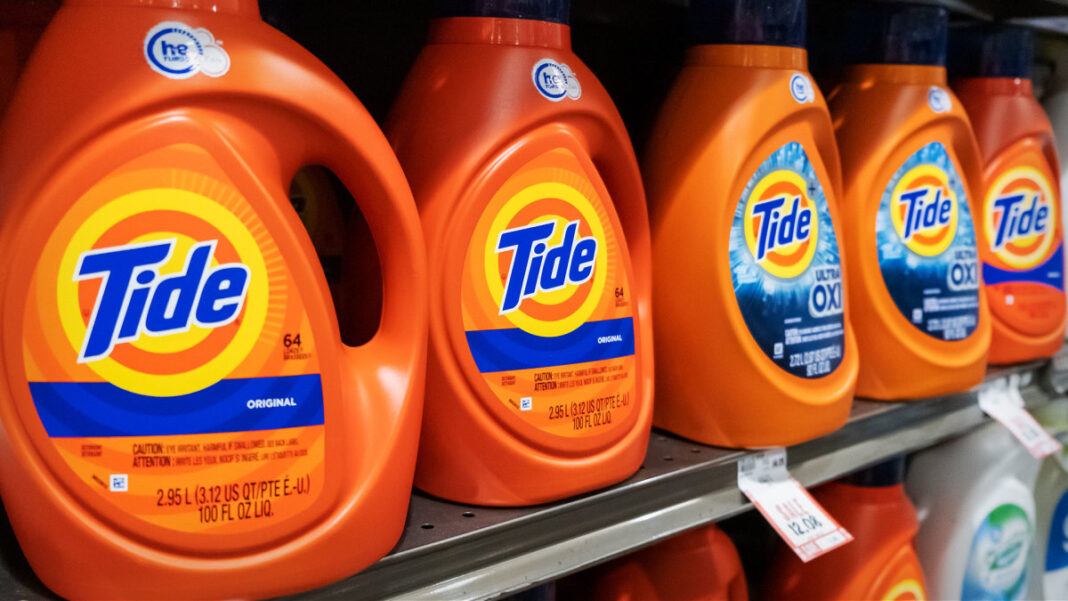
Within the detergent market, consumers may be shifting from premium-priced Tide to Gain. With both brands owned by P&G, the company is retaining customers but likely losing some organic growth due to an unfavorable category mix.
Schulten’s take on the current environment emphasizes the need for discipline.
“I wouldn’t call it affordability. I would say value is clearly in the center of the equation,” he explained during the earnings call. “And value defined as price over integrated performance.”
The company’s latest quarter is a testament to its versatility and how certain brands can shine depending on the operating environment. Companies that operate in fewer brand categories or are more dependent on a handful of geographic regions don’t have P&G’s flexibility.
P&G’s operating margins are also industry-leading. That’s a testament to its efficiency and ability to leverage its size and scale to drive profitability, even when revenue growth slows.
In the last 12 months, PG stock paid shareholders an annual dividend of $4.23 per share, up from $2.65 per share in 2016 and $1.12 per share in 2006. Over the last 20 years, the blue-chip dividend stock has grown its dividend payout by 6.9% annually.
According to Tikr.com, analysts tracking the consumer giant forecast free cash flow to grow from $14.61 billion in fiscal 2025 to $18.6 billion in fiscal 2030. In this period, the annual dividend is expected to increase from $4.08 per share to $5.14 per share.
With a payout ratio below 65%, Procter & Gamble has the flexibility to reinvest in growth initiatives and strengthen its balance sheet while supporting a growing dividend payout.
P&G isn’t growing earnings at the rate it was in years past. But it is still delivering good results, given the challenging operating environment.
The company is on track to generate substantial free cash flow, which supports dividend increases and stock buybacks. Management has been clear that restructuring savings are flowing back into growth investments, not just padding the bottom line.
And to top it all off, P&G is trading at a compelling valuation. The dividend stock is currently trading at 19.6x forward earnings, which is below its 10-year average of 22.8x. It also trades at a 20% discount to consensus price targets in January 2026.
Moreover, PG offers a combination of yield, consistency, and financial strength that’s hard to find anywhere else in the market.
The company has proven it can weather tough environments while continuing to reward shareholders. And with 69 consecutive years of dividend increases, it’s clear P&G is committed to maintaining that streak for years to come.