

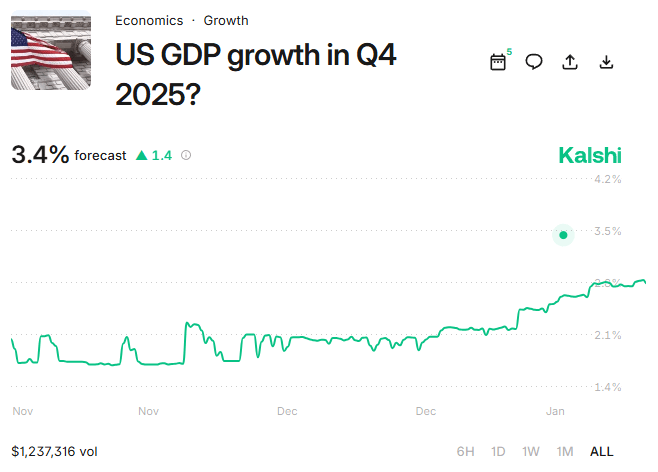

The US economy is closing out 2025 with a bang—or at least, that’s what some prediction markets are suggesting. According to betting platforms and real-time economic trackers, there’s growing confidence that Q4 2025 GDP growth could exceed 3.0%, a threshold that would signal robust economic momentum heading into 2026.
But as any seasoned market watcher knows, forecasts are like weather predictions: helpful, but not gospel. Let’s break down what’s driving the optimism, what could derail it, and why this particular GDP print matters more than usual.
What Are Prediction Markets Saying?

Prediction markets like Kalshi have become increasingly popular tools for gauging economic sentiment. These platforms allow traders to bet real money on economic outcomes, creating a crowd-sourced forecast that often rivals—or even outperforms—traditional analyst predictions.
Recent activity on these platforms shows strong positioning for above-3.0% Q4 GDP growth. The confidence isn’t coming from thin air. According to the Atlanta Fed’s GDPNow model, which tracks real-time economic data, Q4 2025 GDP growth was estimated at 5.1% as of January 9, 2026—a surprisingly robust figure that’s captured market attention.
GDPNow isn’t an official forecast but rather a running estimate based on incoming economic data. Since its inception in 2011, the model has maintained an average absolute error of 0.77 percentage points, making it a respected indicator among economists and traders alike.
The Bull Case: Why Growth Could Exceed 3.0%
Several factors are lining up in favor of stronger-than-expected Q4 growth:
Consumer Spending Resilience: Despite concerns about affordability, consumer spending remains the backbone of the US economy. Personal consumption expenditures grew at a revised 3.0% rate in early Q4, according to GDPNow estimates. The top 20% of earners have been driving spending, accounting for approximately 57% of consumer outlays through mid-2025, per Dallas Federal Reserve data.
Export Surge: Net exports made a significant positive contribution to Q4 growth, with GDPNow showing exports adding roughly 1.97 percentage points to GDP. This reverses earlier drag from trade and suggests American goods are finding buyers abroad despite global economic headwinds.
AI Investment Boom: Business investment in artificial intelligence infrastructure continues at a blistering pace. Information-processing equipment investment jumped 20.4% year-over-year in Q2 2025, and software spending rose 12.2%, according to recent Bureau of Economic Analysis data. These investments are providing a substantial boost to overall GDP.
Government Spending: Both state and federal government expenditures increased in Q3 2025, led by defense consumption and state/local spending. This trend appears to have continued into Q4, providing additional support to growth figures.
Strong Q3 Base: The third quarter came in at 4.3% annualized growth, according to the BEA’s initial estimate released in late December 2025. This momentum provides a solid foundation for Q4 performance.
The Bear Case: Why Growth Could Fall Short
Not everyone is convinced Q4 will clear the 3.0% bar. Here’s why skeptics remain cautious:
Tariff Headwinds: The elephant in the room is tariffs. The average effective tariff rate climbed from 2.5% at the start of 2025 to above 10% by August, with further increases expected. Goldman Sachs estimated that the 11-percentage-point increase in tariff rates cut approximately 0.6% from GDP in the second half of 2025. Yale’s Budget Lab projects tariffs will reduce real GDP growth by 0.5 percentage points in 2025 and 0.4 percentage points in 2026.
Cooling Labor Market: The unemployment rate stood at 4.6% in November 2025—a four-year high. Monthly job gains have slowed dramatically, averaging around 130,000 in the latter half of 2025 compared to 1.8 million in 2024. The Philadelphia Fed’s Survey of Professional Forecasters expects unemployment to rise to 4.5% by year-end 2026. A softening labor market typically precedes reduced consumer spending. (Spoiler alert: unemployed people buy fewer lattes.)
Inventory Distortions: Many businesses front-loaded inventory purchases in early 2025 to avoid tariff costs. As these stockpiles deplete, the positive inventory contribution to GDP could reverse, creating a drag on growth. Economists warn that inventory adjustments can significantly swing quarterly GDP figures.
Consumer Spending Slowdown Ahead: Professional forecasters are projecting consumer spending growth will decelerate to approximately 1.6% in 2026, down from 2.6% in 2025, according to Deloitte’s Q4 economic forecast. Morgan Stanley expects nominal spending growth to cool to 2.9% in 2026, with particular weakness in Q4 2025 and Q1 2026.
Residential Investment Weakness: Real residential investment growth decreased from 1.5% to -5.8% in Q4 according to the latest GDPNow update from January 9. Housing remains one of the economy’s weak spots, with mortgage rates hovering between 6.6% and 7% throughout late 2025.
What the Consensus Thinks
Traditional forecasters are more conservative than recent GDPNow readings suggest. The Federal Reserve Bank of Philadelphia’s Survey of Professional Forecasters projects annual GDP growth of 1.9% for 2025 and 1.8% for 2026 on an annual-average basis.
Goldman Sachs forecasts 2.6% growth for 2026, citing reduced tariff drag, tax cuts from the One Big Beautiful Bill Act, and more favorable financial conditions as interest rates decline. However, their 2025 growth estimate of 2.1% fell short of earlier predictions due to larger-than-expected tariff impacts.
Deloitte expects 2026 growth of 1.9%, down slightly from an anticipated 2.0% in 2025, reflecting a pronounced slowdown in consumer spending and continued tariff pressures.
Why This GDP Print Matters
The Q4 2025 GDP advance estimate, scheduled for release on January 29, 2026, carries unusual significance. It will provide the first comprehensive view of how the economy navigated the dual challenges of elevated tariffs and a cooling labor market in late 2025.
More importantly, it sets the tone for Federal Reserve policy in 2026. The Fed has already cut rates by 175 basis points since September 2024, bringing the federal funds rate to 3.5%-3.75%. Further rate cuts depend heavily on the growth-inflation trade-off, making the GDP print a crucial data point for monetary policy decisions.
For market participants, the prediction markets’ confidence in above-3.0% growth represents a bet that the economy’s strengths—particularly AI investment and resilient high-income consumer spending—will outweigh the headwinds from tariffs and labor market softening.
The Bottom Line
Is Q4 2025 GDP growth likely to exceed 3.0%? The Atlanta Fed’s GDPNow model suggests it’s possible, even likely, based on current data. However, traders should remember that GDPNow’s track record, while impressive, isn’t perfect. The model’s root-mean-squared error of 1.17 percentage points means a current estimate of 5.1% could easily resolve anywhere between roughly 4.0% and 6.2%.
The prediction markets’ optimism may be justified if recent consumption strength and export gains persist. However, the bear case centered on tariff impacts and labor market cooling presents legitimate downside risks that could push growth below 3.0%.
As always, economic forecasting remains more art than science. The smart money isn’t just betting on an outcome—it’s managing risk around a range of possibilities.
Disclaimer: This article is for informational purposes only and does not constitute financial advice. Economic forecasts are subject to significant uncertainty. Past performance of forecasting models does not guarantee future accuracy. Always conduct your own research and consult with qualified financial professionals before making investment decisions.


