

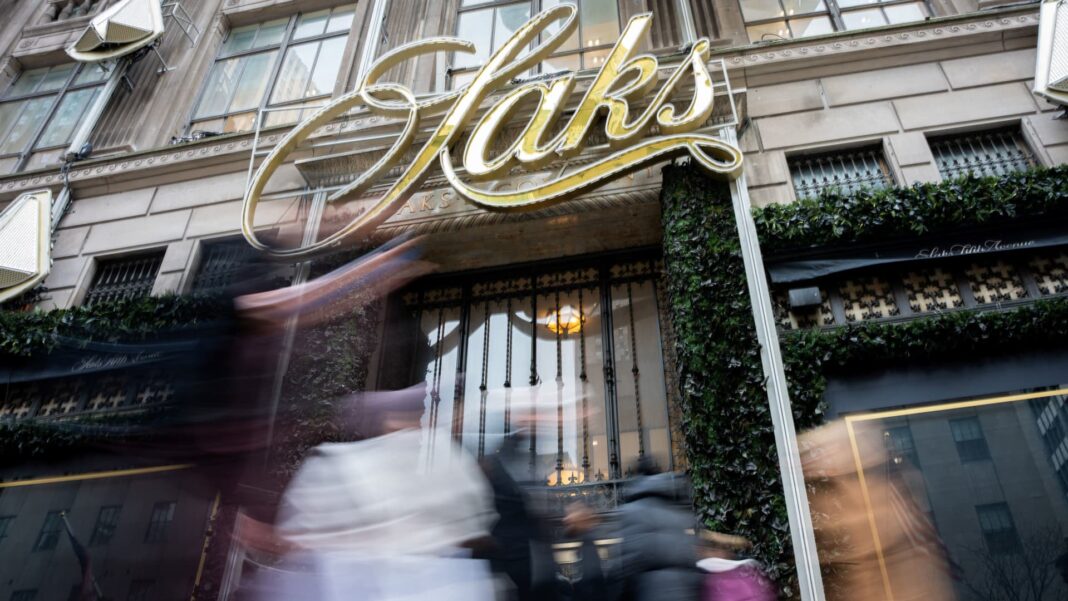

Shoppers walk outside the Saks Fifth Avenue flagship store in Manhattan in New York City, U.S., Jan. 6, 2026.
Angelina Katsanis | Reuters
Saks Global, the parent company behind the 159-year-old department store that’s become both a destination and a symbol for luxury fashion, filed for bankruptcy protection after running out of cash and failing to find investors willing to finance its business.
Crucially, the retailer filed for Chapter 11, which will give it the chance to reorganize its business, clear through its debts and potentially find a buyer willing to take it on as a going concern.
The company announced Wednesday that former Neiman Marcus CEO Geoffroy van Raemdonck will immediately take over as chief executive, replacing Richard Baker, who had been in the job for just two weeks.
Saks also announced it had secured a financing commitment of around $1.75 billion in a bid to strengthen its balance sheet.
As recently as last week, Saks was having trouble lining up as much as $1 billion in financing for a so-called debtor-in-possession loan, which provides the funds to keep a business running during Chapter 11 proceedings, CNBC previously reported. If Saks hadn’t lined up the DIP loan, it made a Chapter 7 liquidation filing more likely.
A bankruptcy filing for Saks Global has been seen as inevitable for weeks after the company missed an interest payment to bondholders late last month. What is still unclear is what will happen to the company and the nearly 200 doors under its umbrella across Saks’ namesake stores and its off-price chain, along with Neiman Marcus and Bergdorf Goodman.
Bankruptcy proceedings could lead to a range of potential outcomes. A deep-pocketed strategic buyer could swoop in and buy the whole company, saving it from liquidation. Saks could also liquidate while other parts of its business sell, such as the smaller Neiman and Bergdorf. Like its erstwhile competitor Lord & Taylor, Saks, Neiman and Bergdorf — or some combination of the three — could close all of their stores and become online-only businesses.
The future of Saks Global will become clearer in the coming weeks as bankruptcy proceedings play out and the company continues to look for new investors.
How did Saks fall apart?
Though it caters to some of the wealthiest shoppers in the world, Saks has been steadily running out of cash and failing to pay some of its bills after it acquired its longtime rival Neiman Marcus in 2024 in a $2.7 billion deal heavily financed with debt.
Still, Saks was struggling to pay its vendors even before it acquired Neiman. Through the acquisition, the company received a flood of new money that was supposed to deleverage the combined business and provide it with “significant liquidity,” Saks said at the time.
The tie up brought a fresh slate of deep-pocketed investors from the tech world, including Amazon and Salesforce, and was expected to create a luxury department store powerhouse with an improved cost structure and stronger negotiating power.
Instead, Saks failed to implement the turnaround investors had banked on. It briefly got better at paying its vendors, but then moved to a 90-day payment term, angering and pushing away brands that said the conditions were too onerous to work for their businesses.
Soon, it stopped paying suppliers once again, which led to both a dip in assortment and sales.
In the backdrop, Saks’ debt began trading below its face value, raising questions about the company’s ability to keep operations running and make interest payments to bondholders, people familiar with the matter said. Over the summer, it secured $600 million in new financing and sold off key real estate assets to drum up more cash.
While those efforts bought the company some time, they ultimately didn’t prevent a bankruptcy filing.


