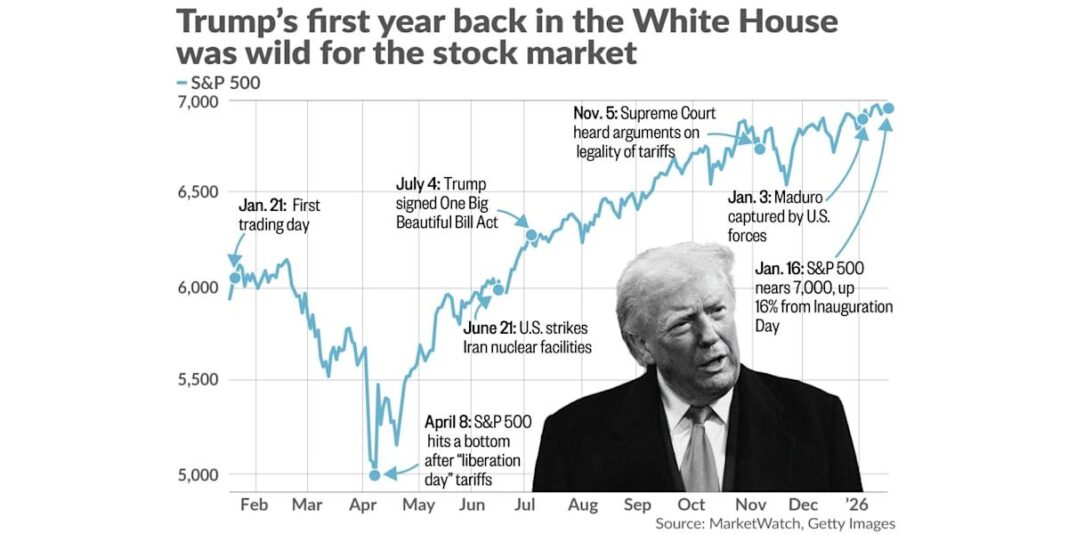
Stocks have risen 16% during President Trump’s first year back in office. – MARKETWATCH, GETTY IMAGES
16% in a year — that’s how much the S&P 500 stock index has climbed during President Trump’s first year back in office.
But don’t let that number fool you: The past year has been a dizzying mix of record highs and sudden pullbacks that kept Wall Street on edge — even as investors rushed to buy the dip.
Ever since Trump announced his “liberation day” tariffs on April 2, nearly every bout of weakness in the stock market has been met with fresh demand, giving investors a key lesson from 2025: Sweeping policy changes from this administration don’t always translate into lasting change, nor market damage.
Yet while this theme — dubbed the “TACO trade” by some — encourages dip-buying, it may also be leaving investors too complacent about new sources of volatility that could lurk on the horizon in 2026.
As of Friday afternoon, the S&P 500 SPX had advanced nearly 16% since Trump returned to the White House as the 47th president of the United States on Jan. 20, 2025. The gain itself isn’t abnormal, though it does sit above the historical median return of 9% for a president’s first year in office since 1929, according to Dow Jones Market Data.
During President Biden’s first year in office, the S&P 500 rose 16.4%. It surged 23.7% in 2017, the first year of Trump’s first term. But the stock market put even better first years under President Obama (see table below).
SOURCE: DOW JONES MARKET DATA –
That might come as a surprise to some on Wall Street who expected Trump’s second term in the White House to be extremely favorable for investors.
“Trump’s first year back in office has been the proverbial drinking out of a fire hose, with news flow and information coming at a continual pace,” said Chris Maxey, managing director and chief market strategist at Wealthspire Advisors.
If the past year taught investors anything, it was the importance of staying patient rather than overreacting to every headline, which led to “more mistakes than benefits” in their investment portfolios, he told MarketWatch.
“It did require an enormous amount of patience for investors to not make any reactionary changes to all those political headlines in 2025,” Maxey said.
To be sure, investors have spent much of this past year worrying whether Trump’s sweeping, ever-shifting tariff policies would trigger a global trade war, stoke a rapid increase in inflation, or tip the world’s largest economy into recession. Those fears have yet materialize.
Aside from a brief bout of volatility in April after “liberation day,” the stock market has shrugged off most of these concerns and trended higher ever since — although investors are still awaiting the Supreme Court’s ruling on whether most of the tariffs will ultimately stand.
While waiting on more tariff clarity, the S&P 500 has recorded 42 all-time closing highs since Jan. 20, while the Dow Jones Industrial Average DJIA has registered 23 such peaks and the Nasdaq Composite COMP has finished at record levels 36 times, according to Dow Jones Market Data.
Beyond market swings, the broader U.S. economy has been expanding faster than expected. Gross domestic product, the official scorecard of the economy, fell in the first quarter of 2025 for the first time in three years. GDP then rebounded with big gains in the second and third quarters. For all of 2025, GDP is expected to show growth of 2.5% or more.
The labor market has cooled but remains relatively stable, with the unemployment rate at 4.4% in December — the lowest level in about two years, even as slower job growth raises the risk of downward pressure on wages and consumer confidence.
Inflation, despite still being well above the Federal Reserve’s 2% target, has cooled down from a 41-year high a few years ago. The annual rate of inflation stood at 2.7% in December, according to the latest consumer-price index (CPI) report.
That economic backdrop could now collide with fiscal policy, including Trump’s One Big Beautiful Bill Act and his latest affordability initiatives. These include a proposed one-year 10% cap on credit-card interest, which could be “overall supportive to the economy, and eventually flow through to corporate America and to consumer spending,” Maxey said.
Investors are also turning their attention to the 2026 midterm elections, an occasion that isn’t known to be smooth sailing in markets.
Historically, stock-market performance in midterm election years, or the second year of a presidential term, tends to be the weakest in a four-year presidential term cycle. Since 1948, the S&P 500 has delivered an average gain of just 4.6% in midterm election years, posting positive returns only 58% of the time. By contrast, pre-election years, or the third year of a president’s term, historically have been the strongest of these four-year cycles, with average gains of roughly 17.2%, according to data compiled by Ned Davis Research.
U.S. stocks finished lower on Friday. For the week, the Dow dropped 0.3%, while the S&P 500 fell 0.4% and the Nasdaq posted a 0.7% loss, according to FactSet data.
Tuesday marks the first anniversary of President Trump’s return to the White House. All U.S. stock exchanges will be closed for the Martin Luther King Jr. Day on Monday, and will resume trading on Tuesday morning at 9:30 a.m. Eastern time. Bond markets will also be closed on Monday.