



- USD/CAD price analysis remains under selling pressure as oil prices remain stable while the dollar weakens.
- Canada’s upbeat inflation suggests the BoC will likely pivot to easing sooner.
- Tariff uncertainty weighs on the dollar despite the Fed’s deferred easing to midyear.
USD/CAD is currently defined by a tug-of-war between a structurally weaker US dollar and a Canadian dollar underpinned by resilient domestic fundamentals. On the US side, the Dollar Index (DXY) is sliding below 99.00 as markets react to renewed tariff threats on multiple EU countries over the Greenland issue.
–Are you interested to learn more about crypto signals? Check our detailed guide-
The USD, a safe-haven, is struggling due to unclear policies and mounting risks, making investors doubt its appeal. Despite Fed easing predictions being moved back to June and September, the dollar remains weak. The currency has rate-differential support but less risk and a lower political premium.
Canada’s story is almost opposite. The currency has survived lower oil prices and political turbulence, but macro data suggest a stronger CAD. The monthly CPI surpassed the most pessimistic estimates, and the YoY CPI rose to 2.4% from 2.2% in previous months. That profile suggests the Bank of Canada won’t immediately ease because inflation isn’t slowing.
Consistent with this, Canadian 10-year bond yields have rebounded toward the 3.4% area with a constructive slope, signaling that markets are pricing a more neutral BoC stance and, by extension, offering more attractive yields to foreign investors. That combination of sticky inflation and firmer yields supports capital inflows and underpins CAD demand.
The larger political picture also doesn’t support a long-term rise in USD/CAD. The US-EU tariff fight over Greenland, which includes threats of 10% tariffs going up to 25% and talk of an EU “trade bazooka,” makes a transatlantic trade conflict more likely. This could hurt the US more than Canada in terms of credibility and growth expectations.
Canada has geopolitical noise, like deals with China and speculation about Greenland, but CAD selling hasn’t increased. Markets swiftly returned to rates and data rather than headline risk. The dollar’s risk premium rises amid growing concerns about policy instability stemming from the US tariff story.
Putting these drivers together, the fundamental balance for USD/CAD is tilting toward a gradual downside bias. The Fed is in no rush to cut, but that stance is now largely priced in, whereas the new information is the uncertainty around US trade policy and the visible weakening in the DXY.
At the same time, Canada’s inflation and yield dynamics argue against an imminent BoC easing cycle and make CAD comparatively more attractive, especially if global investors seek alternatives to the US amid rising tariff risks.
USD/CAD Price Technical Analysis: Looking to Test 200-MA
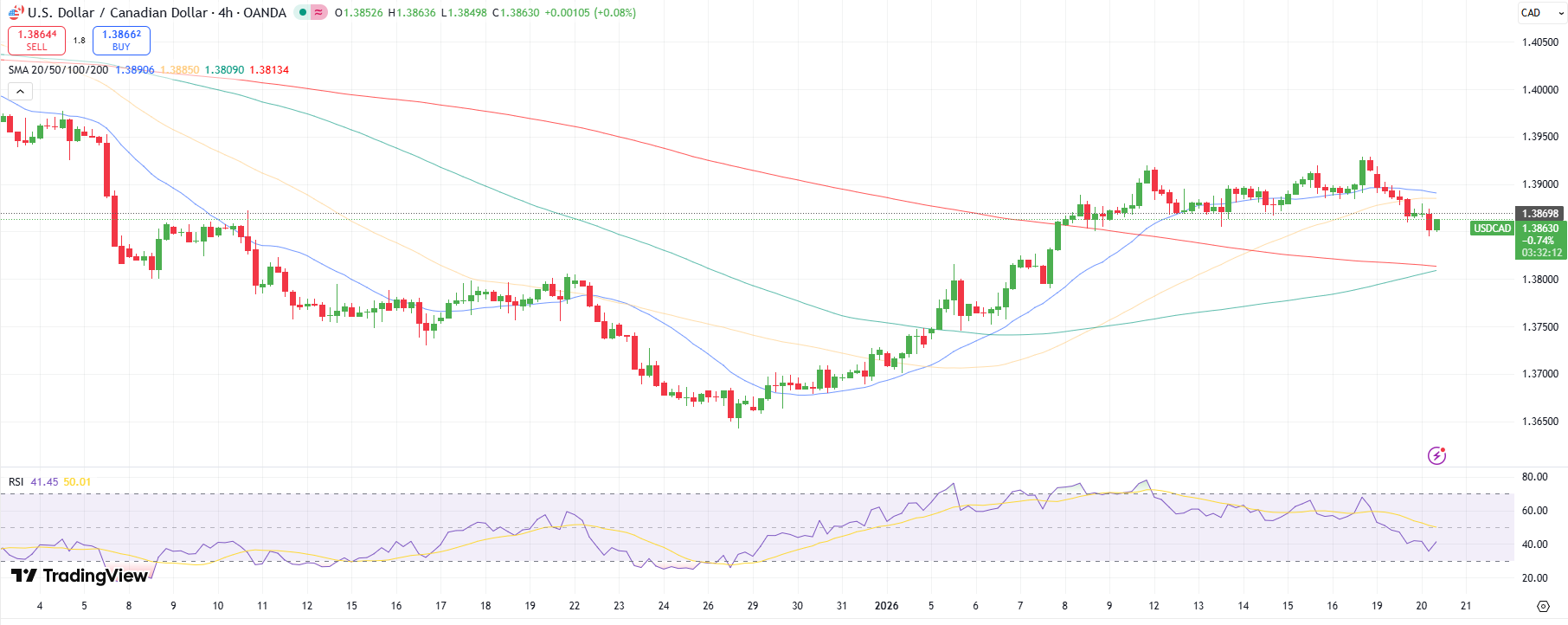
The 4-hour chart for USD/CAD shows room for further losses as the price moves below the 20- and 50-period MAs, heading towards the confluence of the 100- and 200-period MAs near 1.3810. Breaking below this level could open doors to orderblock at 1.3750.
–Are you interested in learning more about tips for forex traders? Check our detailed guide-
However, the RSI is approaching the oversold area near 35.0, indicating a potential consolidation. On the upside, the price could test the 20-period MA near 1.3890 ahead of a swing high around 1.3925.
Looking to trade forex now? Invest at eToro!
68% of retail investor accounts lose money when trading CFDs with this provider. You should consider whether you can afford to take the high risk of losing your money.


