


If you’ve been watching the trade spat between the U.S. and Europe lately, you’ve probably heard a provocative idea floating around: What if Europe just dumped all its US assets?
The scenario sounds dramatic. Fed up with President Trump’s tariff threats over Greenland and trade disputes, European governments coordinate a massive sell-off of U.S. Treasury bonds and stocks. Markets panic. Interest rates spike. The dollar crashes. America learns a painful lesson about pushing its allies too far.
But here’s the question traders should be asking: Could this actually happen, and what would the fallout really look like?
The Numbers: Europe’s $8 Trillion Leverage
Let’s start with the facts. Europe holds a staggering amount of U.S. assets, somewhere between $8 trillion and $10 trillion (depending on how you count it), spanning U.S. Treasury bonds, corporate stocks, and other securities.
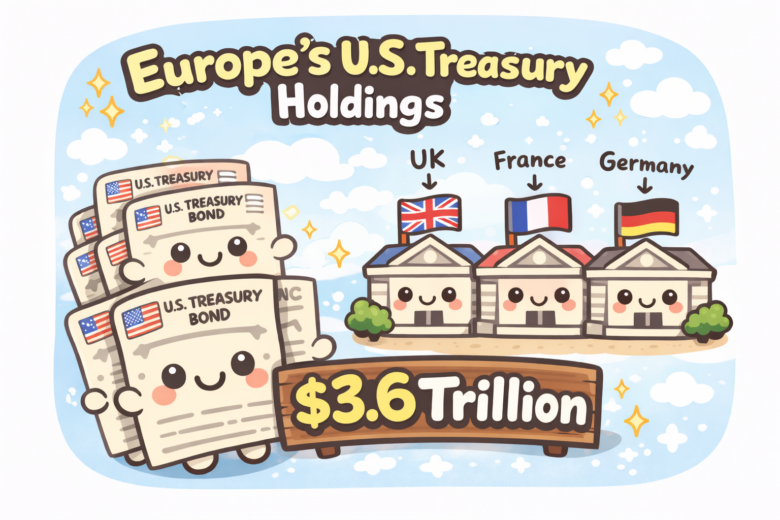
European holdings of U.S. Treasuries alone totaled around $3.6 trillion as of November 2025, according to Treasury Department data. The UK, France, and Germany’s central banks combined hold roughly $1.35 trillion in U.S. government debt.
 Why so much? Because U.S. Treasuries have traditionally been the world’s safest investment. They’re liquid (easy to buy and sell), backed by the world’s largest economy, and denominated in the dollar, which is still the global reserve currency. For European central banks managing foreign exchange reserves, U.S. debt has been the obvious choice.
But here’s where it gets interesting. George Saravelos, Deutsche Bank’s head of FX research, pointed out that Europe owns almost twice as much U.S. assets as the rest of the world combined. With the U.S. running massive trade and budget deficits, America needs Europe to keep buying its debt to keep borrowing costs down.
That dependency, Saravelos argues, gives Europe potential leverage. If Europeans decided they no longer wanted to “finance America’s bills,” the idea is that they could weaponize those holdings.
Why This Threat Keeps Coming Up
The current trigger is Trump’s tariff threats over Greenland. Earlier this month, Trump announced tariffs starting at 10% and rising to 25% on eight European countries unless Denmark agreed to sell Greenland to the US. European officials called it economic coercion and blackmail.
France immediately urged the EU to deploy its “Anti-Coercion Instrument” a.k.a. “trade bazooka” which is a tool adopted in 2023 that allows the EU to restrict U.S. access to European markets, target foreign investment, and potentially hit financial assets.
Some analysts and politicians floated the idea of going further: coordinating a sell-off of Treasuries to drive up American borrowing costs and send a message that Europe won’t be bullied.
Danish pension funds have already started. Throughout 2025, Danish funds sold approximately 10 billion kroner (about $1.5 billion) of US Treasuries, citing concerns about Trump’s policies and the “sustainability of government debt.” PFA, one of Denmark’s largest pension funds, said they’d sold out of Treasuries while keeping US stocks and corporate bonds.
Something similar has happened fairly recently. Trump’s “Liberation Day” tariff announcements last year triggered what traders call the “Sell America” trade. In this scenario, investors dumped dollar-denominated assets on fears that the U.S. was becoming an unreliable partner. The dollar weakened, Treasury yields spiked briefly, and gold rallied.
Why It Probably Won’t Happen This Time
Now for the reality check. Despite the dramatic headlines, most financial experts think a coordinated European Treasury dump is extremely unlikely. Here’s why:
Most Holdings Are Private, Not Government-Controlled
The biggest problem with the “financial weapon” narrative: Europe can’t actually force a sell-off. The majority of European holdings of US assets are in private hands (pension funds, insurance companies, banks, and individual investors) not controlled by governments.
Governments could sell their own Treasury holdings (central bank reserves) but that’s a much smaller portion of the total. Even then, it would require unprecedented coordination across 27 EU member states, each with different economic interests.
Europe Would Hurt Itself
Dumping Treasuries could wind up backfiring on the entire region, leading European investors to suffer financially for political purposes.
U.S. Treasury Secretary Scott Bessent pointed out that if Europeans sell Treasuries, they’d need to buy other currencies like the Chinese yuan, which would strengthen the euro, something European policymakers have been desperately trying to avoid because it makes European exports more expensive.
Besides, European banks use U.S. Treasuries as collateral to borrow dollars in short-term funding markets. Without that collateral, they’d face a dollar funding crisis, which is exactly what happened during the 2008 financial crisis and COVID-19 pandemic, when the Federal Reserve had to open emergency dollar swap lines to keep European banks afloat.
Also, pension funds would take losses. If selling Treasuries drove yields higher (prices fall when yields rise), European pension funds holding those bonds would immediately book losses on their portfolios.
The Fed Could Just Step In
During the COVID-19 pandemic in 2020, the Federal Reserve absorbed $2.26 trillion worth of assets onto its balance sheet in just six weeks. If European selling threatened to destabilize markets, the Fed could simply buy whatever Europe was selling.
In other words, the U.S. central bank has essentially unlimited capacity to purchase Treasuries to stabilize the market. Europe would lose the collateral and liquidity it needs, while the US market would stabilize relatively quickly.
Many Investors Already Reduced Exposure
Following the April 2025 tariff announcements, a CoreData report found that 63% of European investors had already reduced their US exposure, with 82% planning long-term reductions. Some of the most sensitive money has already left.
This means there’s less “sell America” left to do, and the investors who remain have made a calculated decision to stay exposed to US assets despite the political tensions.
What the U.S. Could Do in Retaliation
Although seemingly unlikely, let’s say Europe did attempt a coordinated sell-off. What would the U.S. response look like? The US could retaliate in several ways:
- Sell European debt. The U.S. holds European government bonds too. Washington could dump those, driving up borrowing costs for European governments already dealing with high debt levels.
- Regulatory warfare. The U.S. could increase capital requirements on European banks operating in America, restrict access to dollar clearing systems, or impose sanctions on specific financial institutions.
- SWIFT access. The ultimate nuclear option would be restricting European access to SWIFT (the global payments system) or limiting dollar swap lines from the Federal Reserve that European banks rely on during crises.
- Asset freezes. Using national security justifications, the U.S. could freeze European holdings of US assets—essentially trapping them. This would be unprecedented between allies, but the legal framework exists.
-
Trade Escalation. Beyond financial retaliation, the U.S. also could:
- Impose 100% tariffs on European goods (Trump threatened this on European pharma earlier)
- Block European companies from U.S. government contracts
- Restrict European foreign direct investment in strategic US sectors
- Withdraw from or weaken NATO security commitments
The Real Risk: Gradual De-Dollarization
A more realistic concern isn’t a sudden dollar dump, but a gradual shift. European institutional investors are already diversifying away from dollar assets. The trend includes:
This slow rebalancing doesn’t crash markets, but over years it could:
- Increase U.S. borrowing costs gradually
- Weaken the dollar’s reserve currency status
- Reduce American ability to finance deficits cheaply
China has been pursuing this strategy for years, reducing Treasury holdings from peak levels while building alternative payment systems outside the dollar.
The Bottom Line
So, could Europe really “attack” the U.S. economically by selling Treasuries? Technically, yes. Practically, no.
The obstacles are overwhelming: most holdings are private, selling would hurt European financial stability, the Fed could absorb the sales, and the political coordination required is nearly impossible.
But here’s what’s changing: The fact that government officials, financial institutions, and market players are even discussing this option suggests an ongoing breakdown in transatlantic trust. For decades, U.S. Treasuries were considered risk-free partly because allies would never weaponize their holdings. That assumption is eroding.
The real story isn’t about a dramatic Treasury dump. It’s about the slow-motion shift in how Europe views its financial relationship with America from partner to potential adversary.
That shift creates new risks, new volatility, and new opportunities for traders who understand that geopolitics is now inseparable from market dynamics. For now, Europe’s Treasury “weapon” remains mostly theoretical. But the willingness to even discuss it tells you everything about where this relationship is headed.
Disclaimer: This article is for educational purposes only and does not constitute financial advice. Trading and investing involve risk, including the potential loss of principal. Always conduct your own research and consider consulting with a qualified financial advisor before making investment decisions. Past market behavior does not guarantee future results.
Interested in fundamental analysis made for newbies and how to pair it up with technical analysis to find high quality opportunities that may match your trading and risk management style? Check out our Premium membership for event trading guides, short-term strategies, weekly recaps and more!
BabyPips.com Annual Premium Members also get an exclusive 30% discount on the annual subscription for the first year on Tradezella–the top rated journaling app! ($120 in savings)! Click here for more info!


