

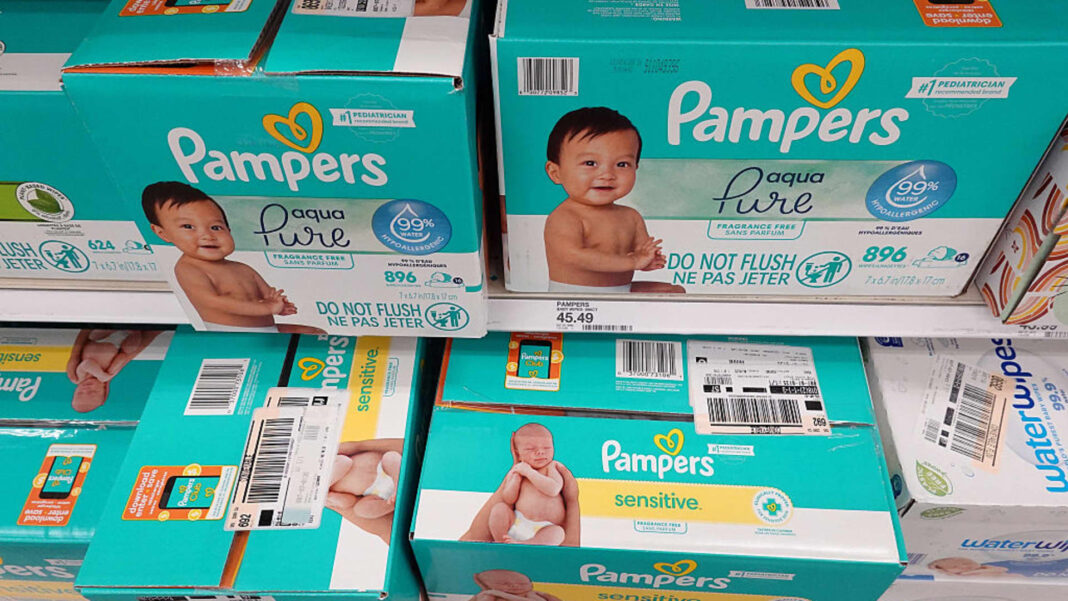

Packages of Pampers diapers are displayed at a Target store on June 05, 2025 in Novato, California.
Justin Sullivan | Getty Images
Procter & Gamble is selling diapers made with silk fibers in China as part of the company’s strategy to entice shoppers to spend more, even as demand for some of its products wanes.
China is the company’s second-largest market, trailing only the United States. In both markets, P&G has turned to innovation, rather than discounts, to attract consumers who are otherwise trying to spend less at the grocery store. For example, last year, it unveiled a new formula for its liquid Tide detergent in the U.S.
In China, P&G also faces another challenge: a record-low birth rate. Government data released on Monday showed that births dropped to 5.6 per 1,000 people in 2025, down from 6.4 in 2023.
For P&G, fewer babies means that the company is selling fewer diapers. To boost the sales of its baby care division, P&G is leaning into luxury.
Executives touted the success of the Pampers Prestige product on the company’s earnings conference call on Thursday. It added silk fibers to the inside of the diaper for skin comfort and protection.
“Chinese parents want only the best for their baby,” P&G CEO Shailesh Jejurikar said.
He added that “reframing” the company’s super-premium diaper line has fueled double-digit organic sales growth and a 3% market share increase for P&G’s baby care business in Greater China over the last 18 months. The company did not share how the pricing of Pampers Prestige compares to its other diaper lines in China.
In the latest quarter, P&G’s overall baby care division reported single-digit organic sales declines, despite a 20% jump in organic sales in Greater China, according to CFO Andre Schulten.
More broadly, the focus on innovation is paying off for P&G. Consumer sentiment in China is still negative, yet P&G saw 3% growth in the market in the latest quarter, Schulten said on a call with press on Thursday.
Stateside, P&G’s sales were weaker. Organic sales in North America fell 2% in its fiscal second quarter. P&G is hoping that the strategy that is working in China could soon pay off in the U.S.
The current bifurcated — or “K-shaped” — economy has showed that wealthier Americans are still willing to flex their purchasing power, even as lower-income shoppers pull back.
Shares of P&G rose more than 2% in morning trading on Thursday after the company reported better-than-expected earnings. However, the company’s revenue fell short of Wall Street’s expectations, hurt by weaker demand in the U.S.


