


Almost every week, one or two contracts for differences (CFD) brokers obtain a Dubai licence. Although there are two entry routes, brokers are largely taking the easier and cheaper one. But is it only the first step or a base for broader operations?
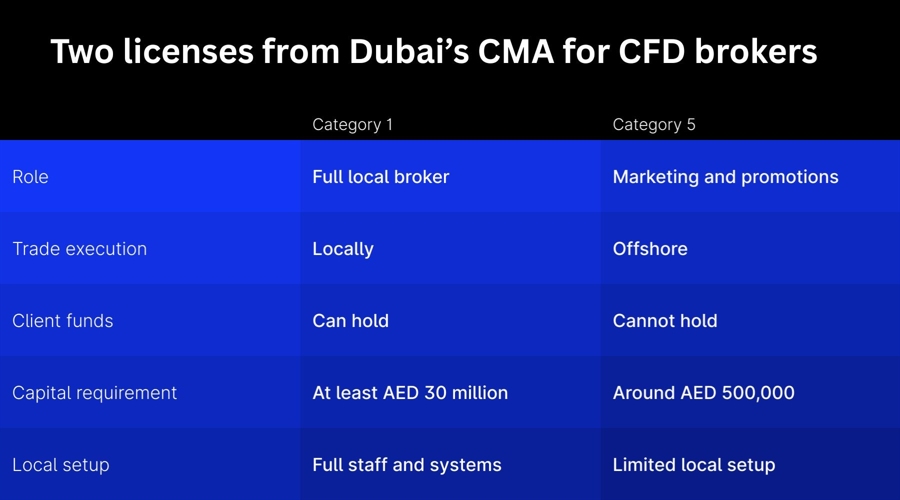
Most brokers, large and small, are choosing the Category 5 licence from the Capital Markets Authority (CMA), which was recently renamed from the Securities & Commodities Authority (SCA). However, a handful are seeking the Category 1 licence, which allows them to operate as a full local broker.
Are you attending iFX Expo Dubai? Do not miss the first-ever Trading Festival.
Low Entry Point, but Serves the Purpose
The popularity of the CMA’s Category 5 licence is clear. XM, Exinity, VT Markets, Eightcap, EC Markets, Pepperstone, Taurex, and many others have secured it. This licence is similar to an introducing broker licence in some other parts of the world.
Demand for this licence has increased sharply in recent years as the Dubai regulator refined its rulebook and licensing framework, clarified activity categories, and adjusted requirements.
Under the Category 5 licence, brokers can market CFDs, onboard clients in a regulated way, and, in some cases, offer limited advisory or arrangement services. However, they cannot execute trades or hold client money locally.
All these brokers maintain another licensed entity offshore, which onboards UAE-based traders and executes trades.
“For many CFD brokers, that structure is ideal. It delivers regulatory credibility and an onshore presence in the UAE without forcing them to rebuild their entire brokerage stack locally,” said Remonda Kirketerp-Møller, Muinmos’ CEO.
Indeed, building a complete brokerage infrastructure in Dubai is resource-intensive. According to Nikolas Xenofontos, Managing Director at SALVUS Funds, the Category 1 licence requires at least AED 30 million in capital, while the requirement for Category 5 is only AED 500,000.
Some Brokers Are Willing to Pay the Price for Full Access
Category 1 licensees are also required to establish a heavier operating staff and office footprint, including more senior control functions and stronger operational infrastructure.
“Those two points alone deter many groups unless they are committed to running a full-onshore brokerage,” Xenofontos stressed.
With Category 5, brokers are not required to build local dealing desks, trading surveillance functions, or client money infrastructure. Staffing requirements are lighter, systems are simpler, and outsourcing arrangements are easier to manage.
However, some brokers are willing to bear that cost. Plus500, XTB, Deriv, and RoboMarkets are among the well-known firms that have secured Category 1 licences. There are also newer Dubai-based entrants that have chosen the full brokerage route.
Kirketerp-Møller said the Dubai regulator’s clarity around local rules helped “international firms understand where Category 5 sits and how it can be used”, while the Category 1 licence remains demanding.
Due to the capital-heavy requirements of the full brokerage licence, international brokers usually obtain it only after establishing a strong presence in the UAE market. “Category 5, therefore, becomes the natural first step, rather than an alternative to Category 1, at least to test the market,” she added.
Brokers that obtain a Category 5 licence do not rule out applying for a Category 1 licence later. Cyprus-headquartered XM, which obtained a Category 5 licence last year, told FinanceMagnates.com that the Category 5 licence aligns better with its business model, while keeping the option open to apply for a Category 1 licence in the future.
Read more: Dubai’s FX Sales Heads Bank Big—Twice the Pay of Cyprus Roles
The Faster Way to Establish a Presence
Another factor in favour of the Category 5 licence is the timeline for receiving approval.
“Category 5 timelines can be shorter in practice because the operating model is narrower,” said Xenofontos. “That said, timelines still depend on ownership structure and profiles, as well as how quickly the firm can finalise its staffing, policies, governance, and supporting documents.”
Demand for a UAE licence increased after traders from the country and the wider region proved very lucrative for CFD brokers. While detailed local data are limited, several brokers have highlighted rising demand in the region.
Capital.com reported that 52 per cent of its H1 2025 trading volume came from the Middle East, compared with 15 per cent from Europe. The broker had 35,000 MENA traders compared with 61,400 in Europe. In addition, 71.7 per cent of Capital.com’s $804.1 billion trading volume in MENA was generated by UAE-based traders.
Read more: Capital.com Seeks Japan Licence
CFI Financial, another Middle East-focused CFD broker, handled a record $2.7 trillion in trading volume during the fourth quarter of 2025. By comparison, the broker’s total trading volume for the whole of 2024 was $2.79 trillion.
The influx of brokers into Dubai shows that many want a share of this growing market, and the CMA’s Category 5 licence appears to be the most efficient way to achieve that.
“Category 5 works extremely well for introducing broker, white-label, and B2B distribution models. The UAE-licensed entity focuses on regulated marketing, client relationships, and introductions, while execution, liquidity, and platform risk sit with another regulated broker,” said Kirketerp-Møller.
“This structure allows firms to keep strong control over risk and operations at the group level, while still operating under local supervision in the UAE. It also avoids many retail-facing obligations that come with being the executing broker locally. For global CFD groups, this is not a workaround but an efficient operating model.”
Brokers Must Not Go Beyond the Red Lines
The main limitation of the Category 5 licence is its scope.
As firms cannot execute trades locally or hold client funds, their revenue depends on the performance and stability of the executing entity elsewhere in the group.
“Category 5 is not a replacement for a full onshore brokerage permission, so firms must be disciplined in what the UAE entity does and how it presents itself to clients,” Xenofontos said. “The most common risk is scope creep, where marketing and introductions begin to resemble brokerage activity, or where client communications create the impression that the UAE entity is the broker.”
Kirketerp-Møller also noted that “there is a strong regulatory focus on conduct and marketing standards, as promotions, disclosures, and client targeting are closely reviewed, and regulators are paying more attention to digital marketing practices.”
Despite these limits, the benefits of Category 5 licences outweigh their drawbacks. The pace at which brokers are choosing this route shows that a regulated presence in Dubai is becoming very important.
“Many brokers now see the UAE as a regional distribution and relationship hub, rather than a place where all execution and balance-sheet risk must sit,” Kirketerp-Møller continued. “Category 5 supports that approach by allowing a regulated local presence without forcing structural changes to the group’s core brokerage entities. In that sense, Category 5 supports global expansion plans more effectively than Category 1 for most international firms.”
This article was written by Arnab Shome at www.financemagnates.com.
Source link


