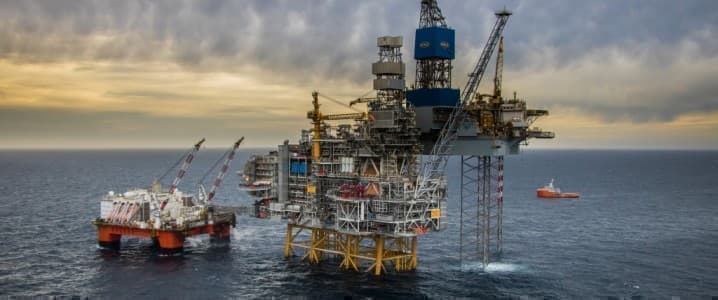
Recently, U.S. President Donald Trump claimed that the UK has 500 years of oil reserves left in the North Sea, and blamed the country’s high energy prices on the government’s unwillingness to drill. However, the unfortunate fact is that the North Sea oil and gas sector has been in a significant and prolonged decline due to the basin’s aging oil fields, with production falling sharply since its peak in the early 2000s. According to the North Sea Transition Authority (NSTA), the UK’s energy regulator, the North Sea had ~2.9 billion barrels of oil equivalent at the end of 2024, suggesting only decades of supply, not hundreds of years as Trump claims.
Indeed, WoodMac has predicted that the current year could be the last time the UK will produce over 1 million boe/d from the North Sea.
The North Sea decline has led to reduced investment, job losses, and increased UK reliance on imports, despite ongoing efforts to manage the energy transition. Meanwhile, high taxes and policy uncertainty, particularly the Energy Profits Levy, have been deterring new projects, accelerating consolidation, and shifting focus towards offshore wind. The UK Energy Profits Levy (EPL) is a temporary “windfall tax” with a headline rate of 78% on exceptional profits on UK oil and gas producers that was introduced in 2022 during the global energy crisis. EPL is set to end by March 2030, but will be replaced by a permanent, revenue-based Oil and Gas Price Mechanism (OGPM) from 2030, applying a 35% charge when prices are high, using thresholds like $90/barrel oil and 90p/therm gas. The EPL has been a point of contention for the industry due to its negative impact on investment.
Related: Geopolitics Override Fundamentals as Oil Extends 2026 Rally
According to a new report by Wood Mackenzie, the North Sea upstream oil and gas sector in 2026 will be shaped by falling investment (particularly in the UK), continued M&A activity, regional divergence in Norway and the UK, ongoing energy transition pressures, and a strong focus on capital discipline as well as improved operational efficiency.
Here are five key North Sea upstream themes to look out for in 2026:
#1. Diverging Investment and Activity Levels
Investment in the North Sea upstream sector is projected to fall overall in 2026, driven by a significant decline in UK investment to less than $3.5 billion, its lowest real terms level since the 1970s. In contrast, Norway will maintain momentum with sustained development spending of around $20 billion, focusing on bringing major projects online quickly to maintain production plateaus and ensure European gas supply security. The UK’s decline is linked to a tough fiscal and regulatory environment, while Norway will benefit from more stable policies and a robust project pipeline.
However, Woodmac has predicted that North Sea production will remain steady at ~5.3 million boe/d despite the spending pullback, thanks to new start-ups in both Norway and the UK. Norway’s production will plateau at around 4.1 million boe/d with Equinor‘s (NYSE:EQNR) Johan Castberg and Var Energi’s Balder re-development accounting for over 50% of this new volume, while new projects will contribute another 500 000 boe/d. Norway is projected to bring six new start-ups online in the current year, with Equinor’s 136 million boe Irpa gas field being a key highlight.
#2. Continued Mergers and Acquisitions (M&A) and Corporate Restructuring
Uncertainty in the market will drive further M&A opportunities, especially in the UK, where consolidation of weaker players will continue. The UK landscape is expected to consolidate as companies with strong balance sheets acquire non-core assets, leveraging tax losses and decommissioning relief. Norway, meanwhile, is expected to see more limited, smaller asset deals. New business models and strategic joint ventures (such as the NEO NEXT+ collaboration) are also emerging as solutions to capital constraints and a way to manage risk and basin exposure.
#3. Intensified Focus on Capital Discipline and Efficiency
Amid expectations of lower oil prices (Brent is forecast to average around $57-$59/bbl) and an oversupplied market, North Sea companies will prioritize capital discipline amid financial constraints. Operators will concentrate investment on high-return, quick-return projects such as brownfield expansions and near-field tie-backs to existing infrastructure. This focus on efficiency is crucial for profitability in a challenging price environment.
#4. Energy Transition and Decarbonization Pressures
The industry remains under intense scrutiny to address climate concerns. Key themes include the mainstreaming of Carbon Capture, Utilisation, and Storage (CCUS) projects and the potential for new policies regarding Scope 3 emissions reporting in Norway following legal challenges. The electrification of offshore operations and integrating renewable energy sources are also gaining traction as companies seek to reduce their carbon footprint and meet environmental, social, and governance (ESG) metrics.
#5. Targeted Exploration, Primarily in Norway
According to WoodMac, exploration activity in the North Sea will be almost exclusively a Norwegian endeavor in 2026, with operators planning to drill over 30 exploration wells. This contrasts sharply with the UK Continental Shelf, which saw no exploration wells drilled in 2025. Norwegian exploration is focused on high-impact prospects with clear paths to development, and appraisal wells on existing discoveries such as Afrodite, Carmen and Norma, which could unlock significant gas supplies for Europe.
By Alex Kimani for Oilprice.com
More Top Reads From Oilprice.com
Oilprice Intelligence brings you the signals before they become front-page news. This is the same expert analysis read by veteran traders and political advisors. Get it free, twice a week, and you’ll always know why the market is moving before everyone else.
You get the geopolitical intelligence, the hidden inventory data, and the market whispers that move billions – and we’ll send you $389 in premium energy intelligence, on us, just for subscribing. Join 400,000+ readers today. Get access immediately by clicking here.