

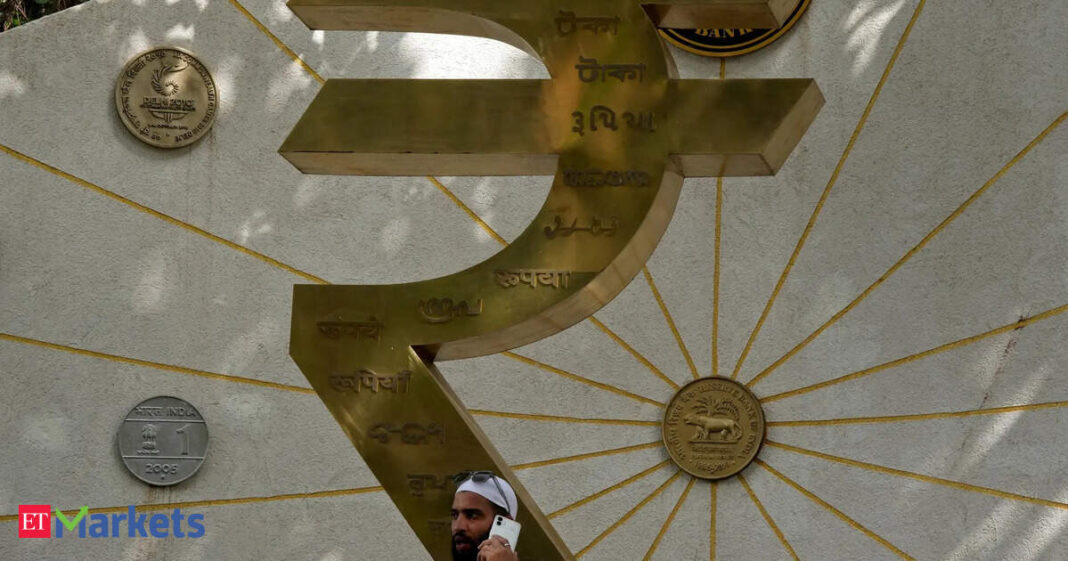

The survey came as the rupee slid to a fresh all-time low of Rs 91.9850 to the dollar, under pressure from persistent foreign outflows and rising hedging demand. Yet the government’s annual stocktake of the economy argued that the currency’s valuation fails to reflect what it described as India’s “stellar economic fundamentals”, even suggesting that “it does not hurt to have an undervalued rupee in these times”.
A strong economy, a weak currency
The survey painted a picture of an economy performing near its best in decades. Growth has accelerated through 2025, inflation is contained, banks are healthy, corporate balance sheets are strong and credit growth remains respectable. External liabilities are low, liquidity conditions are comfortable and policy momentum, the document said, has been reinforced by “policy dynamism and purposeful governance”.
Yet the rupee has underperformed sharply. It is down about 2% so far this year and nearly 5% since the U.S. imposed steep tariffs on Indian merchandise exports in August. The slide has been swift and the currency only broke past the 91-per-dollar mark six trading sessions ago.
The survey acknowledged the contradiction head-on. “The rupee’s valuation does not accurately reflect India’s stellar economic fundamentals,” it said. “In other words, the rupee, therefore, is punching below its weight.”

While an undervalued currency can cushion exporters, especially at a time when higher U.S. tariffs threaten competitiveness, the survey cautioned that persistent weakness also “does cause investors to pause”.
Capital flows and the power gap
At the heart of the problem, the survey argued, is India’s dependence on foreign capital to finance a structural trade deficit in goods. Services exports and remittances, though sizeable, are “not enough to offset it”, leaving the rupee vulnerable when global risk appetite fades.
The document also situates the currency’s troubles in a wider geopolitical and strategic context. It cites the Australia-based Lowy Institute’s Power Gap Index, which shows India operating below its full strategic potential, with a power gap score of -4.0, the lowest in Asia outside Russia and North Korea.“The paradox of 2025 is that India’s strongest macroeconomic performance in decades has collided with a global system that no longer rewards macroeconomic success with currency stability, capital inflows, or strategic insulation,” the survey said.
Global disorder, local resilience
Looking ahead, the survey outlined three global scenarios for 2026, ranging from a fragile continuation of current conditions to a disorderly multipolar breakdown and, at the extreme, a systemic shock cascade worse than the 2008 financial crisis. In all three, India is described as “relatively better off than most other countries” due to its domestic market, foreign exchange reserves and strategic autonomy, but not insulated from capital flow disruptions.
“In a world of geopolitical turbulence, this may not be confined to a year but could be a more enduring feature,” the survey warned, arguing that volatility in capital flows will remain a key risk for the rupee.
The answer, it suggested, lies less in short-term currency management and more in structural change: boosting manufactured exports, integrating deeper into global value chains, improving state capacity and sustaining policy credibility. A “strong and stable currency”, it concludes, “would be a natural corollary of that”.
For now, however, the rupee’s slide underscores the Survey’s central theme, that in a fractured global economy, even strong fundamentals may no longer be enough to keep a currency steady.
(Disclaimer: Recommendations, suggestions, views and opinions given by the experts are their own. These do not represent the views of the Economic Times)


