

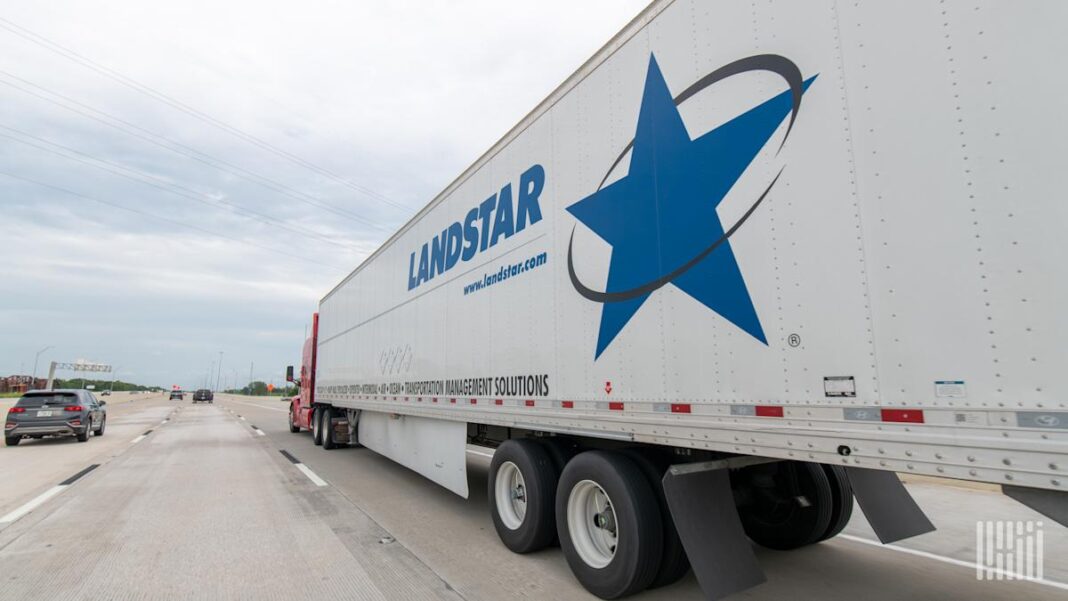

Freight broker Landstar System said strength in flatbed demand largely offset a still soft dry van truckload market during the fourth quarter. However, revenue per load trends outpaced typical seasonality in December and so far in January.
Landstar (NASDAQ: LSTR) reported adjusted fourth-quarter earnings per share of 75 cents after the market closed on Wednesday. The result was 56 cents worse year over year. The number included $22 million (49 cents per share) in unfavorable claims activity from separate tragic vehicular accidents, and $2.1 million (5 cents per share) in noncash impairment charges from its divestiture of Landstar Metro. (The impairment charge was added back to adjusted EPS.)
The company disclosed the items last week and said it plans to appeal a recent post-trial judgement.
Consolidated revenue of $1.17 billion was 3% lower y/y, largely due to a 40% revenue decline in its ocean shipping business.

Truck transportation revenue was flat y/y at $1.08 billion. Load counts fell 1% but revenue per load was up 1%. Strength in flatbed was offset by softer dry van trends. Flatbed revenue increased 11% y/y to $401 million as loads increased 3% and revenue per load jumped 8%.
Total truck revenue per load increased 6% from October to December, due to a reduction in truck capacity, Landstar said. The metric increased 1.5% sequentially in the fourth quarter, which was 50 basis points ahead of normal seasonality.
Landstar noted modest softness in consumer durables revenue (down 2% y/y) along with continued weakness in the automotive (down 7%) and construction (down 3%) verticals. Flatbed demand benefitted from the build out of data centers and decent energy-related revenue (up 6%).
The company’s substitute linehaul revenue was down 15% y/y. Linehaul revenue usually moves notably higher as the market tightens and truck capacity becomes tougher to find.
Revenue generated by business capacity owners (BCOs) increased 2% y/y to $458 million as loads increased 4% and revenue per load fell 2%.
(Landstar’s BCOs are owner operators who haul almost exclusively for the company.)
Trucks provided by BCOs declined 4% y/y to 8,514 units. That was 104 units lower than in the third quarter. The third quarter marked the first sequential increase in BCO truck count since the 2022 first quarter. The BCO truck count previously peaked at 11,935 units.
Retention among the group has improved and truck utilization was 8% higher y/y to nearly 24 loads per truck during the quarter.
Truck counts from BCOs usually increase as the market sees a sustained period of higher TL rates. Landstar expects the BCO fleet to grow in 2026.


