


If you were watching gold prices on Thursday, you probably witnessed one of the wildest moves in precious metals history.
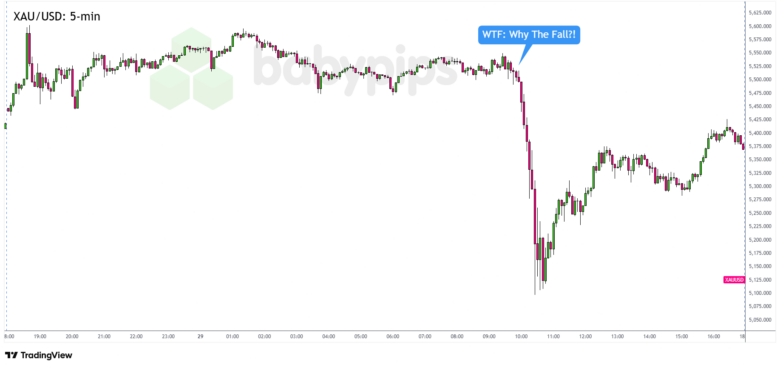
In a single day, gold swung through a massive $500 range—hitting a record high near $5,600 per ounce during the morning before crashing nearly 9% to around $5,100 during U.S. trading hours, then recovering some losses to close near $5,330.
That’s like the S&P 500 dropping 400 points and bouncing back 150 points all in one session!
For a market that’s supposed to be a “safe haven,” it looked more like a thrill ride.
Gold Was Already Running Hot
To understand Thursday’s chaos, you need to know what came before it. Gold had been on an incredible rally through January, up 27% for the month—its best performance since the 1980s. That kind of move is unusual for gold, which typically climbs slowly and steadily during bull markets rather than rocketing higher in a straight line.
The rally was likely driven by several factors:
The U.S. dollar had been weakening, making gold cheaper for buyers using other currencies. Geopolitical tensions with Iran were escalating, driving investors toward safe-haven assets.
And perhaps most importantly, investors were worried about government spending and debt levels—a theme analysts call the “debasement trade,” where people move money out of traditional currencies and bonds into hard assets like gold.
By Thursday morning during Asian trading hours, gold hit $5,594.82 per ounce, a fresh all-time record. Silver, which tends to be even more volatile than gold, rocketed to $121 per ounce.
Everything seemed to be working perfectly for gold bulls. But that’s often when things break.
The Crash: What Went Wrong
The selling started gradually but turned violent when U.S. markets opened. Within hours, gold plummeted nearly $500, erasing $3.4 trillion in total market value. Silver got hammered even worse, dropping almost 12%.

XAU/USD 5-minute Chart Faster with TradingView
So what happened?! Here are possible reasons:
Profit-taking after an unsustainable run. Think about it this way: if you bought gold a month ago, you were sitting on a 27% gain. If you bought a year ago, you were up 83%. At some point, traders start thinking, “maybe I should lock in these profits before they disappear.” When the first wave of sellers hit the market, it triggered automatic sell orders (called stop losses) from other traders, creating a domino effect of selling.
News about the Federal Reserve spooked markets. During U.S. trading, Bloomberg reported that President Trump was preparing to nominate Kevin Warsh as the next Fed Chair. Warsh is known for preferring tighter monetary policy and higher interest rates. Markets reacted by pushing the dollar up 0.5%, and since gold is priced in dollars globally, a stronger dollar makes gold more expensive for buyers outside the U.S., which reduces demand.
Liquidity dried up. In normal markets, when you want to sell something, there are buyers ready to take the other side at a reasonable price. But when volatility explodes and everyone wants to sell at the same time, buyers disappear. Market makers—the firms that usually provide liquidity by always offering to buy or sell—pulled back because the risk was too high. Without enough buyers, prices had to drop dramatically to find anyone willing to step in. That’s what created the “flash crash” feel to the move.
The gold market is moving faster than ever in 2026. Don’t trade on yesterday’s news. Get the real-time feed that professionals use to catch the turn. Join FinancialJuice for Free!
Key Lessons for New Traders
“Safe haven” doesn’t mean “stable price.” Gold is called a safe haven because it tends to hold its value during economic crises and typically moves differently from stocks. But that doesn’t mean the price doesn’t move around—sometimes violently. Thursday’s 8.7% intraday swing proved that even the safest assets can be volatile.
Parabolic rallies don’t last. When you see a chart that looks like a straight line up (what traders call “going parabolic”), that’s actually a warning sign, not an invitation to buy. Those kinds of moves are unsustainable and almost always end with a sharp correction as profit-takers cash out. Thursday was textbook.
Leverage is dangerous. Many traders don’t buy gold directly—they use futures contracts with borrowed money to magnify their gains. This is called leverage, and it’s a double-edged sword. If gold goes up, you make more money. But if it crashes like it did Thursday, you can lose everything and then some. During the selloff, traders using leverage got “margin calls”—their brokers demanded more cash immediately, or they’d close their positions at whatever terrible price the market was at. This forced selling made the crash worse.
The Bottom Line
Despite all that chaos, gold only closed down 1.3% for the day. After that terrifying plunge, it recovered most of the losses and is still on track for its best month in decades. The reasons gold rallied in the first place—dollar weakness, government debt concerns, geopolitical risks—haven’t gone away.
Whether Thursday was just a healthy shakeout of weak hands before gold heads higher, or the start of a bigger pullback, nobody knows. But what we do know is this: markets never move in straight lines. Even gold, the classic safe-haven asset, can turn into a wild ride when the conditions are right.
If you’re thinking about trading gold, make sure you understand the risks, never use more leverage than you can afford to lose, and remember that what goes up fast can come down just as fast.
Interested in fundamental analysis made for newbies and how to pair it up with technical analysis to find high quality opportunities that may match your trading and risk management style? Check out our Premium membership for weekly & event analysis, short-term strategies, recaps and more!


