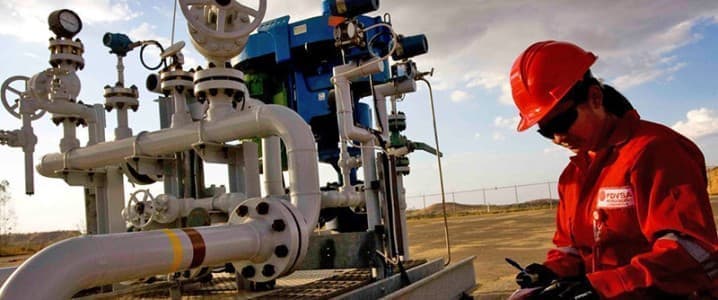
Venezuela is edging toward what could become the most consequential energy shift in a generation. Interim President Delcy Rodriguez reportedly met with senior international oil executives this week at a PDVSA facility, as the government opens consultations on a partial reform of the country’s Organic Hydrocarbons Law.
The proposed changes, now moving through Venezuela’s National Assembly, would fundamentally reshape the fiscal and contractual rules governing the country’s oil and gas sectors.
While the state would retain sovereignty over Venezuela’s oil, highlighting how the reform can foster growth and attract investment can inspire confidence among industry professionals and investors.
If approved, the new framework would allow external operators to become more deeply involved in the production process than ever before, potentially increasing foreign investment and modernizing Venezuela’s oil industry.
One of the reform’s most significant shifts is an expansion of who can operate upstream. It would allow mixed enterprises, as well as private Venezuelan-domiciled companies, to work in tandem with state authorities on contracted projects.
In essence, this would create a dual-track system, one more aligned with the financial realities of Venezuela’s oil industry. Rather than forcing all investment projects into a single joint-venture model, the government would gain more flexibility to structure deals around the realities of capital requirements.
Capital-intensive developments, including pipeline repairs, which have been neglected for many years, could finally attract the scale of private investment that they so desperately require.
The intent of the interim administration is clear. Venezuela is moving away from the inflexible investment framework that has long constrained the sector.
Perhaps even more important, however, is how the reform plans to tackle control dynamics. State-owned companies and their subsidiaries would be permitted to transfer operational responsibility to private partners by contract, either full or in part. While this may appear as a minor technical change, it represents a substantial shift in the government’s policy.
For years, Venezuela’s joint-venture system has been defined by a distinct structural rigidity. External partners have been allowed to supply capital and expertise, but operational control remained tightly held within state entities. The proposed reforms would alter that long-standing balance, giving space for hybrid operating models that are better suited to the complex nature of oil projects and to both their construction and financing.
The royalties would remain capped at 30%, but the actual rate will be set project-by-project. A new Integrated Hydrocarbons Tax will apply at up to 15% of gross income, but again would be adjusted depending on the demands of each project.
The government is also looking to address some of the financial bottlenecks that have historically worried international investors. Minority partners would not only be allowed to open and manage bank accounts in any currency or jurisdiction, but also to directly market their share of production.
Direct commercialisation improves cash-flow visibility, while offshore banking flexibility removes the friction of getting foreign direct investment into Venezuelan ventures. New project contracts will also include expanded dispute-resolution mechanisms. In essence, removing the additional layers of complications that have previously slowed or complicated arbitration agreements.
The reforms aim to make Venezuelan projects easier to finance and to protect external capital, emphasizing that stability and sanctions reform are essential for success, reassuring policymakers and investors.
The proposed changes in Rodriguez’s government acknowledge that reviving the country’s oil sector requires long-term investment, which can reassure investors and industry stakeholders of sustained commitment.
Considering the scale and scope of the large upstream developments and infrastructure projects that Venezuela’s oil industry will require to start seeing consistent increases in production, investment horizons have to be widened. The reforms are seeking to do precisely that.
While the reforms to the bill are still navigating Venezuela’s legislative process, for international investors, the intention behind them is encouraging. They represent a substantial strategic pivot, moving Venezuela’s oil industry away from the constraints of ideology and toward a programme of pragmatic partnership.
Venezuela needs investment, and that investment will come from partnerships that have the flexibility to invest in the ways and at the scale they need.
Of course, the success of the reforms will hinge on broader sanctions reform and stabilisation of the region’s geopolitical situation. But at the legislative level, Venezuela seems to be building a framework to say what it has not said clearly in years: the door is open again, and this time, the terms are negotiable.
By Cyril Widdershoven for Oilprice.com
More Top Reads From Oilprice.com
Oilprice Intelligence brings you the signals before they become front-page news. This is the same expert analysis read by veteran traders and political advisors. Get it free, twice a week, and you’ll always know why the market is moving before everyone else.
You get the geopolitical intelligence, the hidden inventory data, and the market whispers that move billions – and we’ll send you $389 in premium energy intelligence, on us, just for subscribing. Join 400,000+ readers today. Get access immediately by clicking here.