

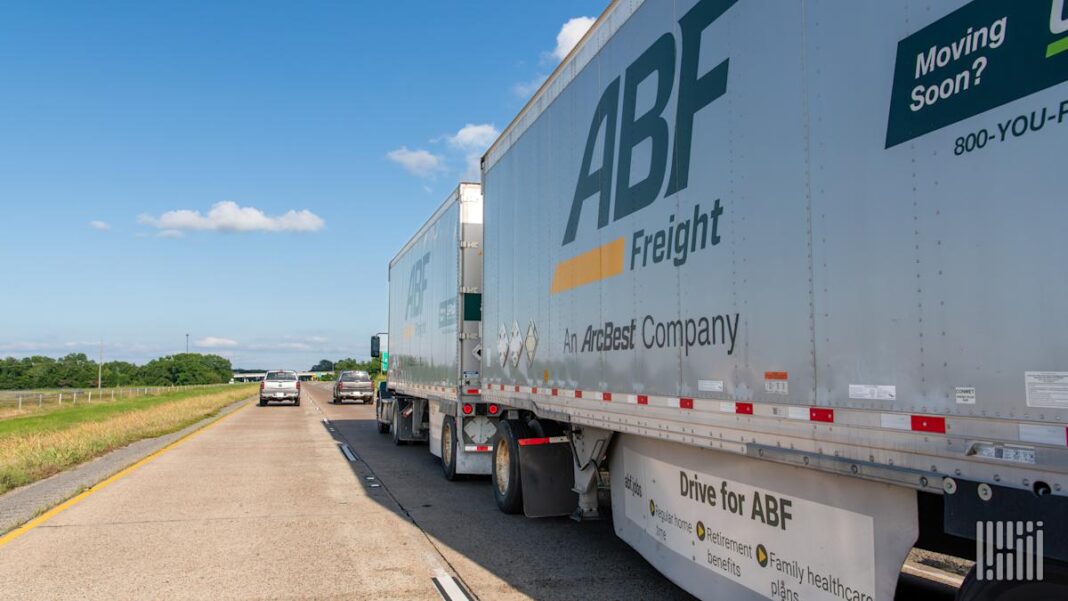

ArcBest is continuing to prep its less-than-truckload network and asset-light business for an eventual recovery. The company is hoping the implementation of better technology tools, along with structural cost takeouts, will amplify returns when demand improves.
ArcBest (NASDAQ: ARCB) reported a fourth-quarter headline net loss of $8.1 million, or 36 cents per share, on Friday ahead of the market open. The number included a noncash impairment charge in its asset-light business and other one-off items. Adjusted EPS of 36 cents in the period was 97 cents worse year over year and 6 cents below the consensus estimate.
Consolidated revenue of $973 million was $6 million ahead of expectations.

The asset-based unit, which includes LTL subsidiary ABF Freight, saw revenue dip 1% y/y to $649 million (revenue per day was down 0.3%). Tonnage per day was up 3% but revenue per hundredweight (yield) was down 3%.
The tonnage increase was driven by a 2.4% increase in daily shipments (to 20,163) and a 0.3% increase in weight per shipment. The higher shipment weights along with a 0.4% decline in length of haul were modest drags on the yield metric.
Wins with new LTL customers that have heavier shipments helped offset lower shipment weights from ABF’s legacy manufacturing customers.
Contract renewals averaged 5% in the quarter, the highest increase in six quarters, and 9.5% higher on a two-year-stacked comparison. Management said bid activity has slowed and that the pricing environment remains “rational.”
Tonnage per day improved on a y/y comparison in each month of the quarter. Tonnage was down 1.2% in October, 3.3% higher in November and 6.7% higher in December. The fourth quarter had a relatively easy comp to the 2024 fourth quarter when tonnage was down 7.3% y/y. However, the prior-year comps get tougher starting in February (negative-2%), turning positive in April (plus-3.6%).
Revenue per day in January was flat y/y as an 8% tonnage increase (on a negative-9.2% comp) was offset by an 8% decline in yield. The mix included more dynamically priced truckload shipments versus January 2025, which pushed weight per shipment 5% higher and dragged the yield result lower. Weakness in the manufacturing and housing sectors has forced the company to take on noncore LTL freight to keep the network full. First-quarter tonnage is expected to increase by roughly 4% to 5% y/y.
The unit posted a 96.2% adjusted operating ratio (inverse of operating margin), which was 420 basis points worse y/y and 370 bps worse than the third quarter. The sequential change was slightly better than management’s guidance, which called for 400 bps of degradation. The unit normally sees just 100 to 200 bps of sequential margin deterioration in the fourth quarter, but weaker demand led to the outsized decline. Also, inclement weather was an overhang and the fourth quarter had three fewer work days than the third quarter.


