

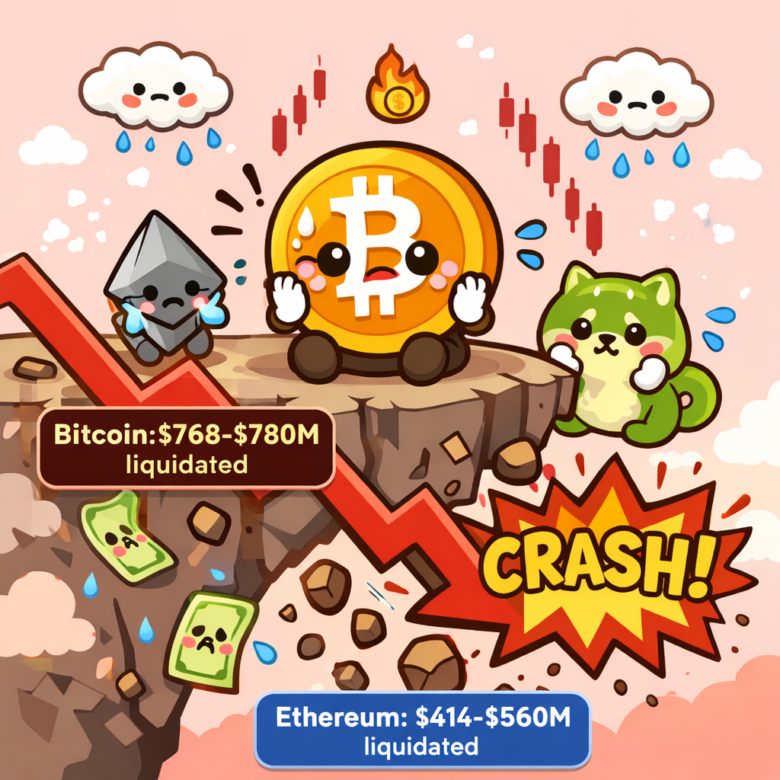

When it comes to describing the crypto market selloff lately, “bloodbath” seems to be a mild way of putting it.
Bitcoin dropped from around $94,000 to briefly touch $76,000 in just days, chalking up a nearly $10,000 nosedive in 24 hours at one point. Ethereum crashed below $3,000 to around $2,400. Over $1.75 billion in leveraged positions got wiped out, with $777 million liquidated in a single hour.
Welcome to crypto’s textbook lesson on how leverage amplifies losses in volatile markets. This wasn’t just a price drop, it was a cascade of forced selling that turned a correction into a full-blown meltdown.
The Basics: Timeline of the Crash

Bitcoin (BTC/USD) 1-hour – Chart Faster with TradingView
Last week, bitcoin experienced one of its sharpest declines since the October 2025 liquidation selloff. Here’s how it unfolded:
Wednesday, January 29: Bitcoin was trading around $94,000 when it started sliding. The drop accelerated as it broke below $85,000, which is a key support level that had held since mid-November 2025.
Thursday, January 30: The selling intensified. Bitcoin plunged to $81,000, then briefly touched $78,479 before recovering slightly. In one four-hour period alone, over $1.5 billion in leveraged long positions were liquidated.
Friday-Saturday, January 31-February 1: In thin weekend trading, Bitcoin fell as low as $75,644 or its lowest price since Trump’s April 2025 tariffs. By Monday, it had stabilized around $77,000-$82,000.
The Market Damage
The carnage wasn’t limited to Bitcoin:
- Ethereum: Dropped 12% to around $2,395, falling below $3,000 for the first time in months
- Solana: Down 11-14% to around $103
- XRP: Fell 10-11% to $1.56
- Total market cap: Lost over $110 billion in 24 hours, dropping to $2.73 trillion
According to CoinGlass data, approximately $1.68-$1.75 billion in leveraged positions were liquidated in 24 hours:
- Bitcoin: $768-$780 million liquidated
- Ethereum: $414-$560 million liquidated
- Long positions: Made up 93% of liquidations (about $1.57 billion)
- Traders affected: Over 270,000 accounts liquidated

The single largest liquidation was a $13.38 million Ethereum position on Hyperliquid.
Why It Matters: The Perfect Storm
This event wasn’t random. Multiple factors converged to create a selling cascade:
1. Leverage Got Out of Control
Many traders had borrowed money to amplify their Bitcoin bets. When prices started falling, their positions hit “liquidation levels” a.k.a. the point where exchanges automatically sell everything to cover the borrowed funds. This forced selling pushed prices lower, triggering more liquidations in a vicious cycle.
2. The $85,000 Dam Broke
Bitcoin had bounced off $85,000 multiple times since November. When it finally cracked below that level, it confirmed to technical traders that the market structure had shifted. Technical traders rushed to sell, and algorithms kicked in to close positions.
Why Deeper Liquidity is Your Best Defense in a Cascade Body: When the $85,000 support cracked, the “exits got crowded fast”. In high-volatility events, execution matters most. Coinbase provides the deep liquidity needed for tighter spreads and reliable execution when every second counts. Join over 100 million users on the most trusted public crypto exchange in the U.S. Learn more at Coinbase!
Disclosure: To help support our free daily content, we may earn a commission from our partners if you sign up though our links, at no extra cost to you.
3. Macro Uncertainty Returned
Several macro headwinds hit at once:
- Fed staying hawkish: Jerome Powell signaled only one more rate cut likely in 2026, keeping borrowing costs high
- Tariff threats: Trump threatened 10% tariffs on European allies over Greenland negotiations
- Government shutdown: A partial U.S. government shutdown added political uncertainty
- Iran tensions: Geopolitical risks from Middle East explosions spooked risk assets
4. Bitcoin Acted Like a “Risk-On” Asset
This is crucial for beginners to understand: Bitcoin often acts like a high-risk tech stock, not digital gold. When uncertainty rises, investors sell risky assets first. In January, Bitcoin fell while gold surged 6% to record highs above $5,400. The correlation between Bitcoin and the S&P 500 hit 0.88 in early 2025, which suggests they move together.
5. Spot Bitcoin ETF Outflows
Institutional investors pulled $681 million from spot Bitcoin ETFs in the week before the crash. This removed crucial buying support just as selling pressure intensified.
Key Lessons for Traders
1. Leverage can kill
The $1.75 billion liquidation showed how borrowed money turns dips into disasters. If you’re trading with 10x leverage, a 10% price drop wipes you out completely. Many traders used 20x, 50x, or even 100x leverage.
Why it matters: You can be right about direction but still get liquidated if you use too much leverage. The market doesn’t move in straight lines.
Application: If you must use leverage, keep it low (2x-3x max) and use stop-losses that account for Bitcoin’s normal volatility. Better yet, trade with money you actually have.
2. Support levels aren’t guaranteed
The $85,000 level had held multiple times since November, so traders assumed it was “strong support.” When it broke, panic set in.
Why it matters: Just because something worked before doesn’t mean it works forever. Markets evolve, and old support levels become new resistance.
Application: Don’t bet the farm on any single technical level. Have a plan for what happens if support breaks.
3. Thin liquidity amplifies moves
The worst drops happened during Asian trading hours and weekends when fewer traders were active. With less liquidity, prices swing more violently on the same selling pressure.
Why it matters: Weekend crypto crashes are common because there’s less money ready to buy the dip.
Application: Be extra cautious holding leveraged positions into weekends. Consider taking profits or reducing size before low-liquidity periods.
4. Bitcoin is usually a risk asset, not a safe haven
Despite the “digital gold” narrative, Bitcoin sold off while actual gold hit all-time highs. When macro uncertainty rises (hawkish Fed, tariff wars, geopolitical tensions), Bitcoin gets hit alongside tech stocks.
Why it matters: If you’re buying Bitcoin to hedge against uncertainty, understand that it often doesn’t work that way, at least not yet.
Application: Don’t treat Bitcoin as your only hedge. Consider how it correlates with your other holdings, especially tech stocks.
5. Cascades feed on themselves
Once Bitcoin broke $85,000, algorithmic trading and forced liquidations created a feedback loop. Lower prices triggered more selling, which pushed prices even lower.
Why it matters: In crypto, moves can be much more extreme than fundamentals suggest because of leverage and thin liquidity.
Application: When you see a cascade starting (huge liquidations, broken support), sometimes the best trade is no trade. Let the dust settle.
The Bottom Line
Bitcoin’s $10,000 crash in 24 hours wasn’t about fundamentals changing overnight. It was about market structure breaking down. Excessive leverage met broken technical support, thin liquidity, and macro headwinds. The result? A liquidation cascade that amplified a correction into a rout.
What to watch going forward:
- Key Support: Bitcoin is currently hovering around $77,000-$82,000 area, nearly testing the strong $81,000 support level that aligns with the average cost basis for many holders. If this breaks, the next major support sits around $74,000-$75,000 (April 2025 lows).
- Key Resistance: The $90,000 level is now formidable resistance. Bitcoin needs to reclaim and hold above $90,000 to signal the worst is over. Beyond that, $94,000-$100,000 represents a bullish recovery.
- Upcoming catalysts: Fed meetings in March and May, tariff developments, and whether spot Bitcoin ETF inflows resume will determine the next major move.
In financial markets, leverage is a double-edged sword that cuts twice as deep on the downside. The same 10x leverage that can double your money on a 10% rise will completely wipe you out on a 10% fall. When everyone’s leveraged long and a key support breaks, the exits get crowded fast.
Over 270,000 traders learned this lesson the hard way. The market doesn’t care about your conviction or your entry price. It only cares about your liquidation level. So only trade with money you can afford to lose, use minimal leverage (or none), and always have a plan for when things go wrong.
Interested in fundamental analysis made for newbies and how to pair it up with technical analysis to find high quality opportunities that may match your trading and risk management style? Check out our Premium membership for weekly & event analysis, short-term strategies, recaps and more!


