

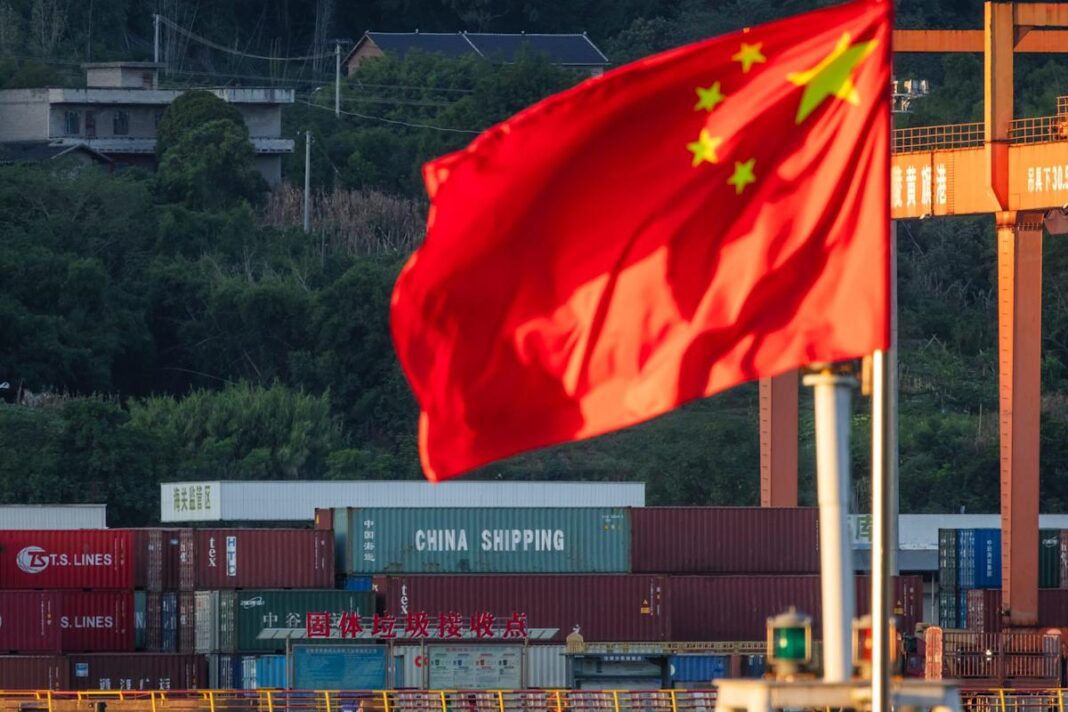

The flood of Chinese exports around the world helped the economy blow past President Donald Trump’s massive tariff hikes, while Beijing touts successes in AI, EVs, robotics and other emerging technologies.
But that strength masks ongoing weakness among consumers and the property sector.
China’s trade surplus jumped 20% to $1.19 trillion in 2025, marking the world’s largest ever, as shipments surged to the European Union, Africa, Latin America and Southeast Asia.
Exports climbed 5.5% and accounted for a third of economic growth in 2025, the highest level since 1997. Imports were virtually flat, reflecting weak domestic demand and Beijing’s push to become more self-sufficient.
The record trade surplus helped GDP grow 5% last year, matching the government’s target, but the headline figure contrasted with mounting signs of broad weakness.
Growth actually slowed toward the end of the year, with GDP up 4.5% in the fourth quarter on an annual basis versus a 4.8% gain in the third quarter.
Retail sales in December inched up just 0.9%, down from 2.9% growth in October and 6.4% in May. Investment in fixed assets reversed sharply into an outright decline, collapsing 15% in December after spiking 15.7% in February.
In fact, fixed-asset investment saw its first annual drop in data going back almost three decades. That’s largely due to China’s real estate crash, which sent property investment down 17.2% last year and offset heavy spending on high-tech industries that Beijing is trying to advance.
Fitch Ratings expects China’s economy to run out of steam this year, predicting GDP growth will cool sharply to 4.1% from 5% in 2025.
“We believe domestic demand will remain constrained by sluggish consumer confidence, deflationary pressures, and investment headwinds that have broadened beyond the property-sector correction and are amplified by the local-government debt overhang,” it said in a report on Jan. 22.

But more than four years since China popped a construction bubble, about 80 million unsold or vacant homes continue to weigh on sales, prices, starts and completions.
After tinkering with attempts to revive the property sector, China has signaled it’s pivoting to a new model of development, away from the emphasis on debt-fueled investment.
“This marks the virtual abandonment of an industry that once accounted for about one-quarter of China’s gross domestic product and roughly 15% of the nonfarm workforce,” Jeremy Mark, an Atlantic Council scholar and former IMF official, wrote on Wednesday.
Many other economic problems—such as weak retail spending, deflation, as well as low consumer and business confidence—can be traced back to the free-fall in real estate, which is the main repository of life savings for hundreds of millions of households, he pointed out.


