

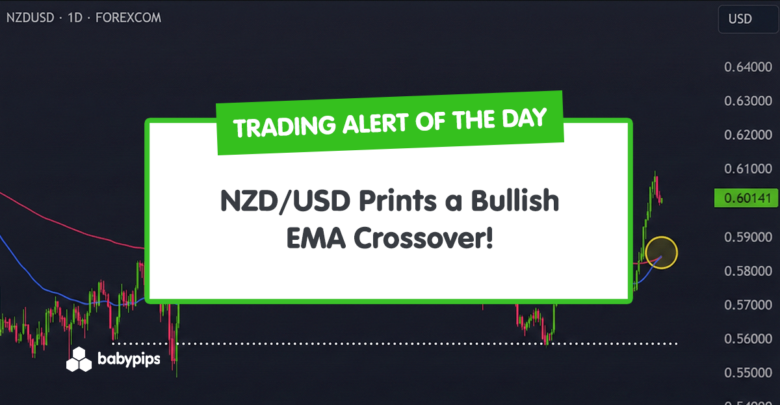

NZD/USD has just printed a classic longer-term trend signal that many traders watch closely .
Even though today’s price action shows a pullback and the immediate candle may look hesitant, its moving averages are pointing to potential underlying strength and a shift in how the medium-term trend is developing.
Welcome to “TA Alert of the Day.” Each day after the market close, MarketMilk scans for popular technical indicator alerts. We use these alerts as the basis for a mini-lesson, breaking down what each alert means, why it matters, and how traders might interpret it. The goal is to help beginner traders not only spot these alerts but also understand the logic behind them and how they can inform trading decisions.
What MarketMilk Has Detected

MarketMilk detected a 50-day EMA crossing above the 200-day EMA on the daily chart, as the relationship flipped from the prior close (50 EMA below 200 EMA) to the current close (50 EMA above 200 EMA).
This crossover occurred with both averages clustered near 0.5834, reflecting a gradual improvement in intermediate trend conditions after weeks of basing.
Price action has improved meaningfully over the past several weeks.
Price reclaimed the 50-day SMA first, then pushed through the 200-day SMA near 0.585–0.588 with an expanding range and momentum, signaling that conditions have flipped in favor of the bulls
The latest close sits just below that recent swing zone, with nearby support suggested around 0.600 and deeper support around 0.592–0.595 (the prior breakout area).
What This Signals
Traditionally, a 50/200 EMA bullish crossover (often called a “golden cross”) suggests that medium-term trend strength is improving relative to the longer-term baseline.
If the move is sustained, it can attract trend-followers because it often marks a transition from a sideways-to-bullish phase into a more persistent uptrend structure.
However, this same pattern can also represent a lagging confirmation that arrives after a sizeable advance, particularly relevant here given the strong January push from the 0.57s into the 0.60–0.61 region.
In those cases, prices sometimes coincide with consolidation or a pullback after the signal, where a break back under key supports can turn the crossover into a whipsaw.
The outcome depends heavily on follow-through price action, the market’s ability to hold recent breakout areas (around 0.592–0.595), and whether momentum remains constructive as NZD/USD reacts to macro drivers like rate expectations and risk sentiment.
How It Works
The 50 EMA tracks the average closing price over roughly the last 50 sessions, while the 200 EMA reflects a longer-term baseline over about 200 sessions.
A bullish crossover occurs when the shorter EMA rises above the longer EMA, indicating that more recent prices are, on average, strengthening relative to the longer-term trend.
Important: Moving-average crossovers are inherently lagging. They tend to work best when a market is transitioning into (or already in) a sustained trend, and they are more prone to false signals when price is range-bound or repeatedly mean-reverting around the averages.
What to Look For Before Acting
Do not assume this crossover guarantees a sustained rally. Consider these factors:
✅ Whether NZD/USD can reclaim and hold the 0.600 handle after today’s dip
✅ A daily close back above the recent supply zone near 0.605–0.609 (prior swing highs)
✅ Evidence the former breakout area around 0.592–0.595 holds as support on retests
✅ The slope of the 50 EMA: a crossover with a rising 50 EMA tends to be more constructive than a flat one
✅ Reduced “chop” around the two EMAs (fewer closes whipping back and forth near ~0.583)
✅ Alignment on a higher timeframe (e.g., check the Weekly chart for trend structure and key levels)
✅ Confirmation from correlated/risk-sensitive markets (e.g., broad USD tone, risk-on/risk-off shifts)
✅ Upcoming catalysts (RBNZ/Fed expectations, key inflation/employment releases) that could increase volatility and invalidate technical levels
Risk Considerations
⚠️ Whipsaw risk: crossovers can fail quickly if price returns to a range and mean-reverts around the EMAs
⚠️ Late signal risk: the crossover may be confirming a move that has already traveled significantly (post-rally consolidation is common)
⚠️ Breakout failure: a drop back below 0.592–0.595 could undermine the bullish structure despite the crossover
⚠️ Event-driven volatility: FX can spike on data/central-bank surprises, overpowering EMA-based signals
Potential Next Steps
Add NZD/USD to a watchlist and monitor whether price can stabilize above 0.600 and defend 0.592–0.595 on any pullback.
Traders who require confirmation may prefer to wait for a renewed daily close above 0.605–0.609 or for a clean support retest before treating the crossover as actionable.
If trading, consider defining risk around nearby structural levels rather than relying on the crossover alone, since moving averages can be slow to reflect sudden reversals.
Trade Idea
Setup:
Buy NZDUSD on a pullback into the level that flipped from resistance to support after the breakout.
Entry:
Stand aside and wait for NZDUSD to pull back into the 0.580–0.5850 zone, where former resistance and the 200-day SMA converge.
Look for stabilization through tight daily ranges, a higher low, or a clear bullish reversal candle.
Enter long once price confirms support by turning back higher from this area.
Stop Loss:
Place the stop on a daily close below 0.5750. If the price loses this level, it signals a failed breakout and a likely return to the prior trading range.
Take Profit:
Target the recent swing high near 0.6100–0.6150 as the first take-profit zone.
If price consolidates above that level, trail stops and look for extension toward the 0.6200–0.6250 area.
This content is strictly for informational purposes only and does not constitute as investment advice. Trading any financial market involves risk. Please read our Risk Disclosure to make sure you understand the risks involved.


