Key Takeaways
-
Tokenized finance is no longer a technical experiment but an early-stage infrastructure shift.
-
Institutions that engage early gain influence over future standards for custody, compliance, and interoperability.
-
The long-term winners will be platforms that combine regulatory trust, cross-chain connectivity, and seamless user experience.
Tokenization is no longer a question of if. It’s a question of who.
Across Wall Street, crypto, and global finance, traditional assets—from U.S. Treasuries and private credit to equities and funds are increasingly being issued as blockchain-based tokens.
These tokens can settle instantly, move globally, and embed rules for ownership, compliance, and payments directly into code.
The technology largely works. The missing piece is adoption.
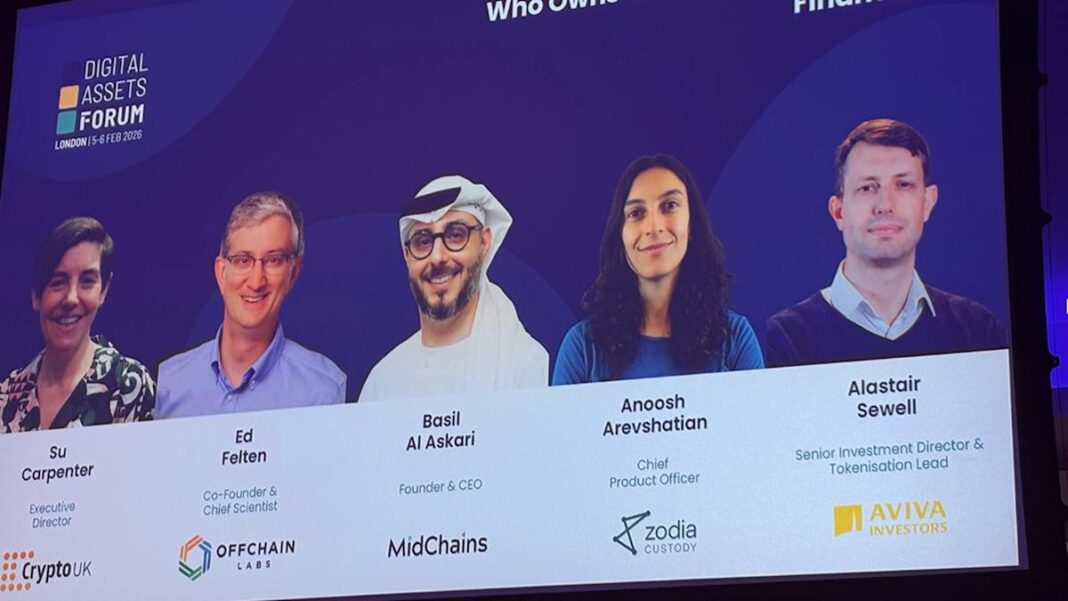
That tension, between proven legacy systems and emerging infrastructure, sat at the center of a recent panel on tokenized finance at the Digital Assets Forum in London.
And it boiled down to one unresolved question: Who will own the rails of tokenized finance when it goes mainstream?
Tokenization refers to representing real-world financial assets as on-chain tokens rather than entries in siloed databases maintained by custodians, clearinghouses, and settlement agents.
In theory, this replaces slow, fragmented processes with shared infrastructure that operates continuously and globally.
In practice, most of today’s financial system still runs on rails built decades ago.
Those rails, clearinghouses like DTCC, messaging systems like SWIFT, and layers of custodians and intermediaries, process trillions of dollars every day.
They are reliable, regulated, and deeply entrenched. By comparison, tokenized systems can look messy.
Liquidity is fragmented across blockchains. Standards are still evolving. Governance remains unclear.
From the outside, it’s easy to dismiss tokenization as unfinished. But history suggests that’s exactly how disruptive infrastructure begins.
This is a textbook case of the innovator’s dilemma: established systems delay engagement with new technology because it initially looks worse than what already works — even when it points to a superior long-term outcome.
Tokenized finance now sits in that uncomfortable early phase.
Ed Felten, co-founder and chief scientist at Offchain Labs, framed the issue as one of optionality and influence rather than short-term performance.
He argued that early participation isn’t about betting everything on one chain or model. It’s about ensuring a seat at the table if tokenized rails eventually become foundational.
Being early, he said, creates two advantages: the ability to benefit economically if the system succeeds, and the ability to shape how it evolves — technically, commercially, and regulatorily.
Waiting until the infrastructure is “perfect” risks forfeiting both.
No one can say with certainty how tokenized finance will ultimately look.
It’s unclear which blockchains will dominate, how standards will converge, or which custody and compliance models regulators will endorse.
That uncertainty makes institutions hesitant. But that uncertainty is also the opportunity.
Early exposure allows banks, asset managers, and regulators to learn by doing—testing tokenized settlement, experimenting with on-chain funds, and influencing standards as they form.
Those who wait may find themselves forced to integrate systems designed without their input.
History offers plenty of parallels. Firms that delayed engagement with electronic trading, cloud computing, or mobile infrastructure didn’t avoid risk—they inherited rules written by others.
Owning the rails of tokenized finance isn’t just about technology. It’s about governance.
Three questions will determine which systems endure:
-
Who defines compliance? Tokenized assets must satisfy KYC, AML, and investor protection rules across jurisdictions.
-
Who controls custody and settlement? Whether assets are held by banks, protocols, or hybrids will shape trust and scale.
-
Who enables interoperability? Without seamless movement across chains and institutions, tokenization remains fragmented.
Rails that regulators trust and institutions can connect to will win. Everything else risks becoming a side experiment.
Anoosh Arevshatian, Chief Product Officer at Zodia Custody, described a long-term vision where tokenized finance fades into the background.
In that future, infrastructure becomes redundant, resilient, and interconnected. Liquidity routes automatically around failures.
Users interact with outcomes — settlement, payments, ownership — not plumbing.
But she stressed that abstraction only works if compliance keeps pace.
As systems become more interconnected, identity and oversight cannot remain optional or fragmented.
Know-your-customer (KYC) frameworks must travel with assets across chains and jurisdictions. Without that alignment, complexity overwhelms the system.
In other words, tokenization doesn’t eliminate regulation—it demands better coordination.
Tokenization has moved beyond ideology. Major financial institutions are already experimenting with tokenized funds, on-chain settlement, and blockchain-based collateral.
BlackRock, JPMorgan, and others are testing pieces of this future today.
The open question isn’t whether tokenized rails will improve. They will.
The question is who participates early enough to influence how they are built.
History shows that waiting for certainty often means accepting someone else’s rules.
In tokenized finance, control will belong to those who engage while the system is still forming—not after it hardens.
The rails are being laid now. The only unanswered question is who will end up owning them.
The post Who Will Control the Rails of Tokenized Finance? Inside the Fight To Shape Wall Street’s Next Infrastructure appeared first on ccn.com.