


Unlock the Editor’s Digest for free
Roula Khalaf, Editor of the FT, selects her favourite stories in this weekly newsletter.
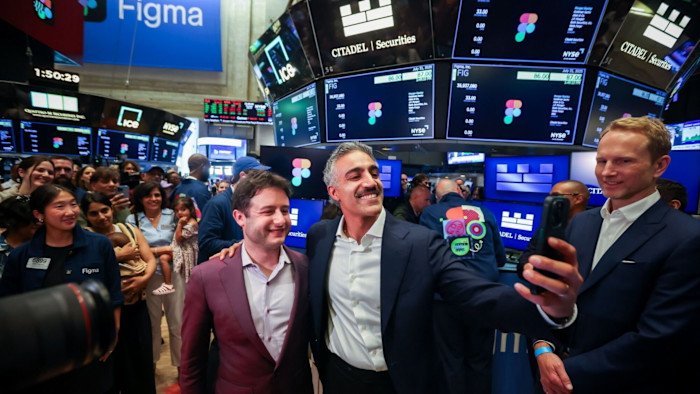
Last summer, Figma’s wildly successful flotation caused one of those furores that periodically flares up over the process of ‘initial public offerings’.
The design software company had gone public at $33 but the stock opened at $115.50, prompting critics like Bill Gurley to howl that the underwriters had left billions on the table through incompetence — or worse. FT Alphaville took the other side, and argued that the anger was both overblown and misdirected.
Today, Figma shares trade at around $22. The six-month lock-up on pre-IPO shareholders expired late last week. So who wuz really robbed here?

The reversal of fortune is a reminder that IPO pricing remains more art than science.
For one thing, underwriters must read the runes of order books riddled with demand inflation and opaque investor intentions. They don’t know how many shares investors really want, or how long they will hold on to them. Often, the investors themselves don’t even know, or they’re liable to change their mind.
The challenge is compounded by the tiny free float typical of tech IPOs. Figma sold just 7 per cent of the share capital, ensuring that any mismatch between supply and demand would translate into dramatic swings.
The problems don’t end there. IPO valuations themselves are driven by assumptions about future performance, often informed by underwriter research analysts working from company guidance. When results miss or exceed expectations, the stock moves, sometimes violently. In retrospect, the IPO price looks either prescient or foolish, depending on how actual performance compares with what the market expected.
Which brings us to the fundamental question: what is the right timeframe for judging an IPO’s success? One day? One month? One year? One decade? Critics who seized on Figma’s first-day pop implicitly chose day one as their benchmark. Today’s price suggests the offering was overpriced by around 50 per cent.
Neither assessment captures the full picture.
Facebook offers a useful case study. Its shares fell more than 50 per cent in the months following its 2012 IPO at $38, and investors and the plaintiffs bar accused Facebook and the underwriters of overhyping the company’s prospects. Today, the stock trades at around $670. With the benefit of hindsight, where, exactly, should that IPO have been priced?

The knee-jerk assumption that sophisticated venture capital firms were somehow duped by investment banks also gets the power dynamics backwards. Figma’s owners — Index Ventures, Greylock Partners, Kleiner Perkins and Sequoia Capital — aren’t wide-eyed rubes. They boss around the banks; not the other way around.
Presumably these VCs had good reasons to accept a $33 price at the time of the IPO. These investors retained over 200mn shares after the IPO, and so they may have had strategic considerations extending well beyond maximising proceeds on day one. They may have believed that a strong debut would generate momentum, attract talent, and support business development.
The most an IPO lead manager can realistically do is present the company honestly, conduct proper due diligence, provide realistic guidance, engage the right investors, and allocate stock to long-term holders while preserving after-market liquidity — in short, act as an honest broker.
Persuading everyone of that, however, is nearly impossible. With competing objectives and imperfect information, there will always be disappointed parties convinced the price was too high or too low, or that they received too many or too few shares. And these parties can often be very, very loud.
Could you argue that Figma was underpriced based on its first-day pop? Of course. Could you argue it was overpriced given where the shares trade today? You betcha. Or you could acknowledge that in setting the price with the VC firms, the underwriters faced conflicting pressures, a tiny free float, a 40-times oversubscribed order book, and febrile retail buying in the after-market that made price-setting a tricky business.
The traditional IPO process has flaws. But the alternative models have not proved superior. Dutch auctions struggle with price discovery. Direct listings work only for household names and often produce volatile debuts. SPACs have performed dismally.
The conventional book-build persists not because of some nefarious or rent-seeking Wall Street cartel but because it strikes a workable balance among many competing interests.
Bill Gurley has suggested tokenisation, tweeting: “Zero chance anyone in crypto would fail to use an auction to price something”. Sure, go for it. But nothing has stopped the smartest, most crypto-philiac venture capitalist firms from trying out these ideas — and conspicuously they have not.
As we wrote last August:
In short, Figma’s backers likely understood the trade-offs and chose to accept them. Until someone builds a better system, these first-day pops will occasionally happen.
Figma’s trajectory from $33 to $115 to $22 vindicates neither the critics nor the underwriters. It demonstrates how challenging it is to price an IPO, how quickly market enthusiasm can evaporate, and why Chinese premier Zhou En-lai’s famous assessment of the French Revolution (“too early to say”) applies just as well to IPOs.


