

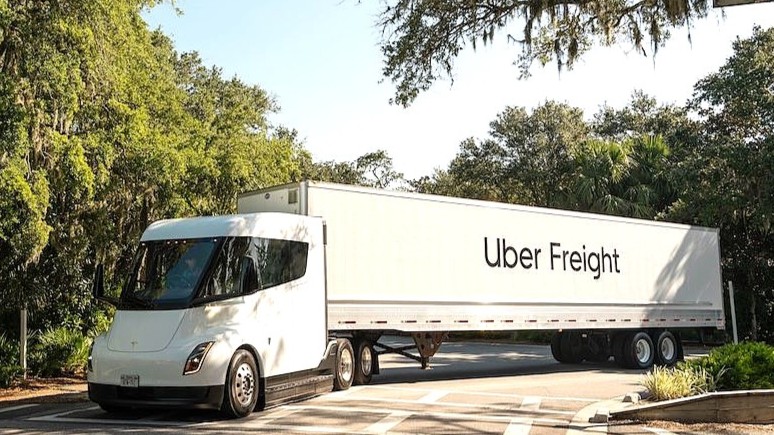

Uber Freight underperformed compared to the company’s mobility and delivery segments in the fourth quarter, posting flat revenue and slightly lower gross bookings amid a prolonged downturn in the North American trucking market, even as the broader platform delivered record profitability.
Uber Freight generated $1.27 billion in gross bookings, down about 1% year over year, while freight revenue was essentially flat at $1.27 billion for the three months ended Dec. 31.
The company released its quarterly financial report and held a conference call with analysts on Tuesday before the market opened.
Despite the dip in gross bookings, Uber officials said the freight business reached breakeven profitability during the quarter for the first time in more than three years.
“Our freight business achieved breakeven adjusted EBITDA for the first time in over three years despite a continued challenging operating backdrop,” Chief Financial Officer Prashanth Mahendra-Rajah said.
He attributed the improvement to operational discipline rather than stronger pricing, signaling that carriers may continue to face rate pressure in early 2026, while shippers retain leverage in contract negotiations amid abundant capacity.
San Francisco-based Uber Technologies (NYSE: UBER) operates three platforms: Uber (ride-hailing), Uber Freight (logistics), and Uber Eats (food and goods delivery).
Uber’s overall platform delivered a record quarter. Total gross bookings climbed 22% year over year to $54.1 billion, driven by double-digit growth in both mobility and delivery, while adjusted EBITDA surged 35% to $2.5 billion.
While freight demand remains under pressure today, Uber executives pointed to autonomous vehicles as a longer-term lever that could reshape the freight unit’s economics.
Chief Executive Officer Dara Khosrowshahi said autonomous vehicles represent a significant growth opportunity that could ultimately strengthen its freight and logistics business by driving much higher vehicle utilization.


