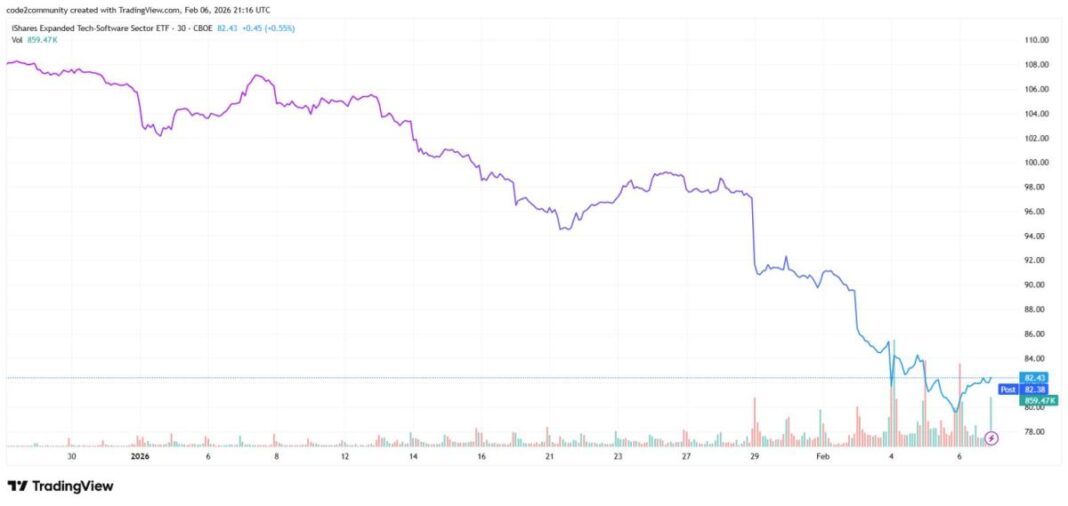
Software stocks are facing an increasingly loud reckoning as Wall Street rethinks how artificial intelligence affects the sector.
Goldman Sachs is the latest to offer a reality check, suggesting that software’s reckoning may not yet be over, even as short-term selling appears overdone and some investors are going bargain-basement buying, including Bank of America.
In a research note shared with me, Goldman Sachs’ analysts said Wall Street investors are morphing from AI‘s unlimited opportunity to a ‘show me the money’ style mindset.
It’s a big and potentially grim shift for the software industry and shareholders.
Where the rubber will hit the proverbial road will be in what happens next to revenue and earnings growth; software stocks in particular may see a major re-rating of revenue and profit estimates as they come under the crosshairs of agentic AI.
Having had a front-row seat to the Internet Boom and Bust and paying sizable tuition in the process, I’ve seen shifts like this before. When markets sour on high-valuation stocks, the reset can be long and painful. But it doesn’t happen in a straight line.
Here’s why Goldman Sachs says software stocks are under the gun, and why Bank of America thinks investors should consider four software stocks that are oversold.
Software stocks rallied for years on growing adoption of cloud and hybrid networks, requiring solutions that could work across siloes, and a shift to subscription models that provided repeat high-margin revenue predictability.
The rise of AI is challenging the notion that enterprises and government need to rely upon many specialized software vendors.
Agentic AI is reshaping Wall Street’s outlook for the software industry.A ·A
Agentic AI apps are rapidly evolving, and many argue that they’ll eventually replace many programmers, allowing enterprises more flexibility to create and manage their own software solutions internally.
The “SaaS Apocalypse”: Software-as-a-Service (SaaS) historically relies on human interaction with interfaces (UIs). If AI agents perform tasks via API or background processes, the advantages of expensive front-end software subscriptions vanish.
Commoditization of Features: AI agents can “stitch together” simple tools to solve complex problems, eroding the high-value “moats” of specialized software companies.
Shift to “Results-as-a-Service”: If an agent completes a task in seconds that used to take humans hours, companies can no longer justify charging based on “user access” and “per seat” licensing.
Goldman Sachs views these risks as a potential existential crisis that could cause Wall Street to rethink paying up for its own software stocks.
“Proximate catalysts for the latest leg of the sell-off include Anthropic’s release of plug-ins for its Claude Cowork tool as well as the release of Google’s Genie 3 model,” wrote Goldman Sachs analysts in a note shared with TheStreet.
“In recent conversations, investors have focused both on incremental downside risk to Software profit growth as well as existential risk to the industry.”
Two of the most common ways to value software stocks are the price-to-sales ratio and price-to-earnings ratio. Both have retreated substantially during the sell-off as revenue and profit expectations have remained largely unchanged.
More Wall Street
“The Software price/sales ratio has declined from 9x in September 2025 to 6x currently,” wrote Goldman Sachs. “Despite this decline, the industry trades at a 260% premium to the equal-weight S&P 500, in line with the historical average.”
The price-to-sales ratio doesn’t suggest software is necessarily cheap. However, P/E ratios may indicate opportunity, assuming Wall Street’s forward consensus estimates don’t tank.
“The forward P/E multiple for software has declined from 35x in late 2025 to 20x currently, representing the lowest absolute level since 2014 and the smallest premium to the average S&P 500 stock since 2010,” said the analysts.
At 20 times forward earnings, the software sector is at its cheapest level in over a decade.
According to Goldman Sachs, the current forward P/E multiple is more in line with companies growing 5% to 10% annually, while the industry’s P/E multiple of 36 last September suggested 15% to 20% growth.
This suggests a major disconnect for investors. Either sales and profit estimates are going to fall substantially, or these stocks are underpricing potential growth.
The retreat has been fast and relentless, and in my experience, stocks don’t move in a straight line up or down for long.
It’s likely that, regardless of the ultimate outcome of AI’s threat to the industry and IT budgets, investors will start dipping their toes into best-in-breed software stocks that may have been incorrectly caught up in the rout, especially since many institutional managers may have already exited.
“Our analysts also see opportunities in some of the stocks caught up in the recent sell-off,” wrote Goldman Sachs. “From a positioning perspective, both hedge funds and mutual funds have recently cut their exposures to Software… mutual funds entered 2026 underweight the industry.”
“We expect investors will hunt for the proverbial babies thrown out with the bathwater,” said Goldman Sachs.
What stocks could be in line to see a rally first?
Bank of America called out four stocks that it thinks will rally:
Snowflake (SNOW): “We view the business attractively positioned to be a long-term share gainer in the AI data cloud opportunity. Snowflake is helping companies solve a critical problem: making sense of mountains of data.”
MongoDB (MDB): “We think MongoDB’s JSON document database is special…and it’s setting the business up nicely as a long-term share gainer of new AI workloads and as enterprises modernize legacy ones.”
Datadog (DDOG): “What is being missed is that observability is mission critical. Even OpenAI, one of the craziest growth stories in the past few decades spent well over a hundred million with Datadog before even thinking about moving some of that work in-house.”
JFrog (FROG): “Despite adjacent vendors in the software development ecosystem getting noisier with new competitive products, we think JFrog is the leader and is at low risk of being displaced any time soon.” Source: BofA Global Research report.
Todd Campbell owns shares in iShares Expanded Tech-Software Sector ETF (IGV) and Snowflake (SNOW).
We came across a bearish thesis on Ubiquiti Inc. on Hunterbrook’s Substack. In this article, we will summarize the bears’ thesis on UI. Ubiquiti Inc.'s share was trading at $548.24 as of February 4th. UI’s trailing and...