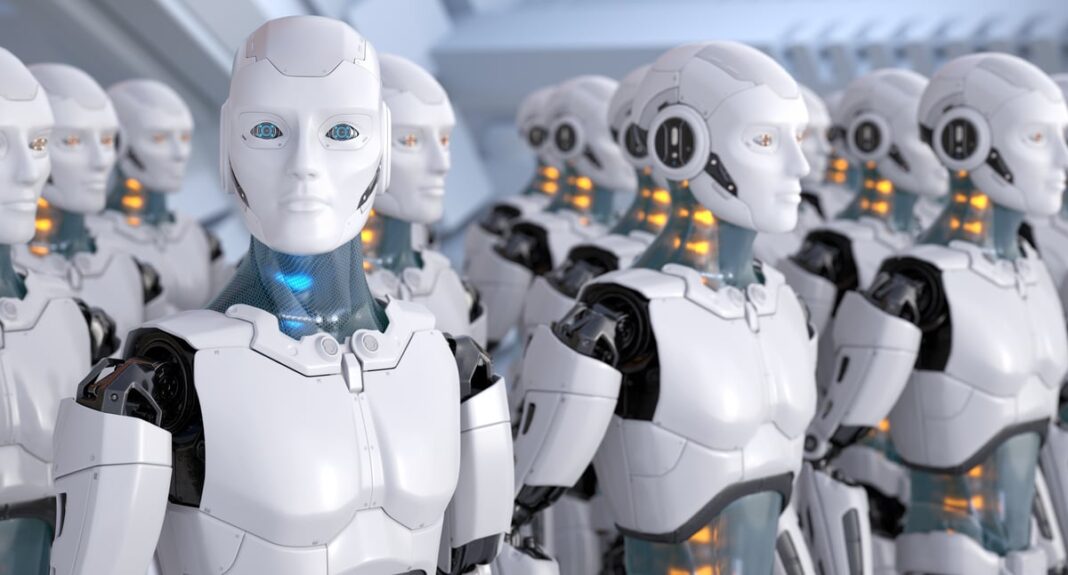
The idea of humanoid robots that can walk, talk, and interact with people in everyday life has captivated imaginations for decades. And today, several companies are amping up their efforts to combine robotics with the latest advances in artificial intelligence (AI) to turn that science-fiction dream into reality.
How will you know when “the robots are here”? Morgan Stanley research forecasts that 10% of U.S. households could own a humanoid by 2050, with the devices selling at an average price of $50,000. However, the first widely adopted humanoid robots might not be robot housekeepers for the consumer market.
Where to invest $1,000 right now? Our analyst team just revealed what they believe are the 10 best stocks to buy right now, when you join Stock Advisor. See the stocks »
Instead, the latest trends suggest that these humanoid robots might arrive first in car factories. If you believe humanoid robots are almost here, you might want to buy shares of Hyundai, Toyota(NYSE: TM), and Tesla(NASDAQ: TSLA).
Image source: Getty Images.
Korean automaker Hyundai made big headlines at CES 2026 with Atlas, a humanoid robot developed by its Boston Dynamics subsidiary. Atlas won the trade show’s award for best robot, and the CES voting panel praised its naturalistic way of walking and sleek design.
Hyundai says it intends to put Atlas robots to work in its car factory in Savannah, Georgia, by 2028, starting with simple processes like parts sequencing. It then plans to expand their workloads to more complex activities by 2030.
According to Hyundai, the Atlas robot is designed to be trainable on most tasks in less than a day and can lift up to 110 pounds. It has advanced rotational joints, human-scale hands, and precise sensors that should make it a good fit for industrial environments. Since the day it announced its plans for the Atlas robot at CES, Hyundai stock has risen by about 60%.
Hyundai might not be the only car company that benefits from Atlas robots. Boston Dynamics has also partnered in recent years with Toyota. In August 2025, the Toyota Research Institute and Boston Dynamics announced a new breakthrough in using large behavior model (LBM) artificial intelligence to help Atlas humanoid robots learn.
A video from Toyota and Boston Dynamics shows the Atlas robot at work. It can crouch, bend, and lift — and its hands are flexible and versatile enough for it to do numerous tasks that occur in a factory setting, like gripping and opening boxes and organizing, packing, and sorting items.
The robot also can self-adjust and adapt to changing circumstances and unexpected challenges — an ability it demonstrates when a researcher interferes with its work by moving a box away or closing its lid suddenly. Here’s why this is such a big breakthrough in AI: The entire Atlas robot, including whole-body motion and adapting to interruptions, was controlled by a single LBM.
Using LBMs to control robots in this way could save significant time, compared to the traditional approach of programming each capability into a system individually. Toyota’s research could help robots add advanced skills to their repertoires more quickly.
Toyota hasn’t announced specific plans to use these AI robots in its factories. But since it announced its Atlas robot AI news on Aug. 20, 2025, Toyota stock is up about 20%.
Tesla is going all in on humanoid robots. On its fourth-quarter earnings call in January, the company announced that it will end production of its Model X and Model S cars, and convert its Fremont, California, factory to make Optimus robots, with a production capacity goal of 1 million per year.
On the earnings call, CEO Elon Musk said that Tesla would “probably unveil Optimus 3 in a few months” and described it as “an incredibly capable robot” that will be a “general-purpose robot that can learn by observing human behavior.” Musk also said that in the long term, he believes that “Optimus will have a very significant impact on the U.S. GDP.”
However, it’s too soon to know just how productive Optimus will prove to be for Tesla in its factories. Musk said that the robots are doing some “basic tasks,” but are “not in usage in our factories in a material way.” He also described the company’s use of Optimus as “very much at the early stages” and “still in the R&D [research and development] phase.”
Tesla has high hopes for robotics. In September 2025, Musk predicted that eventually, about 80% of the company’s value will come from the Optimus business. However, in the days since Tesla’s fourth-quarter announcement, the stock is down about 7%.
The future of humanoid robotics is still uncertain. We don’t know how smart or profitable advanced AI robots will really be, but car companies might be their best early adopters.
Among these automotive stocks, Hyundai trades primarily on the South Korean exchange, which makes it harder for U.S. investors to access. But if you believe in the future of humanoid robotics, you might want to buy shares of Tesla or Toyota.
Before you buy stock in Toyota Motor, consider this:
The Motley Fool Stock Advisor analyst team just identified what they believe are the 10 best stocks for investors to buy now… and Toyota Motor wasn’t one of them. The 10 stocks that made the cut could produce monster returns in the coming years.
Consider when Netflix made this list on December 17, 2004… if you invested $1,000 at the time of our recommendation, you’d have $443,299!* Or when Nvidia made this list on April 15, 2005… if you invested $1,000 at the time of our recommendation, you’d have $1,136,601!*
Now, it’s worth noting Stock Advisor’s total average return is 914% — a market-crushing outperformance compared to 195% for the S&P 500. Don’t miss the latest top 10 list, available with Stock Advisor, and join an investing community built by individual investors for individual investors.
Ben Gran has no position in any of the stocks mentioned. The Motley Fool has positions in and recommends Tesla. The Motley Fool has a disclosure policy.
As bitcoin, ethereum and other cryptocurrencies see major legal, institutional, and technological developments, the financial landscape continues to adapt. Stay up...