Moneywise and Yahoo Finance LLC may earn commission or revenue through links in the content below.
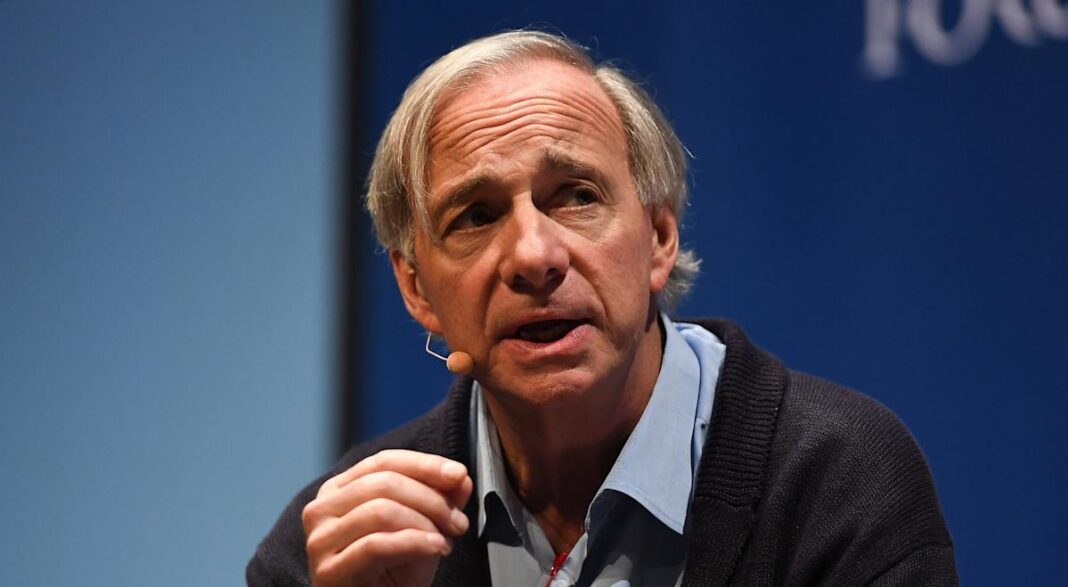
Hedge fund billionaire Ray Dalio has issued a stark warning — one that centers on how countries can wield capital as a geopolitical weapon.
Speaking at the World Governments Summit in Dubai, Dalio said the world is on the cusp of a capital war.
“We are on the brink,” he said (1). “That means not in, but it means we are quite close to [a capital war] and it would be very easy to go over the brink into a capital war, because there are mutual fears.”
The warning comes at a moment of growing global tension.
Dalio pointed to U.S. President Donald Trump’s push to take over Greenland as a potential fault line between the U.S. and Europe. In particular, he said European holders of U.S.-denominated assets could fear sanctions, while there is also “reciprocal fear” on the U.S. side that it could lose access to foreign capital or demand for its assets.
Those concerns are especially significant given Europe’s role in financing the U.S. government.
According to Citi, European investors accounted for roughly 80% of foreign buying of U.S. Treasuries between April and November 2025 (2).
Dalio added that “we’re seeing capital controls and capital wars taking place all over the world today.” But this is not the first time the hedge fund legend has sounded the alarm on money, capital and U.S.-denominated assets.
Last year, he warned that if a politically weakened Federal Reserve allows inflation to run hot, it would lead to bonds and the U.S. dollar becoming “an ineffective storehold of wealth and the breaking down of the monetary order as we know it.”
Against that chilling backdrop, how should investors protect their wealth?
Dalio has pointed to a simple answer: gold.
Last year, he told CNBC that “people don’t have, typically, an adequate amount of gold in their portfolio.”
This time around, when asked whether he still believes gold is the safest given the recent price action, Dalio was affirmative: “It doesn’t change by the day.”
Dalio emphasized gold’s role as portfolio protection when conditions deteriorate.
“Gold is a diversifier. In other words, when the bad times come along, it does uniquely well,” he said, adding that “the most important thing is to have a well-diversified portfolio.”
Gold has long been considered a go-to safe haven. It can’t be printed out of thin air like fiat money and because it’s not tied to any single currency or economy, investors often flock to it during periods of economic turmoil or geopolitical uncertainty, driving up its value.
Despite a recent pullback, gold prices have climbed more than 70% over the past 12 months.
One way to invest in gold that also provides significant tax advantages is to open a gold IRA with the help of Thor Metals.
Gold IRAs allow investors to hold physical gold or gold-related assets within a retirement account, which combines the tax advantages of an IRA with the protective benefits of investing in gold. This makes it an attractive option for those looking to potentially hedge their retirement funds against economic uncertainties.
To learn more, you can get a free information guide that includes details on how to get up to $20,000 in free metals on qualifying purchases.
If gold is the go-to hedge for moments of chaos, real estate is the long game — and no one knows that better than the U.S. commander in chief himself.
Before politics, Trump made his fortune in real estate — and the asset class remains a powerful tool for building and preserving wealth, especially during inflationary times. That’s because property values and rental income tend to rise along with the cost of living.
Unlike some other investments, real estate doesn’t need a roaring stock market to deliver returns. Even during downturns, high-quality properties can generate rental income — offering a dependable stream of passive cash flow.
As Trump told Steve Forbes back in 2011, “I just notice that when you have that right piece of property, whatever it might be, including location, it tends to work well in good times and in bad times (3).”
Today, you don’t need to buy a property outright to benefit from real estate investing. Crowdfunding platforms like Arrived offer an easier way to get exposure to this income-generating asset class.
The process is simple: Browse a curated selection of homes that have been vetted for their appreciation and income potential. Once you find a property you like, select the number of shares you’d like to purchase and then sit back as you start receiving any positive rental income distributions from your investment.
Mogul is another option. It’s a real estate investment platform offering fractional ownership in blue-chip rental properties, which gives investors monthly rental income, real-time appreciation and tax benefits — without the need for a hefty down payment or 3 a.m. tenant calls.
Each property undergoes a rigorous vetting process, requiring a minimum 12% return even in downside scenarios. Across the board, the platform features an average annual IRR of 18.8%. Offerings often sell out in under three hours, with investments typically ranging between $15,000 and $40,000 per property.
Prominent investors like Dalio often stress the importance of diversification — and for good reason. Many traditional assets tend to move in tandem, especially during periods of market stress.
That message feels especially relevant today.
Nearly 40% of the S&P 500’s weight is concentrated in its ten largest stocks and the index’s CAPE ratio hasn’t been this high since the dot-com boom.
This is where, for many investors, alternative assets come into play. These can include everything from real estate and precious metals to private equity and collectibles.
But there’s one store of value that routinely flies under the radar: It’s scarce by design, coveted worldwide and frequently locked away by institutions.
We’re talking about post-war and contemporary art — a category that has outpaced the S&P 500 with low correlation since 1995.
It’s easy to see why art pieces often fetch new highs at auctions: The supply of the best works of art is limited and many of the most desirable pieces have already been snatched up by museums and collectors. That scarcity can also make art an attractive option for investors looking to diversify and preserve wealth during periods of high inflation.
Until recently, purchasing art has been a domain reserved for the ultra-wealthy — like in 2022 when a collection of art owned by the late Microsoft co-founder Paul Allen sold for $1.5 billion at Christie’s New York, making it the most valuable collection in auction history (4).
Now, Masterworks — a platform for investing in shares of blue-chip artwork by renowned artists, including Pablo Picasso, Jean-Michel Basquiat and Banksy — can help you get started with this asset class. It’s easy to use and, with 25 successful exits to date, Masterworks has distributed more than $65 million in total proceeds (including principal).