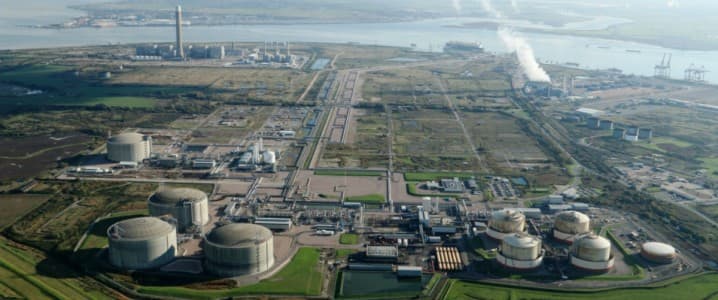
The United States has cemented its position as the world’s leading exporter of Liquefied Natural Gas (LNG) over the past couple of years, thanks to surging natural gas demand in Europe and Asia. U.S. LNG exports hit a record 111 million tons in 2025, surpassing 100 million metric tons for the first time, driven by high utilization and new capacity additions from projects like Plaquemines LNG.
But this could be just the beginning of the U.S. LNG boom: the EIA has predicted that U.S. LNG export capacity will more than double by 2029, with an estimated 13.9 Bcf/d of new capacity added between 2025 and 2029 as projects like Plaquemines LNG Phase 1 and Corpus Christi Stage 3 reach full operations. Meanwhile, additional projects such as Delta LNG, CP2 LNG, and others are expected to further bolster capacity toward 2030.
However, the energy experts are now warning that all this growth will come at cost, as does everything.
According to Wood Mackenzie, European demand for industrial natural gas has declined by 21% since 2021 while industrial power demand has decreased by 4%, driven by soaring gas prices after Russia’s invasion of Ukraine. However, WoodMac has projected that the ongoing massive wave of new global LNG supply, primarily from the U.S. and Qatar, is expected to nearly halve European traded gas prices by 2030 compared to 2025 levels, saving European industry roughly $46 billion annually by 2032. Conversely, surging LNG exports and soaring demand from AI data centers are projected to push domestic U.S. gas prices to an average of $4.90/MMBtu between 2030 and 2035, a nearly 50% increase from 2025 levels. This constitutes a narrowing competitive gap, with the large cost advantage that U.S. manufacturers have enjoyed for over a decade poised to shrink despite U.S. energy remaining cheaper than European energy in absolute terms.
Related: US Oil Drillers Add Rigs Even in Price Uncertainty
That doesn’t mean that European manufacturers will be complaining, though. The EU has become heavily reliant on the U.S., which supplied more than 57% of EU LNG imports by early 2026, up from 45% in 2024. Consequently, falling energy prices will benefit energy-intensive industries sectors such as petrochemicals, metals, and chemicals, which have been under severe cost pressure since the global energy crisis hit four years ago, with WoodMac reporting they are going through a “price reversal window” that will allow them to stabilize or recover. Lower European energy costs are expected to open up growth opportunities, with WoodMac predicting that the continent’s pharmaceuticals, food processing, and data center sectors are likely to capture a larger share of the international market.
This could, however, prove to be a double-edged sword for the U.S. economy. Indeed, the U.S. LNG boom is poised to create a complex, often contradictory impact on the U.S. economy, acting as a major driver for GDP growth, job creation, and infrastructure investments while simultaneously raising domestic energy costs and complicating the energy transition. The LNG boom is expected to contribute up to $1.3 trillion to the U.S. GDP by 2040 and generate $166 billion in federal and state tax revenues, according to an S&P Global study. The industry is expected to create nearly 500,000 jobs, encompassing direct, indirect, and induced employment. Over $50 billion is projected to flow into new, massive infrastructure projects (e.g., Plaquemines, Golden Pass, Port Arthur).
In contrast, experts warn that even relatively modest increases in gas and energy prices can lead to large increases in operating costs, potentially taking a toll on margins. An analysis by the Industrial Energy Consumers of America (IECA) found that every $1 increase in the Henry Hub price costs U.S. consumers and manufacturers ~$54 billion annually in combined gas and electricity expenses, including $20 billion more in electricity expenses as well as $34 billion increase in direct natural gas costs for consumers and manufacturers. For manufacturers, who often cannot pass on energy costs as easily as regulated utilities, a $1 increase in the Henry Hub price poses a direct threat to competitive advantage.
Industries that rely heavily on natural gas, such as manufacturing, chemicals, and fertilizers, face increased operational costs, with estimates of up to $125 billion in added costs by 2050. But it’s not just large industries that could suffer the negative consequences of the ongoing AI and LNG boom. Increased exports connect the U.S. domestic natural gas market to higher global prices, driving higher electricity and heating bills for U.S. households.
Meanwhile, analysts have warned that the U.S. could face a domestic energy crunch that could trigger spikes in energy prices if natural gas production growth fails to meet export demand growth. This could negatively impact the clean energy transition, with higher natural gas prices making coal power more competitive in the domestic electricity market.
By Alex Kimani for Oilprice.com
More Top Reads From Oilprice.com
Oilprice Intelligence brings you the signals before they become front-page news. This is the same expert analysis read by veteran traders and political advisors. Get it free, twice a week, and you’ll always know why the market is moving before everyone else.
You get the geopolitical intelligence, the hidden inventory data, and the market whispers that move billions – and we’ll send you $389 in premium energy intelligence, on us, just for subscribing. Join 400,000+ readers today. Get access immediately by clicking here.