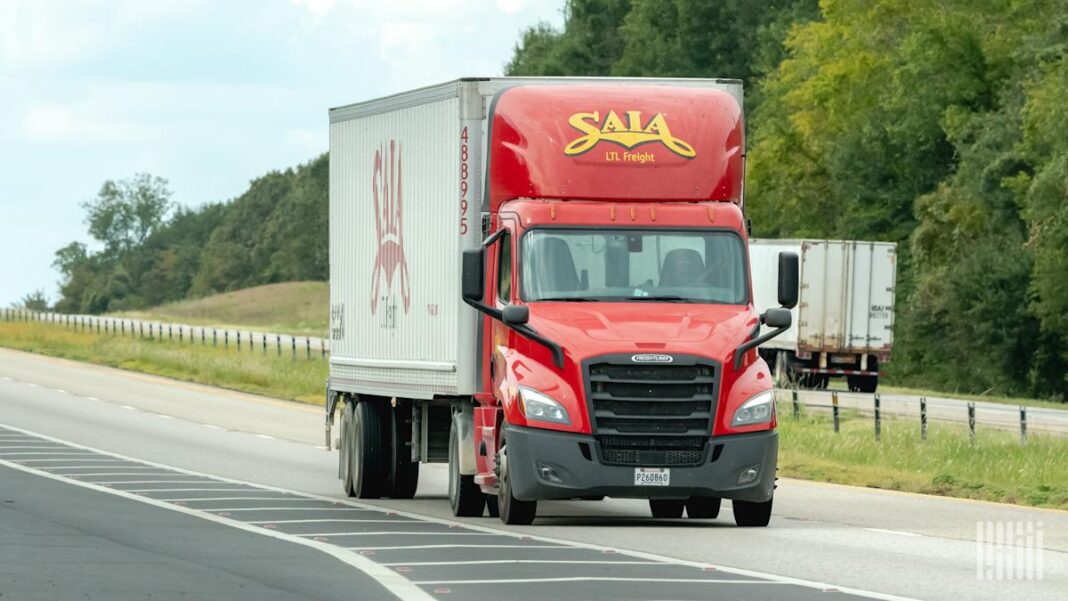
Less-than-truckload carrier Saia said it sees more tailwinds than headwinds facing its business in the new year. The company has opened 39 terminals in the past three years, making it a true national carrier. However, costs associated with ramping the new locations were again an overhang on quarterly results.
The Johns Creek, Georgia-based company reported fourth-quarter earnings per share of $1.77 on Tuesday before the market opened. The result was 38% lower year over year and 14 cents below the consensus estimate. The company flagged $4.7 million in adverse claims developments during the period. Excluding the costs, EPS would have been in line with expectations at $1.91.
Table: Saia’s key performance indicators
An expanded network is allowing Saia to better compete for freight from national shippers, which will allow it to build density over time. However, carrying the additional costs has pushed the company’s margins to multiyear lows in recent quarters, a trend that it expects to reverse starting this year.
Saia’s (NASDAQ: SAIA) 91.9% fourth-quarter operating ratio (8.1% operating margin) was 480 basis points worse y/y and 430 bps worse than the third quarter. Management’s guidance called for 300 to 400 bps of sequential deterioration. The incremental insurance costs were a 60-bp drag.
The fourth quarter could prove to be the nadir even though winter storms have negatively impacted the first quarter—the seasonally weakest of the year.
Management said on a Tuesday call that the company normally records 30 to 50 bps of sequential OR deterioration from the fourth to first quarter. It expects to outperform that change rate this year, potentially logging sequential improvement, given the diminished starting point. The guide could represent y/y improvement from the 91.1% OR posted in the 2025 first quarter. (Saia’s outlook was provided using a fourth-quarter adjusted OR of 91.3%, which excludes the insurance hit.)
The company is also calling for full-year margin improvement of 100 to 200 bps in 2026, with the high end of the range tethered to modest volume and yield improvements. However, management still expects y/y margin improvement, even if the broader economy remains soft.
“A $2 billion capital investment, like what we’ve deployed in this business, the returns that we are expecting are sub-80 OR,” said Fritz Holzgrefe, Saia president and CEO, on the call.
He said some mature portions of the network currently operate at ORs in the upper-70s.
The company’s weight per shipment comps ease in the back half of the year. It now has 20% to 25% excess door capacity and should be able to take share when the market turns. Industry consensus suggests many regional carriers are likely already capacity constrained, unlike national carriers that have expanded their networks.
Management also expects to price freight ahead of cost inflation following the investments, which have meaningfully raised its service offering. Contractual rate increases averaged 4.9% in the fourth quarter (plus-6.6% in January). Customer retention is running above 90% following a 5.9% general rate increase in October. The carrier normally sees retention between 80% and 85% following GRIs.
SONAR: Longhaul LTL Monthly Cost per Hundredweight, Class 125+ Index. Less-than-truckload monthly indices are based on the median cost per hundredweight for four National Motor Freight Classification groupings and five different mileage bands. To learn more about SONAR, click here.
Saia reported fourth-quarter revenue of $790 million, which was $1 million higher y/y and $14 million better than the consensus estimate. On a per-day basis, revenue was flat as a 1.5% decline in tonnage was offset by a 1.6% increase in revenue per hundredweight, or yield. Yield was 0.5% higher, excluding fuel surcharges.
The quarter had a tough tonnage comparison to the year-ago period (plus-8.3% y/y). By month, tonnage was down 3.3% y/y in October, up 1.8% in November and down 2.2% in December. Tonnage increased on a two-year-stacked comparison throughout the quarter, from plus-4% in October to plus-11% in December.
Tonnage was 7% lower y/y in January, but that was against a plus-13.8% comp from January 2025. Also, inclement weather negatively impacted the network during the month. Shipments were down 2.1% y/y in January, but management said they would have likely been up without the storms.
Yield had an easier comparison in the period (negative-2.3% in the 2024 fourth quarter). A 1% decline in weight per shipment was a modest tailwind for the yield metric. Revenue per shipment was down 0.5% in the quarter, excluding fuel surcharges.
The 91.9% OR (91.3% adjusted) occurred as growth in cost per shipment exceeded growth in revenue per shipment by 560 bps.
Salaries, wages and benefits expenses (as a percentage of revenue) were 280 bps higher y/y. The company implemented a 3% wage and benefits increase in October. Headcount was 5.1% lower y/y (6.4% lower excluding linehaul drivers). Group health insurance cost increases represented more than 30% of the cost-per-shipment increase.
Depreciation and amortization expenses were 110 bps higher. The new terminals operated profitably in 2025.
Net capex is expected to step down from $544 million in 2025 ($1.05 billion in 2024) to $350 million to $400 million in 2026.
Shares of SAIA were off 5.1% at 3:05 p.m. EST on Tuesday compared to the S&P 500, which was off 0.1%. The stock is up 55% since the week before Thanksgiving when trucking stocks began moving higher along with truckload spot rates.