Mercedes’s Tariff Nightmares Come True as China Eyes a Slice of the Pie – Moby
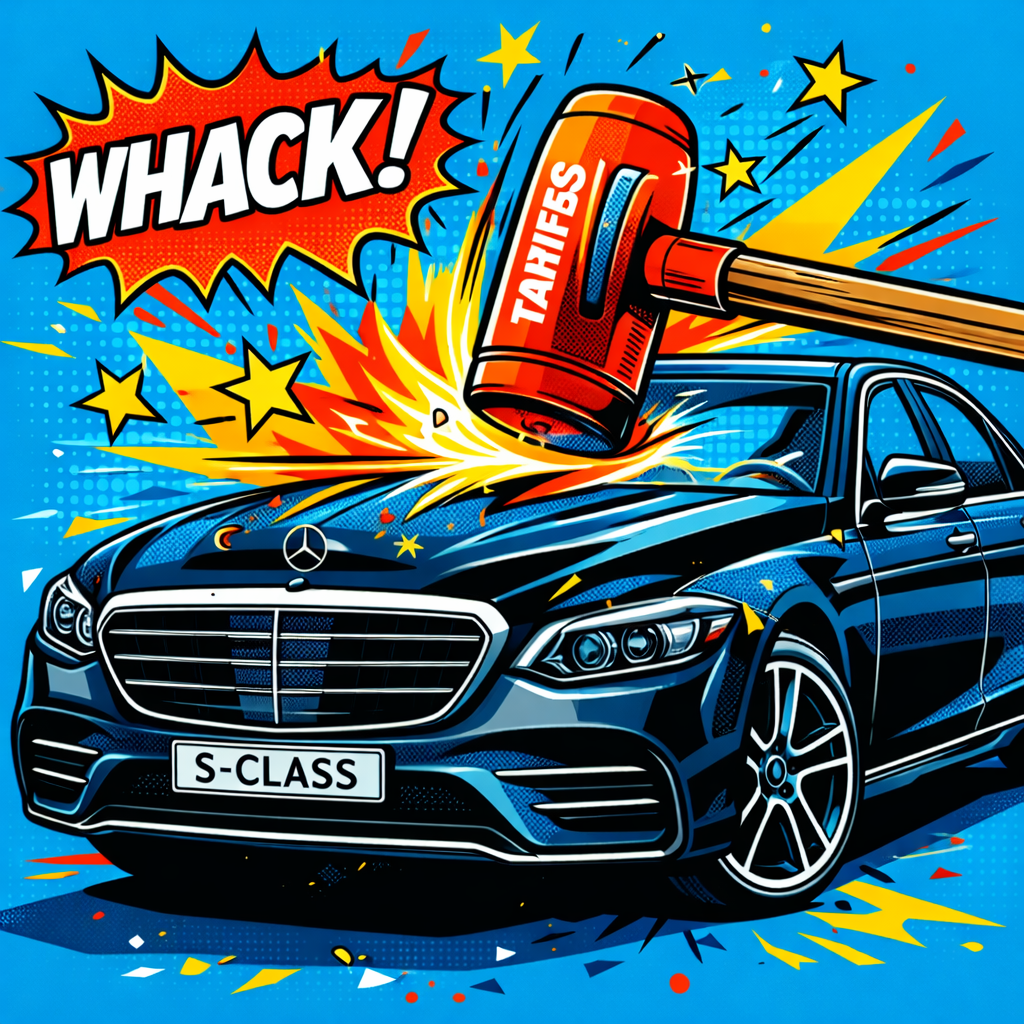
Mercedes-Benz just delivered a brutal reminder that luxury does not insulate you from geopolitics. A $1.2 billion tariff hit helped drive a 57% collapse in annual operating profit, as China competition and currency headwinds compounded the pain.
Mercedes-Benz Group reported full-year 2025 operating profit of €5.8 billion (about $6.9 billion), down 57% from the prior year and well below analyst expectations of around €6.6 billion. The company cited €1 billion, roughly $1.2 billion, in tariff costs, alongside weaker performance in China and adverse foreign exchange effects.
Group revenues came in at €132.2 billion, broadly flat year on year. Margins in the core cars division slipped to 5%, missing expectations of 5.4%. For 2026, Mercedes guided for an adjusted return on sales in its cars business of just 3% to 5%, signaling further pressure ahead.
Shares fell as much as 5% in early trading before trimming losses.
Management struck a defiant tone. Chief executive Ola Källenius said the group remained within guidance and emphasized efficiency, flexibility and cost discipline. The company plans further cost cuts in 2026 and outlined an aggressive product push, with around 40 new or refreshed models over the next three years, starting with an updated S-Class.
At the group level, Mercedes said it expects revenues in 2026 to remain roughly in line with 2025, while forecasting operating profit to be significantly above the depressed 2025 base. Free cash flow from the industrial business is expected to come in slightly below the €5.4 billion posted in 2025.
Mercedes is discovering that premium positioning does not confer immunity in a multipolar trade war.
The $1.2 billion tariff hit is not a rounding error. It is a structural reminder that global supply chains built in the era of hyper-globalization are now political liabilities. U.S. auto tariffs, Chinese retaliation risks and a fragmented regulatory landscape are forcing European manufacturers into a permanent state of strategic recalibration.
For Mercedes, the problem is not just Washington. It is Beijing.
China remains the world’s largest car market and a key profit pool for German automakers. But domestic Chinese EV makers are engaged in an all-out price war, compressing margins across the industry. Mercedes car sales in China fell sharply last year, and management has warned that volumes could fall again in 2026.
That combination, tariffs in the West and deflationary competition in the East, squeezes the middle of the income statement. You lose pricing power in China and absorb cost shocks in the US. Meanwhile, fixed costs remain stubborn.
Our analysts just identified a stock with the potential to be the next Nvidia. Tell us how you invest and we’ll show you why it’s our #1 pick. Tap here.
The margin guidance tells the story. A 3% to 5% return on sales for the core cars division is a long way from the 8% to 10% margin range Mercedes once touted as sustainable. Even if operating profit rebounds off the 2025 trough, the structural ceiling looks lower.
Then there is the electric vehicle question.
European carmakers have spent billions pivoting toward EVs, only to confront slower-than-expected demand growth and shifting subsidy regimes. In the US, the rollback of EV incentives has forced manufacturers to rethink allocation and pricing. In Europe, regulatory pressure persists even as consumers hesitate.
Mercedes says it is “reinventing” itself. That may be true, but reinvention is expensive.
The group incurred €1.6 billion in restructuring costs tied to job cuts and efficiency measures. It is expanding production in lower-cost countries such as Hungary to protect margins. That is rational corporate behavior. It is also a tacit admission that the old cost base no longer works.
Zoom out and a broader narrative emerges. European autos were once the crown jewels of the continent’s industrial base. Today they sit at the intersection of trade friction, technological disruption and geopolitical fragmentation.
Tariffs are not going away. Chinese competition is not easing. EV transitions are not linear. In that environment, even a brand as storied as Mercedes must fight to defend profitability.
Investors will watch two numbers closely in 2026: China volumes and car division margins.
If Chinese sales stabilize and the product offensive gains traction, Mercedes could rebuild toward the upper end of its 3% to 5% margin range. A rebound in operating profit from the depressed 2025 base would help restore confidence.
But if tariffs persist and China remains locked in price war mode, the pressure on returns could deepen. Cost discipline can only go so far before it begins to erode brand equity and long-term investment capacity.
Mercedes has the balance sheet, brand power and engineering pedigree to navigate turbulence. The question is whether it can do so while preserving premium margins in a world that increasingly punishes global complexity.
For now, the message from Stuttgart is clear. The rules have changed. Luxury cars are still desirable. The economics behind them are becoming far less so.
One stock. Nvidia-level potential. 30M+ investors trust Moby to find it first. Get the pick. Tap here.