


The January NFP report delivered a significant upside surprise with 130,000 jobs added versus 40,000 expected, yet the dollar’s initial surge proved short-lived as massive benchmark revisions and hawkish Fed commentary created conflicting signals for traders navigating pre-CPI positioning.
Which USD strategies moved beyond the watchlist stage, and how did the better-than-expected headline translate to price action amid sobering labor market revisions and shifting risk sentiment?
Watchlists are price outlook & strategy discussions supported by both fundamental & technical analysis, a crucial step towards creating a high-quality discretionary trade idea before working on a risk & trade management plan.
If you’d like to follow our “Watchlist” picks right when they are published throughout the week, check out our BabyPips Premium subscribe page to learn more!
We’re breaking down our dollar setups this week and examining how each pair performed after the employment data, while markets digested historic downward revisions to 2025 job figures and positioned ahead of Friday’s critical inflation report.
The Setup
What We Were Watching: U.S. Non-Farm Payrolls Report (January 2026)
- Expectation: NFP to add 40,000 jobs, unemployment rate rising to 4.5%
- Data outcome: The U.S. added 130,000 jobs with unemployment falling to 4.3%, though the report included an 862,000-job downward revision to March 2025 (second-largest on record), reducing total 2025 job gains from 584,000 to just 181,000
- Market environment surrounding the event: Markets opened cautiously following mixed signals from earlier data releases. Post-NFP, hawkish Fed commentary from Kansas City’s Schmid partially reversed initial dollar weakness, though traders remained cautious ahead of Friday’s CPI data with equity markets consolidating and Treasury yields advancing modestly.
Event Outcome
The January employment report exceeded expectations with 130,000 jobs added versus the 40,000 consensus, while the unemployment rate unexpectedly declined to 4.3% from 4.4%.
However, the headline strength was significantly undermined by the annual benchmark revision showing just 181,000 jobs added across all of 2025 (down from the initially reported 584,000) with the 862,000-job downward adjustment marking the second-largest negative revision on record.
Average hourly earnings rose 0.4% month-over-month and 3.7% year-over-year, maintaining sticky wage pressures despite the softer underlying labor market trends. Healthcare and social assistance dominated job gains with 124,000 of the 130,000 total, while federal government employment continued declining as deferred resignations pulled workers off payrolls.
Key Takeaways:
- January payrolls surprised significantly higher at 130,000 versus 40,000 expected, though prior months saw combined 17,000 downward revisions
- Historic benchmark revision reduced March 2025 employment by 862,000 jobs (not seasonally adjusted), showing 2025 averaged just 15,000 monthly gains versus previously reported levels
- Unemployment rate fell unexpectedly to 4.3% from 4.4%, suggesting labor market stabilization despite massive historical overcounting
- Wage growth remained sticky high at 3.7% year-over-year, maintaining Fed inflation concerns despite softer employment trends
- Narrow job concentration continued as healthcare/social assistance accounted for 95% of January gains, highlighting uneven hiring strength
The U.S. dollar, which had been trending mixed ahead of the U.S. session, spiked higher immediately following the 130,000 headline that doubled expectations. The Greenback surrendered roughly half these gains within an hour as traders absorbed the massive downward revision raised fundamental questions about underlying labor market strength.
USD regained momentum around mid-morning following hawkish remarks from Kansas City Fed’s Jeffrey Schmid, who emphasized recent employment trends over backward-looking revisions. The dollar retreated modestly near the London close before edging slightly higher into the New York close, finishing the session with mixed results—gaining against most majors except AUD and JPY.
Fundamental Bias Triggered: Bearish USD Setups
Promotion: Master your trading psychology with AI-powered trade journal and backtesting! TradeZella helps you track, backtest, and eliminate bad habits automatically! Click on the link and use code “PIPS20” to save 20%!
Disclosure: To help support our free daily content, we may earn a commission from our partners if you sign up through our links, at no extra cost to you.
Broad Market and Exogenous Drivers:
Pre-NFP Caution (Monday-Tuesday): Markets traded cautiously following weak leading indicators, including the 22,000 ADP private payrolls collapse and Challenger layoffs reaching worst January levels since 2009. The delayed NFP release due to the government shutdown added positioning uncertainty, while ISM services employment weakened, and JOLTS job openings disappointed. Risk sentiment remained fragile with equity markets consolidating and Treasury yields range-bound.
Post-NFP Mixed Signals (Wednesday-Thursday): The better-than-expected headline initially boosted risk appetite and dollar demand, though the historic benchmark revisions created conflicting narratives about labor market health. Hawkish Fed commentary from Schmid reinforced the “higher for longer” stance, while equity markets remained cautious amid AI disruption fears that had triggered tech sector selloffs earlier in the week. Thursday brought renewed risk-off flows as AI concerns spread to commercial real estate and logistics sectors, with sharp equity declines and robust Treasury demand overshadowing employment strength.
Pre-CPI Positioning (Friday Setup): Markets entered defensive positioning ahead of Friday’s delayed January CPI report, with the employment data’s mixed signals (strong headline vs. weak revisions) leaving Fed policy trajectory uncertain. Traders scaled back directional bets across asset classes, creating choppy two-way action in currency markets.
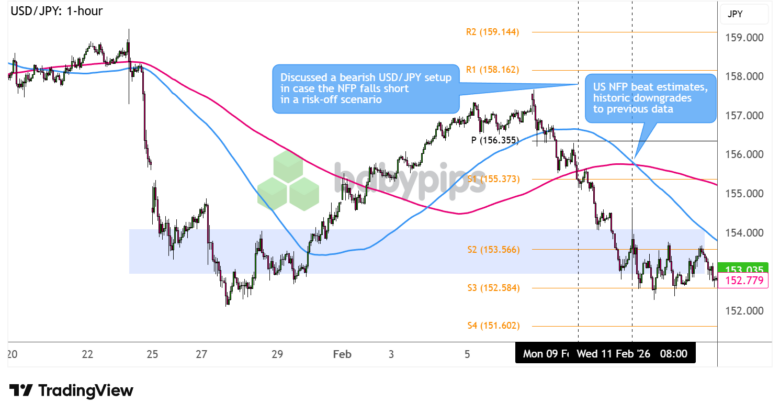
USD/JPY: Bearish USD Event Outcome + Risk-Off Scenario = Arguably good odds of a net positive outcome

USD/JPY 1-hour Forex Chart Faster with TradingView
Our USD/JPY setup focused on the 153.00-154.00 support zone as a potential target if weak NFP data combined with risk-averse sentiment to boost safe-haven demand for the yen over the dollar.
The pair had already declined to the 153.00-154.00 target zone ahead of the NFP release, with traders positioning defensively following weak ADP data, rising Challenger layoffs, and Japanese officials’ repeated intervention threats. Then, USD/JPY initially spiked to around 154.60 immediately following the stronger-than-expected jobs print as traders aggressively pared Fed rate cut expectations.
However, USD/JPY soon reversed lower, falling back through 153.00 to reach session lows near 152.88. The reversal reflected traders absorbing the catastrophic 862,000-job benchmark revision, showing 2025 averaged just 15,000 monthly gains—fundamentally revealing the NFP report as bearish USD despite the strong January headline.
The combination of the ultimately bearish USD fundamental outcome (massive downward revisions undermining labor market confidence) and the risk-off environment from U.S.-Iran tensions, AI-driven equity selloffs, and defensive pre-CPI positioning rendered this USD/JPY setup eligible to move beyond the watchlist stage.
While the initial headline spike temporarily disrupted the bearish USD thesis, the underlying data—historic benchmark revisions, narrow job concentration in healthcare, and questions about data reliability—proved decisively dollar-negative. Risk aversion from geopolitical tensions and equity market stress supported safe-haven yen demand throughout the week.
USD/JPY spent the rest of the week between 152.50 and 153.50 as several bearish factors lined up. Japanese intervention threats continued to support the yen, while weaker U.S. jobless claims and softer CPI reinforced concerns about the labor market and supported expectations for Fed easing later this year.
Traders who stayed short from the 153.00 to 154.00 zone, or who sold into the reversal near 155.00 to 156.00, were able to ride the move down into that consolidation range. The pair remained well below pre-NFP levels as the softer data and risk-off flows kept pressure on the dollar.
Not Eligible to Move Beyond Watchlist – GBP/USD & Bullish USD Setups
GBP/USD: Bearish USD Event Outcome + Risk-On Scenario

GBP/USD 1-hour Forex Chart Faster with TradingView
Our watchlist discussed potential Cable upside toward 1.3726-1.3842 if weak NFP data in a risk-friendly environment kept dollar pressure intact, while Sterling benefited from its “risk currency” characteristics.
Instead, NFP printed at 130,000 versus the 65,000 to 75,000 consensus, giving the dollar an initial pop. But steep downward revisions quickly changed the tone, forcing a rethink on Fed expectations and turning the release into a net USD bearish event. At the same time, U.S.-Iran tensions and AI jitters kept sentiment cautious. The USD-bearish report, combined with a risk-off trading environment, invalidated GBP/USD’s setup from moving beyond the watchlist stage.
Cable slid from 1.3715 to 1.3665 after the headline beat as June cut odds dropped. It later bounced toward 1.3675 as the dollar gave back gains on the revision-driven repricing, but still ended the week just under its pre-NFP levels.
USD/CHF: Bullish USD Event Outcome + Risk-On Scenario

USD/CHF 1-hour Forex Chart Faster with TradingView
Our USD/CHF watchlist idea zoomed in on a potential long-term support bounce around the .7650 minor psychological mark and January lows in the event the U.S. jobs report supports a more hawkish Fed stance in a risk-on scenario.
While the headline NFP figure surprised to the upside, major downgrades to previous employment data rendered the target event bearish for the U.S. dollar, invalidating the fundamental bias of this setup. In addition, elevated US-Iran geopolitical tensions weighed on risk appetite around the time of the release, along with hawkish Fed commentary and AI-related tech disruption jitters.
Although the pair initially ripped higher upon seeing the upbeat surface-level numbers, the rally fizzled within hours after the release as traders digested the implications on Fed policy. Consolidation followed in the next sessions while the dollar struggled to establish direction, before eventually turning back down on Thursday and slumping close to pre-NFP levels as traders got wind of weaker than expected U.S. CPI the next day.
GBP/USD: Bullish USD Event Outcome + Risk-Off Scenario

GBP/USD 1-hour Forex Chart Faster with TradingView
This Cable watchlist idea flagged a short-term falling trend line test on the hourly time frame, anticipating that price would retreat from the resistance zone if the U.S. NFP turns out much stronger than expected.
The January reading beat expectations, but the significant downward revisions to earlier employment figures invalidated the bullish fundamental USD bias on this setup, even as several factors (hawkish Fed commentary, geopolitical tensions, tech sector slump) favored safe-havens around the time of the release.
GBP/USD already bounced off the trend line when the U.S. retail sales report disappointed early in the week, but the pair still attempted another test of resistance ahead of the NFP release. The ceiling held when the dollar briefly rallied in reaction to headline results, but the selloff didn’t gain much traction in the succeeding sessions as Fed commentary kept policy expectations largely unchanged.
The pair even saw a slight rebound despite U.K. growth data simply coming in line with expectations, suggesting that dollar traders weren’t exactly swayed in a bullish direction by the January NFP print. Even though downbeat U.S. existing home sales sparked another short-term dip, softer U.S. inflation data on Friday still allowed GBP/USD to climb back to the pivot point before the week closed.
Interested in fundamental analysis made for newbies and how to pair it up with technical analysis to find high-quality opportunities that may match your trading and risk management style? Check out our Premium membership for event trading guides, short-term strategies, weekly recaps and more!
BabyPips.com Annual Premium Members also get an exclusive 30% discount on the annual subscription for the first year on Tradezella–the top-rated journaling app! ($120 in savings)! Click here for more info!
The Verdict
The January NFP report looked dollar positive at first glance. Payrolls rose by 130,000 versus the 65,000 to 75,000 consensus, and the unemployment rate dipped to 4.3% from 4.4%. USD initially popped on the headline beat, but that strength was temporary.
Once traders dug into the details, the tone shifted dramatically. A massive 862,000 job downward revision to March 2025, the second largest on record, revealed that job growth last year was far weaker than previously reported. 2025 averaged just 15,000 monthly gains, with outright job losses in the second half. That benchmark revision reframed the entire report, turning what looked like a solid print into a broader bearish USD narrative.
At the same time, risk sentiment stayed cautious as AI-related equity weakness and escalating U.S.-Iran tensions weighed on markets, while traders positioned carefully ahead of Friday’s delayed CPI. Thursday’s higher jobless claims added to labor market concerns, and Friday’s cooler CPI print reinforced expectations that the Fed could ease later in 2026. Even coordinated hawkish remarks from Fed officials midweek failed to offset the damage done by the revisions and follow-up data.
Overall, we’d rate this week’s USD/JPY discussion as “neutral-to-likely” supportive of a potential positive outcome. The behavior post event gave bears a few brief moments of taking shorts at great prices (154.00 and above), and beyond that there were several opportunities to play the tops of the developing consolidation range (around 153.50) could have snagged quick pips.
But for those who considered shorting below 153.00 would have had to be very active (i.e. scalping or day trading) to generate positive outcomes, and if not, the likely outcome probably would have been roughly in the range of neutral to a slight loss as the market never really got above the 153.50 area for the rest of the week.
Selecting the right trading strategy would have been tough this week with U.S. CPI on Friday and Fed speak keeping the interest rate outlook uncertain. Very short term traders would have likely benefited the most from these developments and analysis vs. those looking to hold for a full day or multiple days.
Key Takeaways:
Historic Revisions Can overpower Headline Beats
January’s 130,000 payroll gain triggered a knee-jerk surge for USD. But the massive 862,000 job downward benchmark revision, which showed 2025 averaged just 15,000 monthly gains, flipped the narrative within 90 minutes. Markets chose to focus on structural weakness over a single strong month, and USD/JPY reversed sharply before settling into the 152.50 to 153.50 range by week’s end.
Central Bank Commentary Matters
With the actual employment numbers giving mixed signals (strong latest headline print, notable downgrades to previous data), remarks from Fed policymakers (Schmid) can put things in perspective and possibly guide markets in recalibrating their interest rate outlook. Although the historic negative revisions raised eyebrows, the dollar was still able to squeeze out some gains during the session before pre-CPI caution set in.
Book Profits Quickly Ahead of Other Market-Moving Data
In this particular case, the U.S. had back-to-back major reports lined up, with the inflation numbers still holding plenty of weight when it comes to possibly shifting the narrative. As a result, the dollar’s initial moves were short-lived while traders refrained from committing to big positions ahead of another potential game-changing release.
Follow-Up Data Can Outweigh Central Bank Talk
Hawkish comments from Fed officials briefly steadied the dollar midweek. Still, weaker jobless claims and a cooler CPI print carried more weight. The sequence of soft revisions, softer claims, and tame inflation built a consistent bearish USD story that policy rhetoric could not offset.
Promoted: The financial markets are moving faster than ever. Don’t trade on yesterday’s news. Get the real-time feed that professionals use to catch the turn. Join FinancialJuice for Free!
Disclosure: We may earn a commission from our partners if you sign up though our links, at no extra cost to you.


