

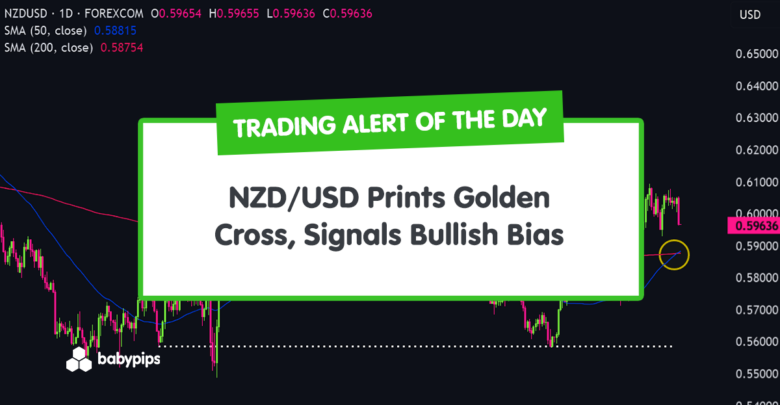

NZD/USD is flashing a classic trend signal that many traders associate with a transition from recovery to a more sustained uptrend.
With price holding above 0.5900, attention often shifts to whether momentum can stay constructive after the initial crossover event.
Welcome to “TA Alert of the Day.” Each day after the market close, MarketMilk scans for popular technical indicator alerts. We use these alerts as the basis for a mini-lesson, breaking down what each alert means, why it matters, and how traders might interpret it. The goal is to help beginner traders not only spot these alerts but also understand the logic behind them and how they can inform trading decisions.
What MarketMilk Has Detected

MarketMilk has detected a 50-day SMA crossing above the 200-day SMA, a widely followed bullish moving-average crossover.
NZD/USD has climbed from the late-November lows near 0.558–0.560 to a late-January push above 0.605, with the price trading near 0.5960, hovering just above the rising 200-day SMA (around 0.5875) and holding above the prior breakout zone.
Nearby reference levels from recent swings include resistance around 0.609 (late-January high) and support around 0.595 and 0.600 (early-February pullback zone and round-number support).
The broader structure has improved, but this pullback will determine whether the breakout has staying power.
What This Signals
Traditionally, a 50/200 SMA bullish crossover (often called a “golden cross”) suggests that medium-term momentum is improving relative to the longer-term baseline.
If the move is sustained, it can attract trend-following participation, especially when price holds above both moving averages and prior pullbacks remain shallow.
However, this same pattern can also represent a lagging confirmation that arrives after a sizable portion of the rally has already occurred (notably the surge from the mid-0.57s into the 0.60–0.61 area).
In that scenario, the crossover sometimes coincides with late-stage momentum where prices briefly hold up, then mean-revert back toward the moving averages—creating whipsaw risk if NZD/USD fails to clear resistance near 0.609.
The outcome depends heavily on follow-through above recent resistance, how price behaves on pullbacks toward 0.600/0.595, and broader USD and risk-sentiment conditions.
How It Works
The 50-day SMA tracks the average closing price over roughly the last 50 sessions, while the 200-day SMA represents a longer-term trend baseline.
A bullish crossover occurs when the 50-day average rises above the 200-day average, indicating the market’s medium-term price action has improved enough to overtake the longer-term trend measure.
Important: Moving-average crossovers are inherently backward-looking and can be prone to whipsaws in range-bound markets. Reliability often improves when the crossover is supported by a clean market structure (higher highs/higher lows) and a successful retest of key support.
What to Look For Before Acting
Do not assume the crossover guarantees continued upside. Consider these factors:
✅ Whether NZD/USD can break and hold above 0.6080 (late-January peak) rather than rejecting from it
✅ Whether pullbacks find support near 0.600 and/or 0.595 without sharp sell-through
✅ Price remaining above both the 50-day and 200-day SMA in the sessions following the cross
✅ Evidence of a higher-low structure since the early-February dip (around 0.595)
✅ Signs that prior breakout areas (around 0.585–0.587) are not quickly reclaimed to the downside
✅ Confirmation on a weekly view (trend clarity and where price sits relative to broader multi-month ranges)
✅ Cross-currency and macro alignment (e.g., broad USD tone, rate expectations, and risk appetite) supporting follow-through
✅ Event risk awareness (upcoming central bank communications, inflation/labor releases) that could drive volatility through key levels
Risk Considerations
⚠️ Whipsaw risk: crossovers can fail quickly if NZD/USD remains range-bound around 0.60–0.61
⚠️ Overhead resistance near 0.609: repeated rejection here can turn the signal into a consolidation rather than a trend continuation
⚠️ False-break risk: brief pushes above 0.605–0.609 that reverse back under 0.600 can trap late buyers
⚠️ Event-driven volatility: macro surprises can overwhelm technical signals, especially around major releases
⚠️ Mean-reversion pullback: price can retrace toward the moving averages after a strong run-up, even if the bigger trend is improving
Potential Next Steps
Momentum has cooled after the initial breakout surge, which is typical during retests of key moving averages.
The key question is whether this pullback forms a higher low above 0.5870 or rolls over and invalidates the breakout. The structure is constructive, but confirmation is required at support.
Add NZD/USD to a watchlist and monitor how the price behaves around 0.600 (support) and 0.6080 (resistance).
Traders who use crossover systems often wait for follow-through, such as a daily close that holds above nearby resistance or a controlled pullback that respects support, before treating the signal as actionable.
If trading, consider defining risk around invalidation areas and sizing positions to account for FX volatility and upcoming macro catalysts.
Trade Idea
Setup:
Buy NZDUSD on a pullback into the rising 50-day SMA, using it as dynamic support within the new recovery structure.
Entry:
Wait for NZDUSD to dip into the 0.5850–0.5880 area, where the 50-day SMA is currently rising.
Look for signs of support such as:
- A bullish daily rejection wick,
- A higher low forming above the moving average,
- Or a strong bullish close back above 0.5900.
Enter long once price clearly respects the 50-day SMA and begins pushing higher.
If price slices cleanly through the 50-day SMA and closes decisively below it, stand aside. This would signal weakening momentum and increase the probability of a deeper move toward 0.5750.
Stop Loss:
Place the stop on a daily close below 0.5750, below the recent structural low and prior breakout base.
Take Profit:
Target the recent swing high near 0.6050–0.6100 as the first objective. If price breaks above that level and holds, trail stops and look for extension toward 0.6200.
Bottom line:
The rising 50-day SMA is acting as dynamic support within the uptrend. As long as the price respects that level and forms a higher low, the bias favors buying dips.
This content is strictly for informational purposes only and does not constitute as investment advice. Trading any financial market involves risk. Please read our Risk Disclosure to make sure you understand the risks involved.


