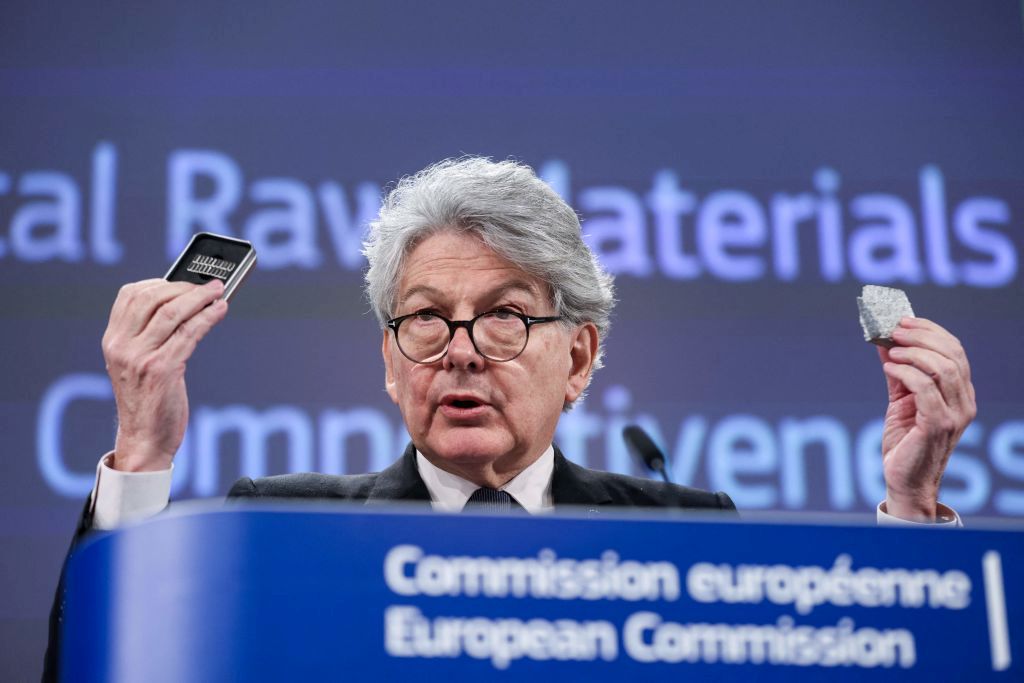
The European Commission closed the second application round for strategic project status under the Critical Raw Materials Act on 15 January 2026, with decisions expected in the second quarter of 2026 (Q2 2026). The process follows the approval of 47 mineral projects within the EU in March 2025 and a further 13 non-EU projects in June, including four in Africa: in Malawi, Madagascar, South Africa and Zambia.
Seven months after those first non-EU designations, Africa has emerged as a key testing ground for Europe’s effort to secure critical minerals and reduce its dependence on China. Projects range from rare earths, graphite and cobalt developments to processing investments, highlighting the EU’s growing focus on value-added supply chains beyond extraction.
Yet the continent’s push to move downstream has long been constrained by weak infrastructure, energy shortages, water scarcity and political risk. With 60 strategic-labelled projects now in place worldwide, attention is shifting to what the strategic designation has actually delivered – and whether Europe’s partnerships can translate policy ambition into industrial reality.
The Zandkopsdrift rare earths project, developed by Frontier Rare Earths, is located in South Africa’s Northern Cape Province and is expected to produce around 17,000 tonnes per annum (tpa) of separated rare earth oxides, including 4,000tpa of magnet rare earths, in addition to 100,000tpa of battery-grade manganese sulphate by 2030. While often described as a mine, the project is primarily a processing operation: only 5% of capital costs are for mining, with 95% allocated to the processing plant, effectively a chemical refinery, as James Kenny, CEO and co-founder of Frontier Rare Earths, underlined to Mining Technology.
The project is fully permitted, with mining, environmental and access rights secured, and its social and labour plan has been approved by both local and national authorities. Work began in 2007, and after more than 15 years of development, the project represents a $700m (€590.16m) investment in large-scale chemical processing. During construction, it is expected to employ around 1,000 people, rising to 750 direct jobs in production, with a further 1,500 indirect roles supported through local services.
“Given the typical challenges faced by companies like ours – namely junior mining companies – in developing a project of this scale and complexity, securing the support of sovereign and supranational partners is essential, as it brings greater access to industry players, financial institutions, financing bodies and downstream partners,” says Kenny.
“We therefore viewed this as a very positive step by the EU and decided to participate, knowing that success and recognition would reflect positively on both our company and our project.”
The Luxembourg-registered company spent four to six months preparing its application, which Kenny described as “very thorough and comprehensive”. For rare earths, the company had to demonstrate that the project could make a meaningful contribution to European industrial demand by 2030, quantifying projected output, EU demand and the volume of supply it could realistically provide to Europe.
While it is still too early to fully assess the impact of the designation of the project after just six months, Kenny says some benefits are already emerging.
“One of the advertised advantages of being a ‘strategic project’ for the EU is essentially fast-tracking your permitting,” he explains. “That designation means it can be given some priority.”
The EU’s designation also provides certification, which in theory makes it easier for industrial manufacturers such as Mercedes-Benz, Siemens or Stellantis to identify vetted suppliers. Frontier could then enter into commercial agreements directly with those partners, rather than with the EU itself.
Kenny describes the process as a form of matchmaking, an introductory service that “has been very useful and valuable so far”. The company has since been invited to closed-door meetings with industry and financial partners, where the EU has endorsed the project and facilitated introductions.
While outcomes remain uncertain, Frontier expects the process to lead to offtake agreements, joint development partnerships and financing for construction.
In Zambia, Kobaloni Energy is developing what it describes as Africa’s first cobalt sulphate refinery, designed to supply traceable, battery-grade cobalt for electric vehicles. The project, located near the Lobito Corridor, is designed to produce 6,000tpa of cobalt sulphate (metal contained), and the company has completed a Class 3 feasibility study.
“We are currently busy raising capital for the project and are targeting a final investment decision in Q2 2026. Building the plant would then take about 14 months – but we have to raise the capital first, and that is what is holding us back right now,” Johnny Velloza, CEO of Kobaloni, explains to Mining Technology.
If financing is secured on schedule, production could begin in the second half of 2027, with the project expected to create 165 direct jobs at full capacity.
“What these projects do for us, particularly that one, is benefit us in so many ways through job creation, first of all,” Chipokota Mwanawasa, policy advisor to Zambian President Hakainde Hichilema and deputy head of the Presidential Delivery Unit, tells Mining Technology.
According to Mwanawasa, the project’s impact extends beyond mining into downstream processing. The planned facility would be the first stand-alone cobalt refinery in Africa, according to Kobaloni Energy, shifting part of the value chain away from exporting raw concentrate. In a region with more than a century of mining history, it points to the potential for the Copperbelt to support longer-term industrial activity through processing infrastructure and related supply chains, rather than extraction alone.
Mwanawasa adds that the project benefits from improved access to downstream markets, supported by the EU’s partnerships in the region.
“The fact that the EU is partnering with Zambia and other countries through the Lobito Corridor also helps guarantee a form of market relationship. It is a strategic partnership,” she says.
Despite recent progress, Europe is still widely seen as moving too slowly to reduce its dependence on a single supplier, particularly compared with faster-acting governments such as the US, Canada, Australia, Japan, and the Gulf states, including Saudi Arabia. Reliance on China for strategic materials remains substantial, and many industry voices argue that the EU’s efforts still fall short of what is needed to address the problem.
“Dependence is a systemic issue which requires systemic solutions; selecting strategic projects can only be a first step,” says Ludivine Wouters, managing partner at European investment advisory firm Latitude Five. “The hard work is financing, structuring and developing these projects, and even more importantly creating a market for their production.
“In a context where China fully leverages its vertically integrated and subsidised model to price emerging competitors out of the market, Gulf players wield significant investment capacity and African partners look for industrialisation and development opportunities. Europeans will need to rethink how they procure and use minerals to best foster the emergence of new production,” she explains to Mining Technology.
The challenge is compounded by the structure of the mining industry itself. Globally, fewer than 1% of exploration projects ever become operating mines, with some estimates closer to 0.1%, or one in 1,000 prospects. At the earliest stage, the odds fall to one in 5,000, and projects that succeed typically take 15–20 years to move from discovery to first production.
Securing financing remains the key hurdle. While the EU is expected to facilitate access to capital for designated projects, this is not the same as providing financing.
“That is probably its biggest challenge. The number one issue in solving the EU’s critical raw materials supply challenges, and the number one way to fix it, is capital,” Kenny points out.
“Deploy capital, take capital risk and move fast. Policy is great, but you will not get it done without capital – and at the moment, capital is missing.”
In December, the European Commission announced up to €3bn in funding for 2026, alongside regulatory fast-tracking for strategic projects, under its ReSourceEU Action Plan. Yet the scale of the challenge remains daunting: the mining sector will require $500bn–600bn in new capital globally by 2040 to meet demand under current policy scenarios, according to the International Energy Agency’s Global Critical Minerals Outlook 2025, which also found that investment growth slowed to 5% in 2024, down from 14% in 2023.
“EU-backed minerals projects in Africa move from policy to proof” was originally created and published by Mining Technology, a GlobalData owned brand.
The information on this site has been included in good faith for general informational purposes only. It is not intended to amount to advice on which you should rely, and we give no representation, warranty or guarantee, whether express or implied as to its accuracy or completeness. You must obtain professional or specialist advice before taking, or refraining from, any action on the basis of the content on our site.