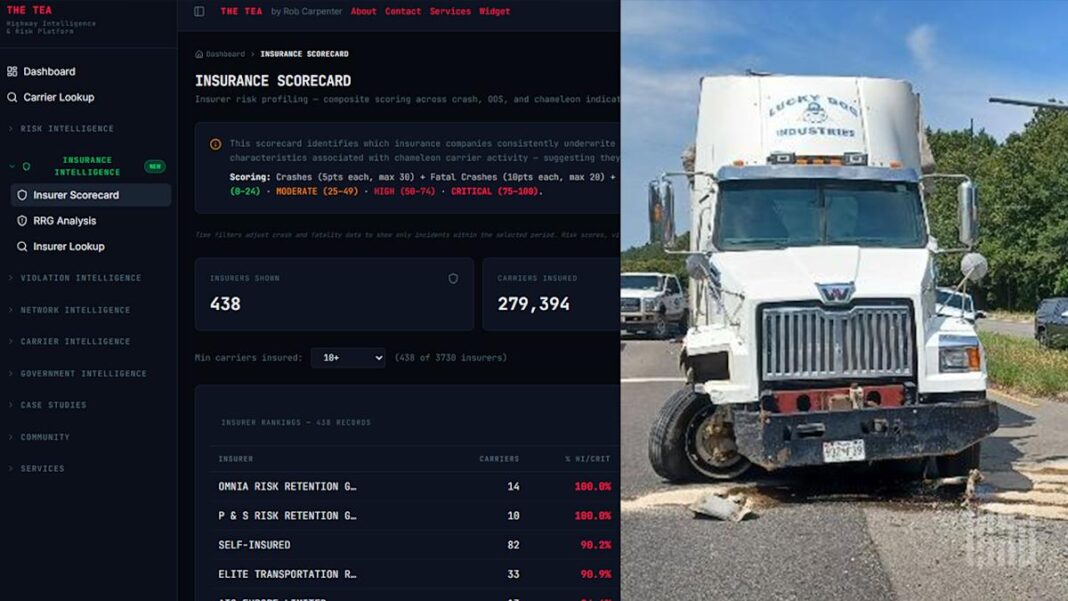
I knew we had significant concerns about trucking insurance, given the rising underwriting absence rates. Instant issue policies are increasingly prevalent, particularly among the worst-performing fleets. What I found was a massive hole in the regulatory framework so large that you could drive a truck through it. Based on the numbers, someone already has. About 589,690 times.
I’ve held a CDL for over 25 years. I’ve managed fleets, owned fleets. I consult for Fortune 500 carriers; I’ve overseen large, multi-entity private equity fleets; I’ve testified as an expert witness in highway accident litigation; and I have spent the better part of my career within the compliance machinery of American trucking. I thought I understood how the system worked. Most would have you believe I know more about the U.S. truck insurance market than most. Then I started pulling that data.
An analysis of 2.8 million insurer-carrier relationships in FMCSA data reveals extreme crash concentration: the top 5% of carriers by insurer portfolio risk account for 31.9% of all crashes and 31.8% of all fatalities. The reason? No federal or state law requires insurance companies to evaluate a motor carrier’s safety record before issuing a policy. The $750,000 federal minimum hasn’t changed since 1980. The result is a system where insurance is a financial barrier to entry but not a safety gate.
What the data says
I analyzed 2.8 million insurer-carrier relationships in the FMCSA’s public data. You can see my insurance scorecards on my site here; each trucking carrier profile also includes an insurance risk rating. Every active insurance filing for every interstate for-hire motor carrier in the United States. Then I scored each carrier using a peer-normalized risk framework that evaluates crash severity, inspection quality, authority stability, and compliance patterns within fleet size cohorts. The scores were aggregated to the insurer portfolio level.
Insurer portfolios in the highest-risk tier, with average risk scores between 21 and 50 on a 100-point scale, cover just 1.8% of all carriers. But those carriers account for 16.9% of all crashes and 16.6% of all fatal crashes in the dataset. The weighted crash rate per carrier in this tier is 58.9. In the lowest tier, it’s 1.13. That’s an insane difference.
When I ranked carriers by the riskiness of their insurer’s portfolio and computed cumulative crash shares, the concentration curve was almost vertical. The top 5% of carriers account for 31.9% of all crashes and 31.8% of all fatal crashes. At 25%, the curve captures 70.1% of both.
One-quarter of carriers, identifiable by their insurers, are involved in seven out of every 10 truck crashes in America.
The long tail is where the bodies are
I split the insurance market into two segments: the 50 largest insurers by carrier count, and everybody else. The 50 biggest cover 55.2% of carriers. The remaining 3,680 insurers account for the remaining 44.8%.
The top 50 have a weighted average risk score of 6.24 and a crash rate of 3.22 per carrier. They account for 27.7% of crashes. The long tail, those 3,680 smaller portfolios, has a risk score of 9.55, a crash rate of 10.32 per carrier, and accounts for 72.3% of all crashes. That’s 72% of crashes from 45% of carriers, concentrated in the segment of the market where surplus lines, specialty programs, and residual market placements are located.
This is the predictable result of a regulatory structure that imposes no quality gate on the insurance procurement process.
Nobody has to check
No federal or state law requires an insurance company to evaluate a motor carrier’s safety fitness before binding a commercial trucking policy.
Not FMCSA. Not your state insurance department. Nobody.
FMCSA sets the floor for how much coverage a carrier must carry: $750,000 for general freight, established during the Reagan administration and never adjusted. The agency checks that a BMC-91 form is on file. It does not check, and has no authority to check, whether the insurer that filed the form reviewed the carrier’s crash history, BASIC scores, out-of-service rates, driver qualification files, or anything else before issuing the policy.
Under the McCarran-Ferguson Act of 1945, insurance regulation is exclusively a state matter. State insurance departments regulate insurer solvency, licensing, rate filings, and claims practices. They do not mandate that insurers conduct prospective underwriting of individual policyholders. The decision to underwrite, and the rigor of that underwriting, is entirely at the insurer’s discretion.
Some insurers choose to underwrite. Group captive programs require on-site risk-control assessments, reviews of driver qualification files, evaluations of maintenance programs, and continuous monitoring of members. Carriers that underperform get placed on alert status. Carriers that don’t improve get removed.
Other insurers don’t. An algorithmically priced, instantly bindable policy from a major instant-issue provider can be obtained without a single human reviewing the carrier’s FMCSA record. The carrier self-reports. The algorithm prices. The policy binds. Authority activates. Trucks roll.
Both pathways are perfectly legal. The regulatory framework doesn’t distinguish between them.
The market of last resort
There’s another piece to this puzzle that almost nobody in trucking talks about, the assigned risk market.
AIPSO, the Automobile Insurance Plans Service Office, has administered the residual market for automobile insurance since 1973. In most states, carriers that cannot obtain coverage in the voluntary market may apply to the Commercial Automobile Insurance Procedure (CAIP). The state plan assigns the carrier to an insurer in proportion to that insurer’s share of the voluntary market. The assigned insurer must provide coverage regardless of the carrier’s risk profile.
The insurer has no discretion to reject the carrier. Assignment is mandatory.
This means that every insurer writing commercial auto in a given state can be forced to cover carriers that the entire voluntary market has already evaluated and rejected. The premiums are higher, but the coverage is issued. The carrier gets its BMC-91 filed. FMCSA activates the authority.
Now consider what happens if anyone ever proposes mandating underwriting standards. Every carrier that fails the assessment gets pushed into the assigned risk pool. The same pool designed to accommodate a small residual population now absorbs potentially tens of thousands of carriers with documented safety problems. The assigned insurers involuntarily bear the risk. The premiums go up. The losses go up. And the pool was never built for that kind of load.
This isn’t hypothetical. In 1992, the New Jersey Automobile Insurance Plan sued over widespread fraud in the Pennsylvania and New Jersey commercial auto assigned-risk plans, in which intermediaries had exploited loopholes in AIPSO-drafted rules to secure substantial premium reductions for trucking companies, shifting losses to assigned carriers. The case went to federal court and lasted for years. The assigned risk system was never designed to serve as a dumping ground for America’s riskiest trucking operations. But that’s exactly what it becomes when the voluntary market has no obligation to screen.
A $750,000 rubber stamp
The federal minimum levels of financial responsibility for motor carriers were set under the Motor Carrier Act of 1980. For general freight, the floor is $750,000 per occurrence. It has not been adjusted in 45 years.
Adjusted for inflation alone, that $750,000 should be approximately $2.2 million. The Truck Safety Coalition, citing FMCSA’s own 2014 review, argues it should be $10 million per occurrence. Their reasoning is worth quoting: the minimums should be “set sufficiently high to give the insurance companies a reason to set realistic underwriting standards that would reward safe companies and identify unsafe operations.”
That sentence reveals the intended but unrealized function of the federal minimum. Congress didn’t design the insurance requirement merely as financial protection for crash victims. It was supposed to be a mechanism that incentivized private-sector underwriting. If the minimum were high enough, insurers would have a financial incentive to evaluate carriers before binding coverage, because the potential loss exposure would justify the cost of risk assessment.
At $750,000, a fraction of the cost of a single fatal truck crash in litigation, the incentive is insufficient. The average verdict in a nuclear truck crash case now exceeds $20 million. The minimum coverage limit is 3.75% of that. You could not design a system more perfectly calibrated to discourage underwriting if you tried.
Risk Retention Groups: one state’s oversight, 50 states’ risk
The Liability Risk Retention Act of 1986 authorized Risk Retention Groups, liability insurance companies owned by their members, to operate nationally under the supervision of a single state. An RRG domiciled in Vermont or South Carolina can insure trucking companies in all 50 states while being regulated by only its home state’s insurance department.
Non-domiciliary states may require registration and tax payments, but they may not impose additional licensing, underwriting, or solvency requirements beyond those of the domiciliary state. The GAO found in 2005 that this created “a regulatory environment characterized by widely varying state standards.”
Here’s the part that matters most: RRG policies are not backed by state guaranty funds. Every RRG policy must include a disclosure that guaranty fund protections are unavailable. If a trucking-industry RRG becomes insolvent, the crash victims whose injuries were supposed to be covered by those policies may face uncollectible judgments. The LRRA’s preemption creates both a regulatory and a consumer-protection gap.
What should we do about it?
Raising the minimum is necessary but not sufficient. If an insurer can bind a $10 million policy on a carrier with 50 crashes without reviewing the carrier’s FMCSA record, the underwriting gap persists. The premium goes up. The screening doesn’t.
The more direct intervention is to mandate minimum underwriting standards. Either through FMCSA rulemaking or through a model act adopted by states via the NAIC, require that commercial auto insurers conduct a minimum safety review before binding coverage on a for-hire interstate motor carrier. The requirement doesn’t have to be complicated: review FMCSA safety data, document the risk assessment, and maintain ongoing monitoring conditions. Convert the insurance barrier to entry from a purely financial requirement. “Do you have a policy?” Should be turned into a safety quality requirement: has someone evaluated your operation?
Any mandatory underwriting regime must address the assigned risk market. Carriers that fail the assessment will be pushed into the residual pool. The current AIPSO-administered plans were not designed for that volume. Options include tiered assigned-risk premiums that reflect actual loss experience, mandatory safety improvement plans as a condition of assigned-risk coverage, and federal coordination with state plans to ensure that the residual market doesn’t become a regulatory bypass.
FMCSA already has the data to act. The insurance filing data is in their systems. Insurer portfolio risk could be incorporated into the Inspection Selection System tomorrow. A carrier insured through a portfolio in the top risk tier may receive prioritized inspection, investigation, or compliance review. No new data collection required. No new legislation needed. Just a decision to use what’s already there.
This is why I built THE TEA Intel.
THE TEA is an insurance intelligence and carrier risk scoring platform. It doesn’t just score carriers; every carrier vetting tool does that to some degree. THE TEA scores the insurance companies themselves. It uses the same peer-normalized methodology described in this article, crash severity, inspection quality, authority stability, and compliance patterns, benchmarked within fleet-size cohorts, and applies it at the insurer portfolio level. You can see which insurers are covering the highest concentration of high-risk and critical-risk carriers. You can see which Risk Retention Groups are writing policies for carriers that share VINs, officers, phone numbers, and addresses with shut-down operations. You can pull a DOT number and see not just that carrier’s risk score, but the risk profile of every other carrier insured by the same company.
That has never existed before. Not from FMCSA. Not from any commercial carrier vetting product. Not from the insurers themselves.
When the data shows that 13 insurers have 500-plus carriers each classified as high or critical risk, that’s intelligence the market has never had. When you can map which carriers in the worst-performing insurer portfolios share common ownership networks, that’s not carrier vetting anymore. That’s risk control intelligence. And it’s the kind of intelligence that insurance underwriters, captive group managers, brokers, shippers, and regulators have been making decisions without for decades.
THE TEA doesn’t replace underwriting. It gives underwriters, risk managers and compliance professionals the data layer that should have existed all along, the ability to see not just what a carrier looks like in isolation, but what the carrier’s insurer portfolio looks like, what that portfolio’s crash concentration looks like, and whether the carrier is sitting inside an insurer book of business that has a documented pattern of covering the industry’s worst performers. That context shifts the conversation from “Is this carrier safe?” to “Who else is standing next to this carrier in the same insurance pool, and what does that tell us?”
So What?
Based on a scoring model applied to 2.8 million records and the resulting output, the information exists to identify where crash risk is concentrated. It is visible. It is measurable. It is sitting in publicly available federal data.
The regulatory framework simply does not require anyone to use it.
That is not a failure of data or technology. It is not a failure of the insurance market. It is a failure of regulatory design, a system built in 1945, expanded in 1980, fragmented in 1986, and never updated for a world in which 5,936 people die on American highways every year in truck crashes. The patterns in this data are not hidden. They are just ignored.