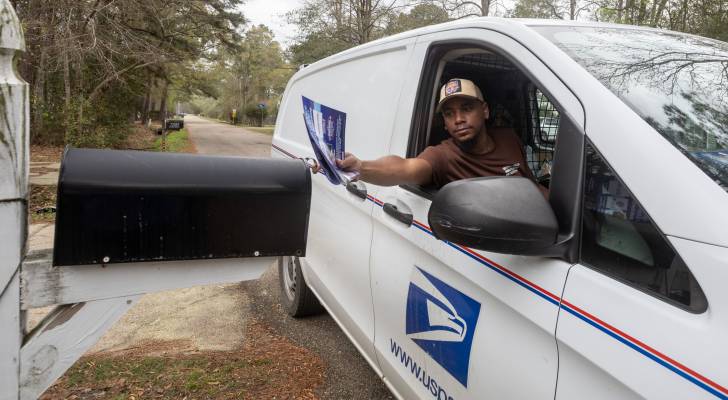
Every day, one in four Americans falls victim to mail theft — even though the United States Postal Service has been promising a crackdown.
Many are repeat victims, like Denver resident Karen Hagans, who told CBS Colorado that her mail disappears almost daily (1).
“If you didn’t go get your mail the minute it was delivered, you couldn’t trust that it was there,” she said.
Hagans’ mail is delivered to a cluster mailbox, easily accessed with a master key — or copy of one. That’s one of the challenges the USPS plans to address.
In the meantime, the problem is only getting worse. Since 2021, the U.S. Postal Inspection Service has reported a nearly 400% increase in mail theft-related fraud (2).
In 2025, USPS told Congress that mail theft of 58 million packages accounted for upwards of $16 billion in losses that year, affecting 25% of Americans (3).
As CBS News reports, mail thieves are intercepting valuables like credit cards and checks — exposing victims to identity theft, damaged credit scores and the hassle of month-long disputes with banks and creditors to make things right.
Here’s a look at the growing sophistication of mail theft and how you can respond.
In 2023, the USPS linked mail theft to organized crime, noting a “significant increase” in mail theft and violent crimes directed at letter carriers (4).
According to the fraud detection software company Nasdaq Verafin, mail thieves are increasingly working with insiders at postal services and banks to carry out check fraud — which accounted for $21 billion in losses across the Americas in 2023 (5).
They’re selling stolen check information and opening new accounts to negotiate checks.
Between February and August 2023 alone, mail thieves in the U.S. intercepted checks linked to $688 million in actual and attempted fraudulent transactions (6).
According to the U.S. Department of the Treasury’s Financial Crimes Enforcement Network (FinCEN):
-
44% of checks stolen from the mail were altered and deposited
-
26% were used to create counterfeit checks
-
20% were fraudulently signed and deposited
If you’re a victim of mail-theft-related check fraud, you may be able to recover your funds, but it could take time — and you will have to wait to access your funds till investigation is complete, according to the Financial Industry Regulatory Agency (FINRA).
So what’s being done about the problem?
A USPS spokesperson told CBS Colorado in a statement that the postal service is rolling out a multi-year nationwide security initiative to reduce mail theft, including more secure cluster mailboxes and collection boxes.
In the meantime, many Americans are unprotected. Here’s what you can do.
Read More: The average net worth of Americans is a surprising $620,654. But it almost means nothing. Here’s the number that counts (and how to make it skyrocket)
Getting your mail the moment it arrives is one response, but many people aren’t home when mail is delivered.
If you’re a frequent target of mail theft, you could install a USPS-approved locking mailbox.
If your mail goes into a cluster mailbox, like Hagans, you could rent a P.O. box. That’s what she did, but she had issues with mail forwarding.
You can use USPS Informed Delivery or courier tracking services to track high-value packages such as prescriptions and credit cards.
Set up email or app alerts for incoming mail, use expedited shipping (especially for prescriptions that could be temperature-sensitive) and request signature notification.
If you’re going to be out of town, have USPS hold your mail. You can do this for up to 30 days, for free.
If you’re mailing checks, FINRA recommends using checks with watermarks or holograms that provide enhanced security.
Use indelible black ink to write the check and fill it out completely — don’t leave any blank space on the ‘payee’ and ‘amount payable’ lines. And use secure drop boxes within USPS rather than curbside mailboxes. (3)
One of the easiest ways to avoid check theft is to avoid sending checks in the first place.
While there are plenty of digital scams out there — that’s a whole other topic — you could set up direct deposit (for money owed to you) and pay bills online.
It’s also important to monitor your accounts regularly so if something seems off, you can take immediate action.
If your mail goes missing, contact your bank and file a report with local law enforcement. You can also file a report with the U.S. Postal Inspection Service.
Join 250,000+ readers and get Moneywise’s best stories and exclusive interviews first — clear insights curated and delivered weekly. Subscribe now.
We rely only on vetted sources and credible third-party reporting. For details, see our editorial ethics and guidelines.
CBS News (1); Financial Industry Regulatory Agency (FINRA) (2); United States Postal Service (3, 4); Nasdaq Verafin (5); U.S. Department of the Treasury’s Financial Crimes Enforcement Network (FinCEN) (6)
This article provides information only and should not be construed as advice. It is provided without warranty of any kind.