

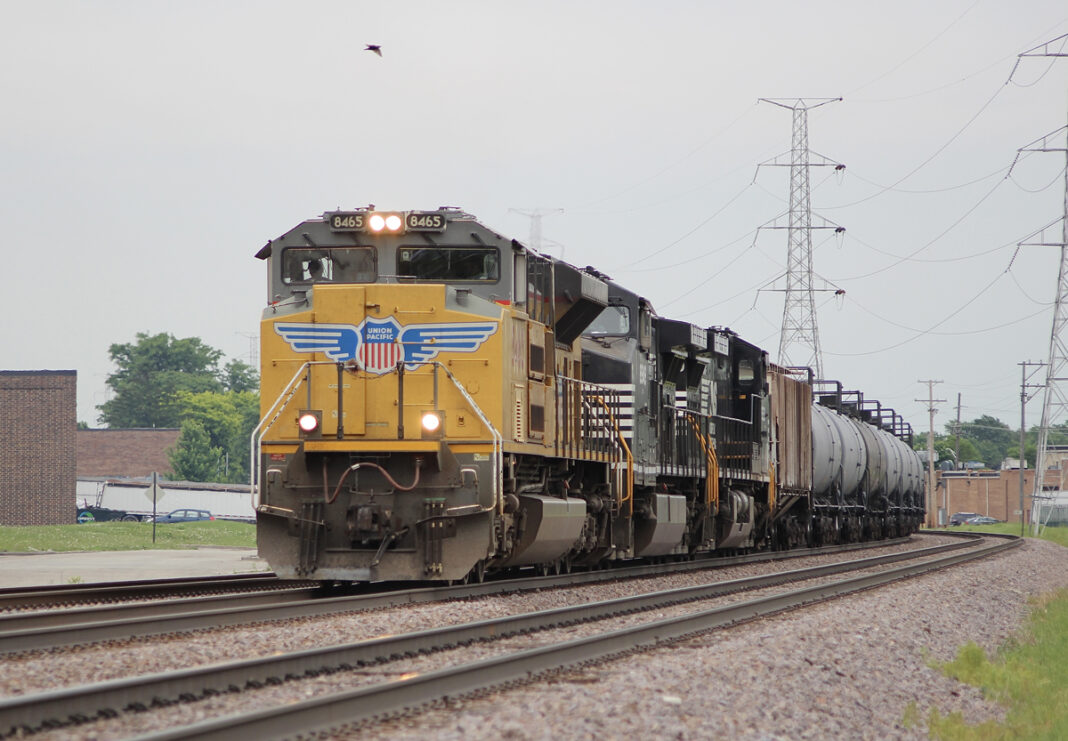

Union Pacific’s plans to submit its revised Norfolk Southern merger application slipped from March to April after federal regulators clarified how certain data must be formatted, UP Chief Executive Jim Vena said today.
On Tuesday, UP (NYSE: UNP) and NS (NYSE: NSC) told the Surface Transportation Board that they would file their updated merger application on April 30. The railroads had previously hoped to submit it in March.
“They said that we needed to give them some more information. Last week, through the liaison, they told us that the way they wanted to see that information was different than we thought three weeks ago,” Vena told an investor conference in Miami on Wednesday morning.
UP shares lost $10 in early trading Wednesday but recovered most of that by afternoon.
The STB on Jan. 16 rejected the application as incomplete. In a 15-page decision, the board said the application didn’t provide the required projections for post-merger market share, failed to include the complete merger agreement between the two railroads, and did not appropriately address control of the Terminal Railroad Association of St. Louis.
The new filing date will give the railroads’ consultants the time required to prepare traffic and economic studies, Vena explained.
“This is not a surprise,” Vena said of a regulatory process that does not move as fast as he would like.
Some observers had been sharply critical of forecasts in the original filing calculated in part by consultant Oliver Wyman.
Other Class I railroads have said that the $85-billion UP-NS merger will not enhance rail-to-rail competition, as required under the STB’s 2001 merger review rules.
Vena points out that UP currently handles 27% of the rail industry’s gross ton-miles in the U.S. After the acquisition of NS, UP would carry 39% of the GTMs – which is identical to what BNSF Railway handles today, Vena said.
“We’re going to be the same size,” he said.
At the same time, 75% of merger-related traffic growth is projected to come from truck diversions, UP Chief Financial Officer Jennifer Hamann said. “It’s not coming from another railroad, it’s coming off the highway.”
The primary argument behind the 2023 Canadian Pacific-Kansas City Southern merger – that CPKC’s end-to-end combination would be able to offer customers seamless, single-line service – also applies to UP-NS, Vena said.
By eliminating 24- to 48-hours delays related to interchange, a combined UP-NS will be able to move freight faster and more efficiently across the U.S., Vena said. This will save shippers money, he added, because they will be able to use fewer freight cars to move the same amount of product.


