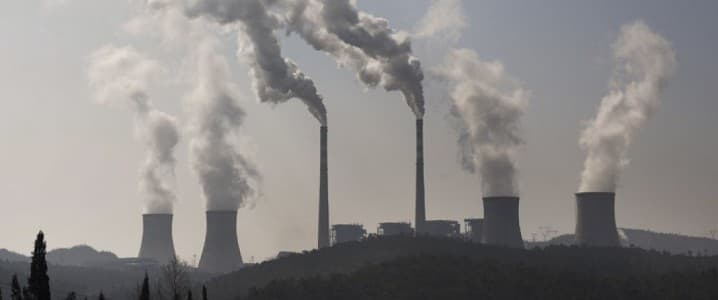
Every few years, a statistic captures the climate debate and briefly dominates headlines. The latest one comes from an analysis highlighted by Inside Climate News, claiming that just 32 companies are responsible for roughly half of global carbon dioxide emissions.
It is a striking figure. It is also deeply unconstructive.
Not because the data is wrong, but because the conclusion many draw from it has very little to do with how emissions can actually be reduced in a complex, fast-changing global energy system.
Correlation Is Not Control
Most of the companies on this list are familiar names. Oil and gas producers. Coal miners. Chemical manufacturers. State-owned energy giants. Their inclusion should surprise no one. These companies extract, process or sell the fuels and materials that underpin modern economies.
They are, by definition, upstream nodes in the system.
Assigning them responsibility for downstream emissions may feel morally satisfying, but it confuses accounting with agency. Emissions occur because energy is consumed, materials are demanded, and systems are built around those realities. Producers respond to that demand. They do not create it in isolation.
This distinction matters. You cannot solve a system-level problem by isolating one layer of the system and treating it as the sole lever for change.
Why Scope 3 Is a Dead End Argument
Much of the pressure placed on these companies focuses on Scope 3 emissions, meaning the emissions generated by their customers. The idea is that producers should force or accelerate change across their entire value chain.
In theory, this sounds reasonable. In practice, it quickly becomes performative.
A company can influence its operations. It can decarbonise production, invest in cleaner processes, reduce methane leaks, electrify assets, and deploy carbon capture. What it cannot do is unilaterally change how billions of people, cities and industries use energy overnight.
Expecting a fuel supplier to control the behaviour of end users is like asking a steelmaker to solve urban planning or a cement producer to redesign housing markets. Responsibility becomes so diffuse that it ceases to be actionable.
The result is not faster decarbonisation. It is friction, litigation, and defensive corporate behaviour.
These Companies Are Symptoms, Not the Disease
The uncomfortable truth is that these 32 companies exist at scale because the current system demands what they supply. Aviation, shipping, construction, chemicals, food production, electricity and heating all rely on the outputs of these industries.
Singling out producers without addressing consumption patterns, infrastructure lock-in and policy design is like blaming a mirror for what it reflects.
Yes, these companies must change. Many already are, albeit unevenly. But they are not always in the driving seat. In many cases, they are responding to regulatory frameworks, price signals and national energy strategies over which they have limited control.
State-owned enterprises, in particular, often operate as instruments of national policy rather than independent market actors. Asking them to move faster than the systems they serve is politically unrealistic.
Why the Narrative Is Counterproductive
Publicly concentrating blame on a handful of companies may feel like accountability, but it risks hardening positions at exactly the wrong moment.
Decarbonisation requires cooperation across value chains. It requires producers, consumers, regulators, financiers and technology providers to move in concert. Framing the transition as a morality play with clear villains undermines that cooperation.
It also distracts from where emissions reductions are actually achieved. Not in balance sheets, but in infrastructure decisions. Power plants. Industrial furnaces. Vehicle fleets. Buildings. Supply chains.
If the goal is to reduce emissions, the question should not be who to shame, but where intervention delivers the highest impact per euro, per regulation, per unit of political capital.
Transition Pathways Matter More Than Attribution
The most constructive role for large emitters is not to be isolated and pressured, but to be integrated into credible transition pathways.
Oil and gas companies, for example, control assets, expertise and capital that are essential for carbon capture, hydrogen, geothermal energy and large-scale infrastructure deployment. Chemical companies are central to developing low-carbon materials and circular processes. Coal-heavy utilities can accelerate grid transformation if given the right incentives and frameworks.
None of this happens through public finger-pointing. It happens through clear policy, predictable regulation and market mechanisms that reward decarbonisation rather than merely penalising emissions.
If anything, focusing excessively on historical responsibility risks slowing the transition by turning potential partners into adversaries.
Decarbonisation Is a System Design Problem
Climate change is not solved by identifying who emitted what. It is solved by redesigning energy, industrial and economic systems so that emissions no longer occur.
That means electrification where possible. Renewable deployment at scale. Grid expansion. Storage and flexibility. Carbon capture for residual emissions. Demand-side efficiency. Carbon pricing that actually works.
Producers play a role in all of this, but so do governments, cities, consumers and investors. When responsibility is framed too narrowly, accountability becomes theatrical rather than effective.
The energy transition will not be won in courtrooms or opinion pieces. It will be won in permitting offices, planning ministries, engineering teams and investment committees.
A Better Use of the Data
The analysis showing the concentration of emissions can still be useful if interpreted correctly. It highlights where engagement matters. It shows where transition finance, technology deployment, and policy dialogue can have outsized effects.
Used that way, the data becomes a roadmap, not a verdict.
The question should not be how to punish these companies, but how to help them change faster without breaking the systems they support. That requires pragmatism, not purity.
Pressure without pathways leads to resistance. Pathways without pressure lack urgency. The balance is difficult, but necessary.
Less Blame, More Transition
There is nothing wrong with demanding faster decarbonisation. There is something wrong with pretending it can be achieved by isolating a handful of companies from the systems that made them large.
If we genuinely want emissions to fall, we should focus less on naming and shaming and more on building transition pathways that work at scale. The world does not need fewer companies. It needs better systems.
By Leon Stille for Oilprice.com
More Top Reads From Oilprice.com
Oilprice Intelligence brings you the signals before they become front-page news. This is the same expert analysis read by veteran traders and political advisors. Get it free, twice a week, and you’ll always know why the market is moving before everyone else.
You get the geopolitical intelligence, the hidden inventory data, and the market whispers that move billions – and we’ll send you $389 in premium energy intelligence, on us, just for subscribing. Join 400,000+ readers today. Get access immediately by clicking here.