[ccpw id="5"]

Home.forex news reportWant to Invest in Small-Cap Stocks? Check Out These Two Top ETFs

Want to Invest in Small-Cap Stocks? Check Out These Two Top ETFs

-


The State Street SPDR Portfolio S&P 600 Small Cap ETF (NYSEMKT:SPSM) and the Schwab U.S. Small-Cap ETF (NYSEMKT:SCHA) aim to provide diversified exposure to U.S. small-cap stocks, but they track different indexes and use distinct methodologies. The two ETFs differ most in holdings, sector emphasis, and recent performance, with SCHA offering broader diversification and a stronger one-year return, while SPSM maintains a slightly lower expense ratio and higher yield.

This comparison explores how their portfolio makeup, costs, and recent risk-return profiles may appeal to investors seeking small-cap equity exposure.

Metric

SPSM

SCHA

Issuer

SPDR

Schwab

Expense ratio

0.03%

0.04%

1-yr total return (as of 2026-02-20)

18.4%

22.3%

Dividend yield

1.5%

1.2%

Beta

1.19

1.00

AUM

$14.8 billion

$20.8 billion

Beta measures price volatility relative to the S&P 500; beta is calculated from five-year weekly returns. The 1-yr return represents total return over the trailing 12 months.

SPSM edges out SCHA marginally on cost (expense ratio) and yield, offering a slightly higher payout for income-focused investors.

Metric

SPSM

SCHA

Max drawdown (5 y)

(27.94%)

(30.79%)

Growth of $1,000 over 5 years

$1,244

$1,223

SCHA tracks a broad small-cap index, holding 1,724 stocks and spreading sector weights across financial services (17.9%), industrials (17.2%), and healthcare (15.8%). Its largest positions include Sandisk Corp (NASDAQ:SNDK), Lumentum Holdings Inc (NASDAQ:LITE), and ATI Inc (NYSE:ATI), with no single stock dominating. Sandisk is the largest holding at 2%. With a 16-year history and over $20 billion in assets under management (AUM), SCHA emphasizes diversification and liquidity for investors seeking comprehensive small-cap exposure.

In comparison, SPSM covers 607 stocks, with sector tilts toward industrials (18.1%), financial services (18%), and consumer discretionary (14%). Its top holdings are Solstice Adv Materials Inc (NASDAQ:SOLS), Moog Inc (NYSE:MOGA), and InterDigital Inc (NASDAQ:IDCC), each representing less than 1% of the portfolio. SPSM’s approach is more concentrated, which may result in slightly different risk and return dynamics versus SCHA’s broader reach.

For more guidance on ETF investing, check out the full guide at this link.

Small-cap stocks offer high return potential but also carry risks and can be volatile. The key to success in small-cap investing, therefore, often boils down to an investor’s patience and appetite for risk.

Because analyzing, picking, and investing in individual small-cap stocks is not for everyone, the State Street SPDR Portfolio S&P 600 Small Cap ETF and the Schwab U.S. Small-Cap ETF are two of the most elite, low-cost ETFs to invest in small-cap stocks. The number of their holdings, however, can make a big difference.

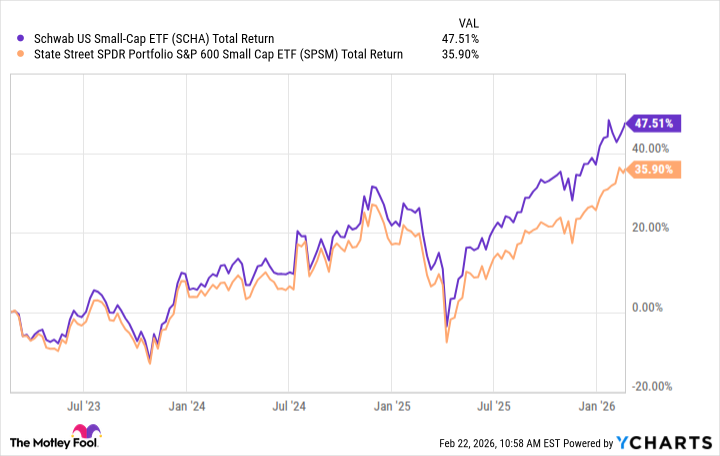
SCHA Total Return Level Chart

SCHA Total Return Level data by YCharts

SCHA tracks the Dow Jones U.S. Small-Cap Total Stock Market Index, which comprises over 1,700 stocks and offers the broadest possible exposure to small-cap stocks. SPSM, comparatively, tracks the S&P SmallCap 600 Index and is more concentrated, with nearly one-third as many holdings as SCHA.

SCHA may appeal to investors with a high appetite for risk because of its large portfolio. Over the past one and three years, this ETF has also outperformed SPSM.

Before you buy stock in Schwab Strategic Trust – Schwab U.s. Small-Cap ETF, consider this:

The Motley Fool Stock Advisor analyst team just identified what they believe are the 10 best stocks for investors to buy now… and Schwab Strategic Trust – Schwab U.s. Small-Cap ETF wasn’t one of them. The 10 stocks that made the cut could produce monster returns in the coming years.

Consider when Netflix made this list on December 17, 2004… if you invested $1,000 at the time of our recommendation, you’d have $424,262!* Or when Nvidia made this list on April 15, 2005… if you invested $1,000 at the time of our recommendation, you’d have $1,163,635!*

Now, it’s worth noting Stock Advisor’s total average return is 904% — a market-crushing outperformance compared to 194% for the S&P 500. Don’t miss the latest top 10 list, available with Stock Advisor, and join an investing community built by individual investors for individual investors.

See the 10 stocks »

*Stock Advisor returns as of February 22, 2026.

Neha Chamaria has no position in any of the stocks mentioned. The Motley Fool has positions in and recommends Lumentum and Moog. The Motley Fool has a disclosure policy.

Want to Invest in Small-Cap Stocks? Check Out These Two Top ETFs was originally published by The Motley Fool


Source link

LEAVE A REPLY

Please enter your comment!
Please enter your name here

LATEST POSTS

‘Yes, We’re in a Bear Market,’ So Get Bitcoin

On Sunday, Anthony Scaramucci said he believes markets have slipped into a bear phase and argued the real issue is duration,...

Investor Slashes $70 Million From Zymeworks as Stock Jumps 60% in a Year

Redmile Group disclosed a significant reduction in its Zymeworks (NASDAQ:ZYME) position in a February 17, 2026, SEC filing, selling an estimated...

Vertiv Stock: Buy, Sell, or Hold?

Vertiv (NYSE: VRT) stock is a popular pick-and-shovel play on the increased build-out efforts related to artificial intelligence (AI) data centers....

RBNZ Governor Breman: Not at all comfortable with having inflation at 3.1%

High risk warning: Foreign exchange trading carries a...

Follow us

0FansLike
0FollowersFollow
0SubscribersSubscribe

Most Popular

spot_img