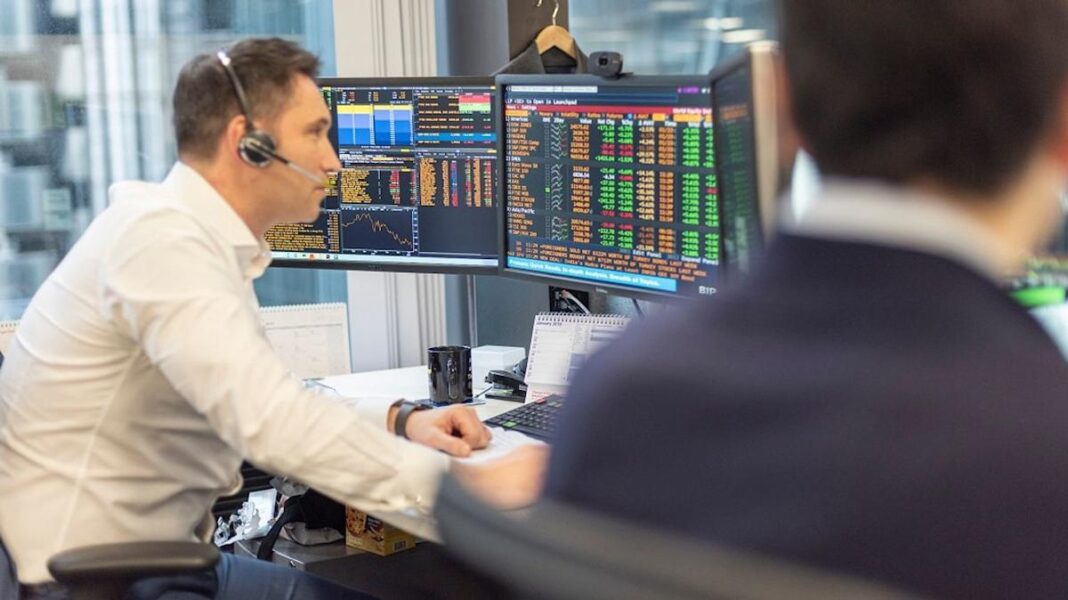
FTSE 100 Live: Stocks inch higher after Trump tariff reset, gold miners and oilers lifted Proactive uses images sourced from Shutterstock
FTSE 100 up 14 points at 10,700
Precious metals in demand amid new tariff uncertainty
Johnson Matthey slashes price of catalyst disposal
We are still in a “Goldilocks” market, according to JPMorgan strategists, which reckons non-US stocks can continue to outperform in coming months.
Despite the US military build-up around Iran and US tariffs being reset, the bank argues the growth-inflation mix remains equity-friendly as we wrap up the second month of the year.
Earnings are holding up, activity data is solid, inflation is softening and long bond yields have drifted lower, Fed funds futures are pricing more easing despite three-year highs in ISM readouts and a punchy payrolls print. Not exactly stagflation.
“The strong equity rally can lead to derisking episodes,” the bank’s strategists say, ie pull-backs, “and particularly if some adverse geopolitical news comes out, such as potential Iran escalation or the latest tariff headlines, but we believe that these will not be long lasting, and should be seen as buying opportunities.”
JPM sees leadership – ie which stocks drive overall market performance – broadening away from the Mag-7 tech giants, which have “stalled” despite strong earnings, in favour of small caps, ‘value’ stocks and international (ie non-US) stocks.
If mega-cap tech does not reassert itself, US indices may struggle to lead.
“After years of lagging, international markets outperformed the US in 2025 by 12%,” and are again in the lead by 8% so far in 2026.
“We think this outperformance is justified, and believe that it will keep having legs,” JPM adds, “given still extreme positioning, elevated concentration of Mag-7 and the large valuation differential.”
“If Mag-7 does not retake the lead, it is unlikely US stocks will be able to, too.”
The FTSE 100 is now inching upwards and has regained the 10,700 plateau.
JD Sports, precious metals and copper miners, plus China-tilted names like Burberry and Standard Chartered are topping the leaderboard.
On mainland Europe, the mood also seems to be more positive in the most part, with Germany’s DAX the only main index still in the red.
US stock futures are also negative, with the Nasdaq indicated down 0.6%, S&P 500 futures down 0.4% and those for the Dow Jones down 0.3%.
Is the ‘Sell America’ trade back?
“The market reaction so far is mixed,” says market analyst Kathleen Brooks, adding that the lower US stock futures “suggests that, at the margin, these new tariffs, are fueling the sell-America trade, and we could see more European outperformance vs US stocks in the coming weeks. This comes after European stocks easily outpaced their US counterparts last week.”
The earlier sell-off in the dollar was far from a rout, but “is worth watching closely, and risk sentiment could be impacted as more details about the tariffs and how they will be implemented come out this week”, she says.
“As we move to the last trading week of the month, US indices are trailing their European counterparts, after a bruising month, that has been categorized by broad US stock sell offs spurred by fears about the latest AI tools.
“The Nasdaq is still in the red for the year so far, as the US tech index is a major global underperformer.”
For the Nasdaq, it is a bit of a repeat of 2025, when the index had its worst start to the year in two decades, but rebounded hard. Also, look back to 2022, the index sold off sharply and fell 33% for the full year, substantially underperformed the S&P 500 and other European indices but then blasted back over the following two years.
Looking ahead, today’s economic data is factory orders and the Dallas Fed manufacturing index.
BP shares are up 0.9% and Shell 0.2%, with Brent crude oil futures down 0.7% at $71.25 a barrel, having at the end of last week topped $72 for the first time since last July.
UBS analyst Joshua Stone says energy markets are carrying “elevated risk premiums” as investors brace for potential US strikes on Iran.
Citing reports that President Trump is considering an initial military move, Stone notes the risk of disruption around the Strait of Hormuz, which handles about 20% of global oil and LNG supply.
However, he cautions that “geopolitically-induced spikes are often short-lived”, especially without lasting supply damage.
In the near term, the analyst and his colleagues like the look of producers with good upstream exposure (citing Equinor) but stress that “prices can fade as quickly as they arrive” and so continue to favour companies with stronger structural growth (highlighting TotalEnergies, Eni and Galp as preferred names to add “on any dips”).
Some movers.
Empyrean Energy has jumped over 20% after telling investors it has finalised binding documents to settle historical cash call arrears tied to Indonesia’s Mako gas project, activating a previously announced farm-out structure.
Smiths News is down 5% after receiving a warning notice from the Pensions Regulator over the Tuffnells Parcels Express pension scheme, raising the possibility of a financial claim against the company.
Helix Exploration jumped 5% in early deals, moving back towards recent highs, after revealing that it has started producing helium gas at its Rudyard project in northern Montana, saying the move makes it the first helium gas producer in the state.
TomCo Energy dropped 35% impacted by expected new equity dilution, after it announced a renewed partnership to progress oil-sands opportunities in Utah’s Uinta Basin.
New US tariffs are “only smoke and mirrors” for other options, say ING’s Carsten Brzeski and James Knightley.
“Given that the latest tariffs can also be legally challenged, they might just be a measure to buy some time for another tariff option: Section 301 of the 1974 law.
“This Section 301 addresses unfair trade practices or violations of trade agreements but requires more thorough investigations.”
The bilateral deals agreed with several countries, such as the UK and Japan, are “not directly affected by the Supreme Court ruling”.
“However, some deals – such as those with Switzerland or India – made explicit reference to the emergency tariffs, as the new tariff rates were framed as reductions from those emergency levels. As the legal reference tariff rate has now disappeared, these deals might have to be redrafted,” the pair said.
In the case of the US-EU trade deal, “things are even more complicated”, they add.
“The European Parliament suspended approval of the EU’s commitments under the agreement when the Greenland conflict escalated. It now remains unclear whether the Parliament will push for a full renegotiation of the deal.
“That said, the US administration would likely rely on sectoral tariffs and Section 301 measures to pressure the EU to return to the negotiating table.”
US macro outlook stays roughly unchanged, they believe, with rising import prices and the latest core goods CPI reading of 1.1% indicating that corporate America is bearing the bulk of the burden from tariff costs.
The FTSE 100 is almost back to flat now, down less than one point.
It’s mixed across on the Continent, with the DAX down 0.4% in Frankfurt, while the CAC 40 is almost flat in Paris, while the benchmarks in Milan and Madrid are both up 0.7%.
The Euro Stoxx 600 is down 0.1%.
Markets are eyeing a global trade landscape that is an “unholy mess, prompting far more questions than answers”, according to market analyst Richard Hunter at Interactive Investor.
But he says the confusion “may yet have revived the ‘sell America’ trade,” with Wall Street futures indicating lower.
“The initial market reaction to the ruling was positive, lifting the likes of Amazon and Home Depot who in theory could benefit from tariff refunds. However, as the weekend events unfolded, sentiment has turned and the current indication is that the main indices will reverse any such gains when trading resumes later.”
There will be more for investors for ponder on the AI trade this week as Nvidia reports earnings, while today is the deadline for Paramount to make a best and final offer for Warner Bros Discovery, potentially derailing Netflix’s $83 billion takeover deal.
Gold and silver miners are among the top risers, as precious metals prices have picked up on the back of the new tariff uncertainty.
Fresnillo shares are up 3.3% and Endeavour Mining 3.1% on the FTSE 100, while among mid-caps, Hochschild Mining has risen 3% and Pan African Resources 2.2%.
The price of gold rose to a three-month high above $5,170 an ounce in early morning trading, but has eased back to $5,125.
Silver was up 1.7% at $86/oz, having neared $88 in the early hours, at least a two-week high.
Copper prices spiked overnight, but were down in early European trading, though Antofagasta is up 1.4%, with Glencore and Anglo American shares also moving higher.
The FTSE 100 has opened 16 points lower at just below 10,671.
Leading the fallers are a disparate mix of companies, including Whitbread, ICG, Mondi, LSEG, DCC, Polar Capital Tech Trust and BAE Systems.
On the FTSE 250, Johnson Matthey is leading the fallers, down 12.7% after cutting the price and payout for the big catalysts disposal it announced last year.
In company news, Johnson Matthey has cut the price it is selling its Catalyst Technologies (CT) division to Honeywell and agreed to extend the deadline, saying it plans to return around £1 billion to shareholders compared to £1.4 billion before.
The chemicals group said it has lowered the price to reflect the deferral of key licensing projects and reduced profitability from supplying catalysts because of what it described as a challenging market environment.
As a result, the agreed enterprise value of the business has been set at £1.325 billion on a cash and debt-free basis, down from £1.8 billion when the sale was agreed last May.
The new tariff situation “leaves a substantial amount of uncertainty, even if markets initially welcomed the perceived clarity of ‘only’ a 10% tariff on Friday”, says Jim Reid, macro strategist at Deustsche Bank.
Trump’s new 15% tariff under Section 122 can only remain in place for 150 days, he notes, meaning Congressional approval would be required by late July to extend it.
“That raises a key political question: will a small number of Republicans in either chamber be reluctant to support what could be framed as an extension of a consumer tax hike just three and a half months before the mid term elections?
“At that point, the administration faces a binary choice: try to secure an extension or allow the tariff to lapse. The latter appears the more likely outcome.”
The White House could pivot to other legal authorities to re-establish a more durable tariff regime, which Reid says the groundwork for such moves has almost certainly been laid and are also vulnerable to legal challenges.
Over the weekend, US Trade Representative Jamieson Greer suggested yesterday that trade deals already agreed with other countries will remain in place.
“It will be interesting to see if the assurances from the likes of Greer ease concerns of those who have already agreed deals,” says Reid.
An emergency European Parliament trade committee meeting is taking place today, with chair Bernd Lange saying: “Nobody can make sense of it anymore – only unanswered questions and growing uncertainty for the EU and other US trading partners.”.
The FTSE 100 is expected to start the week on the back foot as traders chew over the US government’s fast-evolving tariff situation and a fall in UK job vacancies.
London’s blue-chip index has been called 13 points lower, after it added over 240 points last week to finish at 10,686.89.
Wall Street stocks also had a positive week overall, ending on the front foot after the US Supreme Court ruled that Donald Trump’s broad-based tariffs were unconstitutional.
The White House immediately responded with plans for a 10% global tariff under new rules, increasing this to 15% on Saturday, the maximum tariff that can be imposed using the ‘Section 122’ authority, which only lasts until mid-July.
China’s Commerce Ministry urged the US to cancel tariffs as they are “are not in the interests of any party” and “fighting is harmful”.
Back in the UK, the number of job vacancy adverts have been revealed to have fallen 3% last month to the lowest level since 2021, according to the job site Adzuna, the first time below 700,000 in five years.
Asian markets are mixed this morning, with Japan’s Nikkei and the Shanghai Composite indices both down over 1%, while Hong Kong’s Hang Seng shoots 2.2% higher and India’s Sensex is up 0.4%.
U.S. Sen. Ron Wyden (D-Ore.) speaks at a press conference following the Democratic weekly policy lunch on Capitol Hill in Washington, D.C., Dec.9, 2025.Annabelle...