


Retail participation in financial markets has increased steadily over the past decade, with individual investors now accounting for a meaningful share of daily equity volumes and capital inflows in the US. Online brokerages, zero-commission trading, and mobile platforms have made direct market access routine.
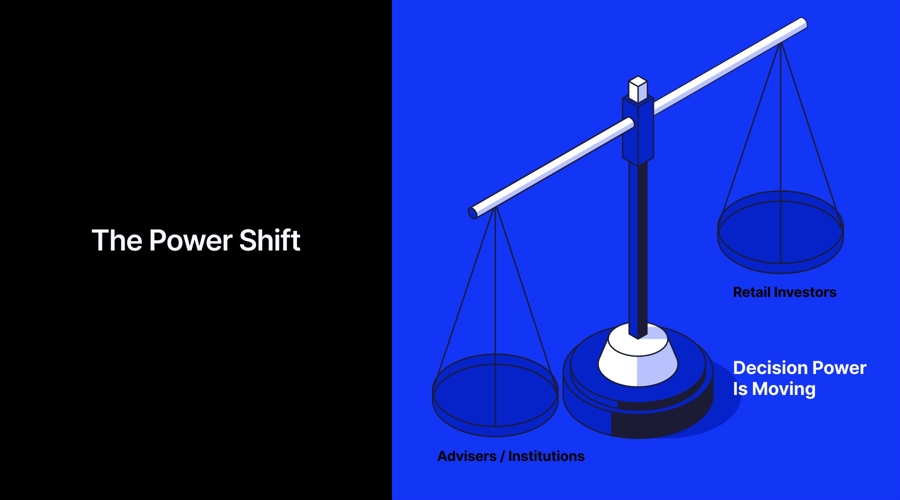
The more significant shift, however, lies in decision-making authority. A growing number of investors are selecting securities and allocating capital without advisers, prompting brokers to redesign platforms, rethink product architecture, adjust revenue models, and strengthen risk oversight around self-directed participation.
What Is a Self-Directed Investor — and How Is That Different From an Active Investor?
A self-directed investor is defined by autonomy. They make independent investment decisions: choose assets, allocate capital, and execute trades without relying on a financial adviser.
An active investor, by contrast, is defined by strategy. They buy and sell frequently to outperform a benchmark, but not necessarily on their own.
These features are not mutually exclusive: investors may act actively within adviser-managed accounts, while self-directed investors can employ passive buy-and-hold strategies.
Autonomy determines who decides. Activity reflects the frequency and intensity of investing. This distinction matters as brokers reshape platforms around ownership, not just turnover.
Investor Autonomy and Trading Activity: Four Retail Archetypes
How Fast Is Self-Directed Investing Growing — and Where Is It Concentrated?
Investor autonomy has expanded materially over the past decade. According to Broadridge, in the US, the percentage of investors who have self-directed accounts rose to 33% in 2025, up from 19% in 2018. The share of assets held in self-directed brokerages rose from 14% to 24% over the same period.
The shift is also visible in retirement capital.Charles Schwab’s latest SDBA Indicators Report confirms that average balances in self-directed brokerage accounts within retirement plans reached $383,087 in the third quarter of 2025, up 10.3% year-over-year.
While Vanguard reports that only around 1% of eligible plan participants use self-directed brokerage features, those who do tend to build more concentrated portfolios: 24% hold extreme allocations — either fully in equities or entirely outside them — a pattern rarely seen in professionally managed accounts.
Adviser usage has edged lower in parallel. According to the FTSE Russell Retail Investor Survey 2024, 59% of retail investors reported working with financial advisers, down from 64% two years earlier. The trend does not imply the disappearance of advice, but it does signal a gradual redistribution of decision-making power toward the end investor.
Why Does Decision Ownership Force Brokers to Redesign Their Platforms?
The rise of self-directed investors does not simply increase trading volume. It changes where responsibility sits. When investors delegate decisions, the platform’s role is primarily administrative: execution, custody, and reporting. When investors insist on making decisions themselves, the platform becomes their primary decision infrastructure.
Retail investors now account for roughly 20–25% of daily US equity trading volume, according to JPMorgan, with participation rising to 35% during peak activity periods. In 2025 alone, net retail inflows into US equities rose by more than 50% year over year, surpassing even the 2021 meme-era peak.
Retail’s Structural Weight in US Markets
That shift affects design at multiple levels. Interfaces must deliver real-time data, frictionless execution, and full portfolio transparency. Order tickets need to be simplified without being simplistic. As a result, platforms tend to prioritize real-time data, simplified order flows, and full portfolio transparency.
Autonomy also alters product architecture. Platforms built around long-term allocation models are being reshaped to support tactical positioning – whether that means rotating ETFs, adjusting sector exposure, or expressing short-term views through derivatives. Even investors who ultimately hold passive instruments expect to be able to rebalance instantly and monitor exposures continuously.
In other words, the broker is no longer just an intermediary between client and market. It is the operating environment in which the investor thinks, analyses, and acts. As decision-making shifts to the end user, platform design shifts from static account management to dynamic, real-time control.
When Does Autonomy Turn Into Activity — and Which Products Capture It?
Self-direction does not automatically translate into high trading frequency. But it lowers friction. And lower friction tends to increase engagement — especially when investors have direct access to tools, real-time data, and leverage.
According to Cboe Global Markets Report for 2025, zero-days-to-expiration (0DTE) options now account for roughly 59% of S&P 500 options volume, with daily activity in SPX contracts averaging in the millions. These instruments offer precise, short-term exposure — aligning with investors who want to express views quickly and adjust positions intraday.
The revenue implications are significant. Options generate substantially more payment-for-order-flow revenue than equities for the same notional exposure — estimates suggest roughly 20 times more.
As a result, platforms serving active self-directed investors see revenue increasingly concentrated in derivatives rather than traditional stock trades.
Prediction markets have emerged as another expression of this shift.
Event contracts allow investors to take directional views in simplified formats. Their growth reflects demand for instruments that translate opinions into positions with minimal structural complexity.
However, not all self-directed investors are highly active. Activity tends to rise when autonomy meets high conviction and easy execution. Product design follows, resulting in platforms optimised for speed and real-time risk exposure.
Why Is AI Becoming the Operating System for Self-Directed Investors?
If autonomy shifts decision-making to the end investor, AI reduces the cognitive burden that comes with it. Self-directed investors do not necessarily want advice delegated, they want analysis accelerated.
That distinction is driving the integration of AI directly into the trading interface. Adoption is already widespread. Data from eToro’s Retail Investor Beat (Q3 2025) show that roughly 58% of US retail investors reported using AI tools in portfolio construction, with significantly higher uptake among Millennials and Gen Z.
These tools range from portfolio digests explaining performance drivers to natural-language order entry and strategy builders that translate market views into trade structures.
For self-directed investors, AI shortens the distance between idea and execution. Instead of navigating multiple screens or interpreting dense analytics, investors can query exposures, simulate outcomes, or initiate trades conversationally. The platform becomes not just a venue for execution but an analytical companion embedded in real time.
The shift has governance implications. Regulators are increasingly focused on explainability, supervision, and “kill-switch” mechanisms as AI systems move closer to autonomous decision support. As AI becomes more central to the interface, brokers are under growing pressure to balance acceleration with accountability — ensuring that automation enhances autonomy without obscuring risk.
AI, in this context, is less about replacing advisers and more about scaling independent decision-making. It enables self-direction at greater speed and complexity — reinforcing the structural move toward investor-controlled portfolios.
How Does Greater Autonomy Reshape Broker Monetization?
As decision-making moves to investors, engagement and revenue concentration tend to increase. Industry surveys and broker initiatives suggest that self-directed investors are typically more engaged with trading tools and platform features, with many maintaining separate accounts to pursue tactical or higher-risk strategies.
When autonomy and activity combine, monetisation shifts toward higher-margin products.
Derivatives are central to that shift. Options, particularly short-dated contracts, generate materially higher payment-for-order-flow revenue per dollar traded than equities, according to SEC disclosures and academic research.
The structural linkage can be summarised as follows:
From Investor Autonomy to Broker Revenue: A Structural Link
| Shift in Investor Behaviour | Platform Impact | Product Impact | Revenue Implications |
| More self-directed participation | Real-time portfolio visibility | Broader ETF & equity access | Asset-based fees, subscriptions |
| Faster decision cycles | Simplified mobile order flows | 0DTE & short-dated options | Higher PFOF concentration |
| Higher risk tolerance | Intraday exposure tracking | Leverage & derivatives | Margin income |
| Demand for analytics | AI-integrated interfaces | Strategy builders | Premium tiers |
| Thematic positioning | Expanded sector & macro products |
Leveraged & inverse ETFs |
Engagement-driven revenue |
How shifts in retail decision-making reshape platform design, product mix, and monetization models.
For brokers with large active self-directed bases, this creates a revenue model increasingly tied to engagement intensity rather than asset custody alone.
At the same time, regulatory scrutiny of payment-for-order-flow (including the EU’s planned PFOF phase-out and the SEC’s proposed order competition rule in the US) is pushing platforms to diversify.
Subscription tiers have gained momentum. In its Fourth Quarter and Full Year 2025 earnings report, Robinhood disclosed that Gold subscribers grew 58% year-over-year, underscoring rising demand for bundled premium tools and margin benefits. Premium tiers typically bundle real-time market data, advanced charting tools, lower margin rates, and increasingly, AI-driven analytics.
As a result, brokers are building hybrid models: transactional revenue from activity, recurring revenue from subscriptions, and balance-sheet income from financing.
The monetisation shift mirrors the behavioral shift. As investors assume greater control, brokers monetise not only trades but the infrastructure that enables autonomous decision-making.
Are Brokers Empowering Investor Autonomy — or Containing Its Risks?
As autonomy expands, so does supervisory complexity. When investors delegate decisions, suitability controls are embedded in advisory processes. When they act independently, risk management shifts to the platform layer.
That shift is reflected in recent regulatory initiatives. In the US, FINRA’s proposed rule change SR-FINRA-2025-017 would amend Rule 4210 by replacing the long-standing day trading margin provisions with intraday margin standards — a move toward real-time exposure monitoring rather than static capital thresholds.
The proposal signals a broader shift from fixed eligibility gates to continuous risk oversight.
Regulatory attention has also intensified around technology-enabled engagement.
Platforms are responding by embedding dynamic safeguards. Risk nudges, exposure alerts, suitability refresh prompts, and behavioural analytics are increasingly integrated directly into order flows. AI systems, while designed to accelerate decision-making, are also being paired with audit trails and supervisory controls to ensure explainability and override capability.
The result is a structural tension. Brokers face the challenge of enabling autonomy by offering speed, precision, and analytical tools, and simultaneously building infrastructure to contain excessive risk-taking. The more investors insist on controlling their portfolios, the more platforms must operate as real-time risk engines.
The transformation underway is mostly about a redistribution of decision authority. As control moves to the individual investor, brokers are evolving from execution venues into integrated operating environments that combine trading, analytics, and risk management.
The challenge is no longer just enabling access, but balancing autonomy with oversight in a market where investors increasingly expect to direct their own participation.
Retail participation in financial markets has increased steadily over the past decade, with individual investors now accounting for a meaningful share of daily equity volumes and capital inflows in the US. Online brokerages, zero-commission trading, and mobile platforms have made direct market access routine.
The more significant shift, however, lies in decision-making authority. A growing number of investors are selecting securities and allocating capital without advisers, prompting brokers to redesign platforms, rethink product architecture, adjust revenue models, and strengthen risk oversight around self-directed participation.
What Is a Self-Directed Investor — and How Is That Different From an Active Investor?
A self-directed investor is defined by autonomy. They make independent investment decisions: choose assets, allocate capital, and execute trades without relying on a financial adviser.
An active investor, by contrast, is defined by strategy. They buy and sell frequently to outperform a benchmark, but not necessarily on their own.
These features are not mutually exclusive: investors may act actively within adviser-managed accounts, while self-directed investors can employ passive buy-and-hold strategies.
Autonomy determines who decides. Activity reflects the frequency and intensity of investing. This distinction matters as brokers reshape platforms around ownership, not just turnover.
Investor Autonomy and Trading Activity: Four Retail Archetypes
How Fast Is Self-Directed Investing Growing — and Where Is It Concentrated?
Investor autonomy has expanded materially over the past decade. According to Broadridge, in the US, the percentage of investors who have self-directed accounts rose to 33% in 2025, up from 19% in 2018. The share of assets held in self-directed brokerages rose from 14% to 24% over the same period.
The shift is also visible in retirement capital.Charles Schwab’s latest SDBA Indicators Report confirms that average balances in self-directed brokerage accounts within retirement plans reached $383,087 in the third quarter of 2025, up 10.3% year-over-year.
While Vanguard reports that only around 1% of eligible plan participants use self-directed brokerage features, those who do tend to build more concentrated portfolios: 24% hold extreme allocations — either fully in equities or entirely outside them — a pattern rarely seen in professionally managed accounts.
Adviser usage has edged lower in parallel. According to the FTSE Russell Retail Investor Survey 2024, 59% of retail investors reported working with financial advisers, down from 64% two years earlier. The trend does not imply the disappearance of advice, but it does signal a gradual redistribution of decision-making power toward the end investor.
Why Does Decision Ownership Force Brokers to Redesign Their Platforms?
The rise of self-directed investors does not simply increase trading volume. It changes where responsibility sits. When investors delegate decisions, the platform’s role is primarily administrative: execution, custody, and reporting. When investors insist on making decisions themselves, the platform becomes their primary decision infrastructure.
Retail investors now account for roughly 20–25% of daily US equity trading volume, according to JPMorgan, with participation rising to 35% during peak activity periods. In 2025 alone, net retail inflows into US equities rose by more than 50% year over year, surpassing even the 2021 meme-era peak.
Retail’s Structural Weight in US Markets
That shift affects design at multiple levels. Interfaces must deliver real-time data, frictionless execution, and full portfolio transparency. Order tickets need to be simplified without being simplistic. As a result, platforms tend to prioritize real-time data, simplified order flows, and full portfolio transparency.
Autonomy also alters product architecture. Platforms built around long-term allocation models are being reshaped to support tactical positioning – whether that means rotating ETFs, adjusting sector exposure, or expressing short-term views through derivatives. Even investors who ultimately hold passive instruments expect to be able to rebalance instantly and monitor exposures continuously.
In other words, the broker is no longer just an intermediary between client and market. It is the operating environment in which the investor thinks, analyses, and acts. As decision-making shifts to the end user, platform design shifts from static account management to dynamic, real-time control.
When Does Autonomy Turn Into Activity — and Which Products Capture It?
Self-direction does not automatically translate into high trading frequency. But it lowers friction. And lower friction tends to increase engagement — especially when investors have direct access to tools, real-time data, and leverage.
According to Cboe Global Markets Report for 2025, zero-days-to-expiration (0DTE) options now account for roughly 59% of S&P 500 options volume, with daily activity in SPX contracts averaging in the millions. These instruments offer precise, short-term exposure — aligning with investors who want to express views quickly and adjust positions intraday.
The revenue implications are significant. Options generate substantially more payment-for-order-flow revenue than equities for the same notional exposure — estimates suggest roughly 20 times more.
As a result, platforms serving active self-directed investors see revenue increasingly concentrated in derivatives rather than traditional stock trades.
Prediction markets have emerged as another expression of this shift.
Event contracts allow investors to take directional views in simplified formats. Their growth reflects demand for instruments that translate opinions into positions with minimal structural complexity.
However, not all self-directed investors are highly active. Activity tends to rise when autonomy meets high conviction and easy execution. Product design follows, resulting in platforms optimised for speed and real-time risk exposure.
Why Is AI Becoming the Operating System for Self-Directed Investors?
If autonomy shifts decision-making to the end investor, AI reduces the cognitive burden that comes with it. Self-directed investors do not necessarily want advice delegated, they want analysis accelerated.
That distinction is driving the integration of AI directly into the trading interface. Adoption is already widespread. Data from eToro’s Retail Investor Beat (Q3 2025) show that roughly 58% of US retail investors reported using AI tools in portfolio construction, with significantly higher uptake among Millennials and Gen Z.
These tools range from portfolio digests explaining performance drivers to natural-language order entry and strategy builders that translate market views into trade structures.
For self-directed investors, AI shortens the distance between idea and execution. Instead of navigating multiple screens or interpreting dense analytics, investors can query exposures, simulate outcomes, or initiate trades conversationally. The platform becomes not just a venue for execution but an analytical companion embedded in real time.
The shift has governance implications. Regulators are increasingly focused on explainability, supervision, and “kill-switch” mechanisms as AI systems move closer to autonomous decision support. As AI becomes more central to the interface, brokers are under growing pressure to balance acceleration with accountability — ensuring that automation enhances autonomy without obscuring risk.
AI, in this context, is less about replacing advisers and more about scaling independent decision-making. It enables self-direction at greater speed and complexity — reinforcing the structural move toward investor-controlled portfolios.
How Does Greater Autonomy Reshape Broker Monetization?
As decision-making moves to investors, engagement and revenue concentration tend to increase. Industry surveys and broker initiatives suggest that self-directed investors are typically more engaged with trading tools and platform features, with many maintaining separate accounts to pursue tactical or higher-risk strategies.
When autonomy and activity combine, monetisation shifts toward higher-margin products.
Derivatives are central to that shift. Options, particularly short-dated contracts, generate materially higher payment-for-order-flow revenue per dollar traded than equities, according to SEC disclosures and academic research.
The structural linkage can be summarised as follows:
From Investor Autonomy to Broker Revenue: A Structural Link
| Shift in Investor Behaviour | Platform Impact | Product Impact | Revenue Implications |
| More self-directed participation | Real-time portfolio visibility | Broader ETF & equity access | Asset-based fees, subscriptions |
| Faster decision cycles | Simplified mobile order flows | 0DTE & short-dated options | Higher PFOF concentration |
| Higher risk tolerance | Intraday exposure tracking | Leverage & derivatives | Margin income |
| Demand for analytics | AI-integrated interfaces | Strategy builders | Premium tiers |
| Thematic positioning | Expanded sector & macro products |
Leveraged & inverse ETFs |
Engagement-driven revenue |
How shifts in retail decision-making reshape platform design, product mix, and monetization models.
For brokers with large active self-directed bases, this creates a revenue model increasingly tied to engagement intensity rather than asset custody alone.
At the same time, regulatory scrutiny of payment-for-order-flow (including the EU’s planned PFOF phase-out and the SEC’s proposed order competition rule in the US) is pushing platforms to diversify.
Subscription tiers have gained momentum. In its Fourth Quarter and Full Year 2025 earnings report, Robinhood disclosed that Gold subscribers grew 58% year-over-year, underscoring rising demand for bundled premium tools and margin benefits. Premium tiers typically bundle real-time market data, advanced charting tools, lower margin rates, and increasingly, AI-driven analytics.
As a result, brokers are building hybrid models: transactional revenue from activity, recurring revenue from subscriptions, and balance-sheet income from financing.
The monetisation shift mirrors the behavioral shift. As investors assume greater control, brokers monetise not only trades but the infrastructure that enables autonomous decision-making.
Are Brokers Empowering Investor Autonomy — or Containing Its Risks?
As autonomy expands, so does supervisory complexity. When investors delegate decisions, suitability controls are embedded in advisory processes. When they act independently, risk management shifts to the platform layer.
That shift is reflected in recent regulatory initiatives. In the US, FINRA’s proposed rule change SR-FINRA-2025-017 would amend Rule 4210 by replacing the long-standing day trading margin provisions with intraday margin standards — a move toward real-time exposure monitoring rather than static capital thresholds.
The proposal signals a broader shift from fixed eligibility gates to continuous risk oversight.
Regulatory attention has also intensified around technology-enabled engagement.
Platforms are responding by embedding dynamic safeguards. Risk nudges, exposure alerts, suitability refresh prompts, and behavioural analytics are increasingly integrated directly into order flows. AI systems, while designed to accelerate decision-making, are also being paired with audit trails and supervisory controls to ensure explainability and override capability.
The result is a structural tension. Brokers face the challenge of enabling autonomy by offering speed, precision, and analytical tools, and simultaneously building infrastructure to contain excessive risk-taking. The more investors insist on controlling their portfolios, the more platforms must operate as real-time risk engines.
The transformation underway is mostly about a redistribution of decision authority. As control moves to the individual investor, brokers are evolving from execution venues into integrated operating environments that combine trading, analytics, and risk management.
The challenge is no longer just enabling access, but balancing autonomy with oversight in a market where investors increasingly expect to direct their own participation.


