

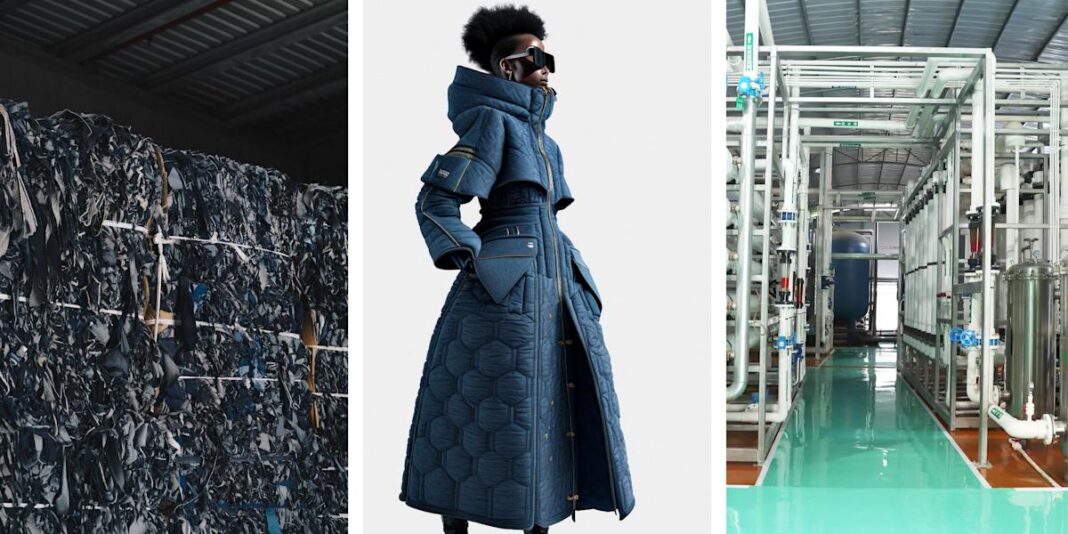


“When our leadership first invested in mechanical textile recycling, there was curiosity but essentially no clear requirement for recycled cotton from the brands. Today, we are proud to say, that nearly all our clients require it in their fabrics and that policy is built into their sustainability goals. To go from that original status quo to the current environment where exciting conversations are had about what else we can provide from recycled viscose, lyocell, polyester and even linen—that is inspiring,” he said.
In 2024, AGI produced more than 30 million meters of fabric with recycled cotton.
Recycling technology has made denim production more resource-efficient by reducing waste and minimizing its environmental footprint, Tekin added. Having its own recycling system and supply chain gives the vertically integrated mill greater control over its products from an earlier stage.
Additionally, because recycled fiber requires more optimization in downstream production, it has led the Pakistani mill to assess different parts of our operation for inefficiencies. Recent investments have been designed with recycled fibers in mind, ensuring all processes are optimized for it. Overall, Tekin said it has encouraged the company to take a more holistic approach to making denim with recycled fibers.
“AGI Denim’s leadership has a history of investing in new technologies, and we are proud to say we were one of the pioneers who brought denim recycling by introducing one of the first dedicated mechanical cotton recycling plant in Pakistan,” Tekin said. “The technology has changed a bit since then, to say the least, but our commitment to turning waste denim into new fibers and materials has not altered. Last year, we produced over 30 million meters of fabric with recycled cotton.”
Siddiqsons’ investment in recycling machinery has enhanced sustainability, reduced waste, lowered production costs, and strengthened its market position by offering eco-friendly denim solutions. The Pakistani mill began investing in cotton recycling in 2013, integrating advanced recycling machinery into its operations. Siddiqsons’ setup includes post-industrial waste and post-consumer waste plants, a waste recycling plant, and a recycled waste yarn plant, enabling the company to minimize waste, enhance resource efficiency, and contribute to a more sustainable denim industry.
The mill recycles 14,400 kg of waste yarn annually and has a shredding waste recycling capacity of over 4,380 tons annually.
“Textile recycling machinery has significantly enhanced sustainability in the denim industry by minimizing waste, optimizing resource utilization, and enabling large-scale recycling of blended fabrics,” said Abbas Jan, Siddiqsons director of sales and marketing. “Beyond promoting circularity, investing in recycling machinery enhances resource efficiency, reduces production costs, minimizes environmental impact, and strengthens compliance with sustainability regulations.”
However, Jan noted that challenges persist in securing cost-effective raw materials, traceability and maintaining fiber quality, necessitating continuous innovation and collaboration.
Zahra Ahmed, Artistic Denim Mills (ADM) director, said textile recycling has profoundly transformed denim production at ADM. The Pakistani mill produces 12,000 tons of recycled cotton annually.
In 2020, ADM began its investment in recycling by partnering with Recover. The strategic collaboration enables ADM to offer clients a traceable and scalable solution for integrating recycled fiber into their products and valuable insights into the recycling process.
“We aim to demonstrate to our brands that recycling is a viable future without compromising product quality. While not all recycled goods are created equal, our commitment to innovation ensures that we offer products on par, all while reducing our environmental impact. This strategic approach positions us as leaders in sustainable denim production,” Ahmed said.
Beyond promoting circularity, investing in recycling machinery allows the vertical mill to initiate fabric innovation ahead of competitors and has prompted ADM to experiment with different blends. “Our goal at ADM is to continue fabric innovation,” Ahmed said. “For instance, we’ve combined recycled cotton with hemp to develop a product that offers a unique soft hand feel while lowering the impact of the garment. This innovative, proprietary blend not only enhances the texture and appearance of our denim but also introduces a new aesthetic, that wasn’t previously available in the market. This opens exciting possibilities for both product differentiation and consumer appeal.”
While the fundamentals of mechanical textile recycling machinery have not changed in the last-half century, Neville said Recover has innovated how it uses machinery. Through continuous learning and improvements, the company has developed proprietary technology that optimizes the output. Recover’s annual production capacity is approximately 65,000 metric tons. “The result in a consistent, high-quality fiber that is spinnable even in ring spinning (which makes up most of the industry), and this is something that sets us apart from a lot of recyclers,” he said.
There is still room for improvement in mechanical recycling, and this focuses mostly on improving the uptake of the fiber by spinners. Neville said the industry is also investing heavily in automated sorting technology, which would enable the industry to turn the huge quantities of post-consumer waste into valuable feedstock for textile-to-textile recycling.
Traceability technologies are evolving the relationship between mills and brands. Up against consumer demand for transparency and legislation requiring digital product passports (DDP), suppliers have adopted various solutions to aid with traceability. FibreTrace, a technology that uses a unique identifying luminescent pigment to raw fiber that can be followed from farm to shelf in real-time, and Oritain, a fiber-testing technology that precisely pinpoints the area down to a few meters where a product or raw material originated, are some of the tools being utilized by mills.
Cone Denim, for instance, minted a partnership with Oritain to verify the origins of its cotton and share that data with customers. Steve Maggard, president of Cone Denim, said that, since the partnership began in 2020, clients have responded favorably to the added security origin verification provides. Oritain’s fiber-testing technology verifies that cotton is compliant with legislation like the U.S.’s Uyghur Forced Labor Prevention Act (UFLPA).
“Cone Denim has publicly committed to operating sustainably and transparently, and Oritain is a key tool to meet that commitment. Not only is it admissible in a court of law, but it has been vetted and is recognized by our customers as valid,” he said.
Traceability and transparency are closely linked. Pakistan’s AGI Denim partners with Oritain as well as Green Story, which uses technology to generate information about a fabric or style’s footprint via a digital product passport (DPP). That data gives buyers insight into how much water, energy and land use went into making a fabric or style—and how much emissions are associated with the creation of such a product.
AGI is targeting EU and U.S. customers with the life cycle assessment (LCA) information; in the EU, incoming legislation will begin to mandate DPPs for a slew of products. This year, AGI will debut 100 styles—up from just a few in 2024—all featuring hang tags with a QR code directing buyers to a full LCA completed by Green Story.
AGI plans to continue working with Green Story to refine DPPs and LCAs for the denim industry. Henry Wong, AGI Denim’s VP of product development and marketing, said the mill wants the technology to be plug-and-play ready for other companies interested in providing their customers with the same information.
“Despite all the competition we have in our space, we still all live in the same world, so we want to see it be more than okay—be great,” he said.
The denim industry’s water consumption sparked controversy in 2013 when Levi Strauss & Co. released the lifecycle impact of a pair of 501 jeans, revealing that each pair requires 3,781 liters of water—equivalent to three days’ worth of total water usage for a typical U.S. household.
The denim industry’s reliance on water, along with solutions to minimize water waste, has become a central focus for investment. Mills from all regions including Artistic Milliners in Pakistan, Arvind in India, Crystal International in Cambodia and Kaltex in Mexico are taking proactive steps to reduce water usage by implementing wastewater treatment facilities to collect, recycle and reuse water.
Among them, Advance Denim stands out as a leader in driving these efforts. Mark Ix, director of North American marketing for Advance Denim, said the company built its wastewater treatment plant next to its factory in China. The wastewater produced during denim finishing is piped into the treatment plant, where it goes through a bioreactor, is filtered to remove indigo and chemicals and is then turned into clean water that can be reused in the factory. Advance measures its ammonia and chemical oxygen demand (COD) to ensure levels of water output by the treatment plant are far lower than government standards.
The plant can process 9,000 tons of water daily, but Ix said the mill doesn’t come close to using that capacity. “The key is, don’t use so much water—create your manufacturing process to limit the amount of water you use,” he said. To achieve that goal, Advance has, in tandem, worked to reuse the indigo filtered out of the water to decrease the amount of water waste it produces, before it ever hits the treatment plant.
Ix said the company has reduced the amount of water it uses in denim production by 73 percent. On average, Advance Denim uses about 600,000 tons of water annually, meaning the treatment plan processes less than 2,000 tons a day. He added that the goal is to create a [wastewater] system that is robust but not overstressed. “The water you’re actually sending to your reverse osmosis system is just a trickle [compared] to what it was seven years ago,” he said.
For Advance, the next item on the docket at its wastewater treatment facility is using renewable energy to power it. By the end of 2025, Ix projects that “no less than 40 percent of the power will come from renewable energy, as well.”
Cotton continues to be the foundation of jeans, but the introduction of additional fibers has propelled the garment into exciting new dimensions.
Textile expert Tricia Carey said the denim market has always been a hotspot for fiber innovation because its unique construction allows experimentation with new materials. “Denim’s coarser yarn counts make it more forgiving for fibers that may not be optimized for quality. Additionally, weft innovation provides opportunities to incorporate fibers that may not have the strength in warp applications since they don’t require dyeing,” she explained.
Additionally, Carey said the presence of vertical suppliers—where spinning, weaving, and sometimes garment-making happen within the same company—enables seamless integration of new fiber technologies and supports cost efficiencies.
Lenzing has worked closely with vertical suppliers to scale the use of Tencel lyocell in denim. The fiber’s foray into denim goes back to the ’90s but Tuncay Kiliçkan, head of global business development for denim at Lenzing, said it took some time for the industry to fully understand the characteristics of the man-made cellulosic fiber that’s derived from wood pulp. “Fiber innovations progress at a slower pace compared to other raw materials, and their adoption takes time. However, these advancements open new chapters for the industry. Brands are no longer willing to rely solely on cotton, making the adoption of alternative fibers like Tencel more essential than ever,” he said.
Tencel has become a key ingredient in the denim sector for its low amounts of water, low carbon footprint and softness. It has also become a point of differentiation in a denim market that has an increasingly homogenized look. “For consumers, little remains to justify a premium feel and a comfortable pair of jeans—aside from a luxurious hand feel, which Tencel fibers naturally provide,” Kiliçkan said. “As a result, there is strong demand for authentic yet soft denim products in both the EU and U.S. markets. Both mills and brands are well-acquainted with this solution, and it has now become a mainstream trend.”
Tencel has also created a blueprint for additional fiber solutions such as Refibra technology, which transform recycled cotton textile waste into new fiber, and Tencel Modal with Indigo, a fiber that Kiliçkan said significantly reduces water, chemical, and carbon footprints while offering superior fastness compared to traditionally indigo-dyed fibers. “I can say that it’s the next-gen denim fiber which can easily adopt to other segments than denim like activewear and knit,” he said.
There’s room for growth, Kiliçkan added. “If the industry can be more patient and supportive, we will see greater diversity in the fiber portfolio. With these added innovations, denim will continue to evolve in both look and feel—while also driving more significant resource savings,” he said.
Denim is also deeply rooted in storytelling, making it an ideal platform to introduce and market fiber innovations in a way that resonates with consumers, Carey added. “Most importantly, the denim industry is a highly collaborative community with deep technical expertise, where brands, mills, and innovators work together to push boundaries and drive meaningful innovation. This combination of technical adaptability and industry-wide cooperation makes denim a natural fit for pioneering new fiber solutions,” she said.
In 2019, Levi’s and Outerknown captured consumers’ attention by launching jeans made from a blend of 70 percent cotton and 30 percent hemp, engineered to feel just like cotton. This fiber innovation, called cottonized hemp, had been under development by The Flax Company—famous for cottonizing linen 50 years earlier—since 2000. Based in Northern France, The Flax Company began bulk production in 2019 with the debut of Marmara Hemp.
“The denim sector is facing major challenges in meeting market expectations, whether in terms of innovation, durability or even cost, and not just in terms of spinning, weaving or finishing. Fiber innovation is one of denim producers’ major allies in meeting brand challenges. Marmara is a golden opportunity to broaden the scope of possibilities while matching the new market rules,” said Denis Druon, CEO of The Flax Company.
The environmental benefits of hemp have intrigued the denim industry. However, hemp’s rough texture previously prevented it from being widely adopted.
“When we speak of a cottonized hemp fiber, we mean a 100 percent hemp fiber that we have tailored to similar specifications in terms of length and fineness, so that it can be spun as a blend on a cotton spinning system (ring or open end) without modification of the existing equipment,” Druon said. “Hemp does not require water to grow or to be produced. So, each kilo used significantly saves water for our planet. Adding Marmara hemp to denim is a big step towards product sustainability.”
Over the past six years, Druon said the firm has worked with supply chain partners to reach the quality standards required by the spinning mills, particularly in terms of fineness/spinnability, to secure sowings to guarantee volumes, and to certify its production chain with an LCA, a C2C certificate and sustainability certification.
Cottonized hemp poses a unique set of challenges—the biggest being the selection of the raw material. “The process starts well before the plant even grows as there is a tremendous amount of work in seed selection, land preparation, straw cutting date in the field and then retting process,” Druon said. “For textile applications, we need fineness and fiber division, which is difficult to achieve with hemp fiber, but we’re getting there.”
The other challenge is to turn a natural fiber, where each field and each batch of fiber has its own particularities, into a fiber that will be homogeneous for every delivery and available in industrial quantities on a regular basis. This is the challenge met by Marmara Hemp, Druon said.
From fit and finish to shrinkage and wash, countless factors go into perfecting a pair of jeans. As the demand for efficiency grows, design is increasingly leaning on digital prototypes to minimize the need for physical sampling.
Companies like Browzwear and CLO are leading the charge in 3D digital prototyping. CLO boasts clients like Diesel, Hugo Boss, L.L. Bean and Levi’s, and Browzwear has customers like Columbia Sportswear, Under Armour, Walmart and Kohl’s.
The key advantage of 3D prototyping is that designers can iterate and adjust styles in real-time, seeing photorealistic versions of their designs and assessing fit without producing a physical sample.
In the denim industry, creating fewer samples is particularly impactful because of the myriad steps that go into dyeing and finishing garments, as compared with a less-involved garment. By dynamically adjusting designs digitally, brands can reduce the number of samples they request before production, which decreases the emissions associated with producing the samples and shipping them, whether domestically or, more commonly, internationally.
“As a technical designer, I find it invaluable for quickly sharing designs and options with just a few clicks,” said Maria Gunnarsson, founder of AMK Atelier.
Using 3D prototyping software can also aid brands and retailers in getting products to market faster. Rather than waiting for several iterations of a physical sample from faraway suppliers, designers can complete most of their vetting digitally, sending only the most finalized version of a product’s tech pack to a manufacturer for sampling.
One of the most effective ways brands reduce their environmental footprints is through advanced finishing technologies.
“If the denim industry didn’t have advanced laundry technologies like laser and ozone, we would see significantly more pollution, water waste, and fewer sustainable finishing options,” said Carey. “Design possibilities would also be more limited, as traditional methods rely heavily on chemicals and manual labor to achieve desired aesthetics.”
Indeed, laser technology has revolutionized denim finishing, enabling companies to achieve worn and aged effects without potassium permanganate and manual scraping. The cutting-edge technology replicates an authentic vintage look while opening up limitless creative possibilities—from natural 3D textures and effects to custom damages, lettering, and imagery. Designers can create a digital file of their desired finish, upload it into the laser system, and within seconds, the power of light effortlessly transfers the design onto the garment.
“This technology drastically increases productivity, improves quality, and enhances worker safety, ensuring precision and repeatability while eliminating harmful manual processes. It enables brands to scale up production efficiently while reducing dependency on skilled labor for finishing,” said Carmen Silla, marketing director of Jeanologia, which launched its laser technology in 1999.
Since Italian tech firm Tonello introduced the technology for garment processing in 1995, laser systems have evolved into highly precise and efficient tools, with innovations like B.O.P. (Be On Point), an AI-powered garment detection system that ensures accurate, error-free marking.
Laser has been a catalyst for other efficiency-driving innovations including Tonello’s All-in-One System, a washing machine that combines multiple sustainable technologies to streamline finishing while reducing resource consumption. The system includes EGO, which utilizes ozone to minimize water and chemical use; NoStone, which replicates stone-wash effects without pumice stones; UP, optimizing washing with an ultra-low liquor ratio; and Core, a nebulizing system that significantly cuts water usage.
In 2005, Jeanologia introduced G2 Ozone technology, replacing traditional water-intensive washing with an air-washing system. Building on this breakthrough, in 2023, the company launched G2 Indra Ozone Airwash. “Just as laser disrupted the dry finishing process, G2 air-washing machines are set to replace water-washing machines, marking a new era for denim finishing,” Silla said. “Traditionally, water has been the carrier for transporting chemicals into garments. With G2 Indra, we shift from water to air, using ozone gas to generate the same abrasion, color reduction, and cleaning effects—without water, chemicals, or pumice stones.”
Though Tonello has been a trusted technology supplier for 50 years, Alice Tonello, R&D and marketing manager, said the family-run company has seen a notable shift in the industry’s approach to sustainable finishing technologies in the past decade. “It has become increasingly clear that the future of denim can only move in this direction, driving a deeper investment in innovative washing and finishing solutions that prioritize responsibility,” she said.
Several key factors in the past decade have accelerated this transition. “Increasing pressure from consumers and brands for more sustainable production methods, along with stricter environmental regulations, have made it clear that the industry could no longer rely on its old ways. At the same time, rising production costs, water scarcity, and the push for digitalization and automation have made investing in new technologies a necessity rather than an option,” Silla said.
Pivoting to these technologies has been a challenging endeavor, particularly for an industry that values its legacy and is recognized for its fragmented supply chain. “While these innovations have already made a huge impact, there is still a need for broader adoption across the industry to maximize their environmental benefits. Advancing these technologies further is crucial to reducing denim’s footprint while maintaining the creativity and diversity that make it such a dynamic category,” Carey said.
Resistance to change has been a major barrier, slowing down the adoption of sustainable and advanced technologies, Silla said. “The finishing industry has always been deeply rooted in tradition, relying on legacy processes where water, chemicals, and manual techniques are the main forces. Historically, the industry has depended on washing machines, pumice stones, and chemical treatments for washing, while manual labor and chemical applications have been essential for dry processes. This traditional approach is still dominant today,” she said.
Despite this, Jeanologia’s vision for the future of denim finishing is digital, which will reduce lead times, physical samples, and waste; automated to increase efficiency and consistency; and water-free.
The future of denim finishing technology is still taking shape, Tonello said. “Since its founding, Tonello has continuously introduced innovations to the market, and the focus now is on refining and improving existing technologies to make them even more efficient and less impactful. Progress isn’t just about invention; it’s also about adoption. Truly transformative innovations often take time to be widely embraced, but as awareness and industry priorities evolve, sustainable and high-performance solutions will become the standard,” she said.
As brands and retailers increasingly seek to offer products made from more sustainable fibers, cotton grown through regenerative practices has emerged as a leading option. Unlike conventional cotton farming, which can deplete the soil and rely heavily on synthetic chemicals and fertilizers, regenerative farming aims to go beyond sustainability by actively regenerating and enhancing the environment.
The global momentum behind regenerative cotton gained undeniable traction, with the farming practice increasingly recognized for its economic and environmental benefits. Last July, the certification body RegenAgri reported a dramatic surge in the adoption of its standards. The number of farms and supply chain operators joining the regenerative movement grew fivefold in 2023, with 640 supply chain companies committing to the program.
Denim mills such as Vichuna, Soorty and AGI Denim have taken leadership roles in driving this transition. For Pakistan-based Artistic Milliners, which has a regenerative cotton program, rehabilitating the soil and ecosystem in a region fraught with the negative impacts of repeated chemical use and climate change has proven a way forward.
The RegenAgri-certified mill has partnered with hundreds of farmers to realize its more sustainable vision. In 2023, it worked with 92 farmers, and that number surged to about 600 in 2024. This year, Saqib Sohail, Artistic Milliners’ lead on responsible business projects, shared that the mill aims to expand the program to approximately 1,000 farmers.
The regenerative cotton program has enabled some clients to transition away from conventionally grown cotton—particularly those who have been priced out of using organic cotton. Furthermore, regenerative cotton offers valuable data to help brands and retailers meet EU sustainability and traceability requirements.
While regenerative cotton often comes at a lower price point than organic cotton, Sohail emphasized that launching a regenerative program requires substantial investment. He expressed hope that in the future, regenerative certification costs will decrease, making the practice more accessible.
“We have to create an environment where the farmers are able to do it on their own, especially when you are working with South Asian farmers who have small land ownership, not the big ranches in the U.S. and Australia and other places,” Sohail said.
Stretch denim revolutionized the industry, unlocking a world of new silhouettes and enabling denim to rival activewear in ways consumers had never experienced. For millennials who grew up with skinny jeans as a staple and Gen Z-ers who abandoned the fit during the pandemic, only to rediscover it as a trend item, the idea of denim without stretch feels almost unimaginable.
“In the mid-1970s we began working with mills to experiment with Lycra fiber in denim. As with many new fabric innovations, there were challenges to overcome. Designers had to figure out how to make fabrics that would stretch but not shrink excessively, avoiding the orange peel effect,” said Jean Hegedus, sustainable business consultant and former denim segment director for The Lycra Company.
With assistance from the Lycra brand technical team, and through numerous fabric trials, the industry began to see improvements in both fabric aesthetics and performance. Burlington Denim was among the first mills to develop stretch denim in the U.S.
By the 1980s jeans themselves had experienced several incarnations, particularly sexy status symbols, Hegedus said. “It was at that time that designers began developing slim fitting, skinny jeans with Lycra fiber, and young women could be found sporting them in discos and clubs,” she said.
“I still remember trying on my first pair of skinny jeans and thinking how odd they felt, but they marked the shift from a denim-chino cycle to a denim-legging era,” said Tricia Carey, textile expert. “Comfort and flexibility became essential. Initially, the focus was simply on adding stretch, but as the market evolved, so did the technology—leading to better recovery and fiber blends that improved durability and shape retention.”
By the 2000s, the burgeoning premium denim market established the use of Lycra T400 fiber. “Not an elastane, it was made from two different types of polyester polymers, which provided inherent and long-lasting recovery so denim fabrics would keep their shape,” Hegedus said. This fiber paved the way for innovations like Xfit Lycra, a fiber technology that allowed designers to develop fabrics that would stretch and recover in all directions, and Lycra dualFX, a solution for denim with high stretch levels.
While previous denim fabrics tended to have 15 to 20 percent stretch, Hegedus said designers wanted them to stretch 30 to 80 percent or more. “This posed numerous challenges to mills and brands alike. As fabric stretch levels increase, so does the tendency for fabrics to have high growth (bagging and sagging) or high shrinkage. Stabilizing these fabrics was difficult at best,” she said.
Rita Ratskoff, The Lycra Company’s senior strategic account manager, said Lycra dualFX was quickly adopted by mainstream brands and retailers, as it significantly improved the comfort, fit and durability of jeans. “Levi’s adoption of stretch in women’s denim sparked global awareness and triggered widespread acceptance. American Eagle was an early adopter of Lycra dualFX technology,” she said.
Stretch denim’s staying power in the market is partly owed to fiber companies’ willingness to evolve and adapt to the market’s ever-changing needs. “[Fiber innovation] is imperative—the industry thrives on innovation and can’t exist without it,” said Ebru Ozaydin, The Lycra Company’s strategic marketing director denim, RTW. “This is why The Lycra Company is so focused on looking beyond just trends and providing true denim innovation with and for our partners.”
An example includes Lycra FitSense Denim Technology, a “fiber-to-fashion solution” that enables designers to enhance jeans with targeted shaping. Additionally, Lycra is adopting bio-based inputs for products like Lycra EcoMade made with Qira, a dent corn-based 1,4-butanediol (BDO) produced by Qore.
“Stretch innovation has transformed the denim sector bringing added comfort, durability, and expanded design capability,” said Simon Hong, Hyosung global denim marketing director. The South Korean spandex producer began developing customized stretch innovations for denim in 2015.
Sustainability is increasingly playing a role in the future of stretch denim. “As consumers demand more eco-friendly products, denim is being held to higher environmental standards,” Hong said.
To meet this challenge, Hyosung has developed many customized sustainable textile solutions for denim beginning with the introduction of RCS-certified, 100 percent recycled Regen Spandex made from reclaimed production waste we commercialized in 2020. In 2022, the company launched Regen Bio Spandex made with 30 percent industrial corn and has since increased the Bio Spandex offering to include higher content of renewable resources.
Hysong’s Creora 3D Max Spandex delivers high-performance stretch and recovery with a small portion of spandex content uniquely allowing the garment to be recycled, and Creora SlipFree Spandex improves seam slippage resulting in reduced waste. “We continuously study the denim market to drive textile innovation and stay ahead of consumer needs,” Hong said.
Artificial intelligence (AI) is revolutionizing the world of design and quality control, ushering in a new era of innovation.
Many companies are leveraging AI to enhance creativity while maintaining the human touch in their designs. For instance, G-Star Raw uses generative AI to assist its designers, and the Netherlands-based brand has already begun selling products that incorporate AI-generated ideas. Other brands use AI to push the limits of what’s possible, showcasing bold and imaginative denim designs in lookbooks and ad campaigns. While these designs may be challenging to mass-produce, they inspire clients to think more creatively.
In an even better scenario, Maria Gunnarsson, founder of AMK Atelier, said consumers could pre-purchase AI-generated products, allowing brands to produce only what is in demand, eliminating overproduction. “I believe we have only scratched the surface of AI’s potential in supporting us. Education will play a crucial role in helping us evaluate and integrate digital designs into more efficient fashion production methods,” she said.
On the production side, mills are harnessing AI to streamline quality control processes by inspecting fabric bolts or finished goods. Advance Denim uses AI to help identify and pinpoint defects in textiles, said Mark Ix, director of North American marketing for Advance Denim. The process uses cameras and sensors to capture data about a given fabric, and an algorithm helps to identify imperfections.
Previously, Advance used cameras in its finishing machines to identify defects, but the system wasn’t properly trained to differentiate between normal denim characteristics and actual flaws. With the advent of AI, the technology now can more accurately distinguish between what’s intentional and what’s a defect.
“They couldn’t tell the difference between just regular character in denim and a defect, so we boxed those and put them in the corner, and now AI has helped teach that kind of technology to differentiate between the defects and stuff that’s supposed to be there,” Ix said.
Not all innovations are the stuff of sci-fi movies. The denim industry is increasingly looking to nature for inspiration, resulting in nature-derived auxiliaries and bio-based performance fibers that deliver the same results as their fossil fuel counterparts. Companies like The Lycra Company, Hyosung and Candiani Denim are pioneering bio-based stretch fibers, while chemical specialists like Archroma have been touting the benefits of natural color for years.
Switzerland-based Archroma launched EarthColors in November 2014 with the vision of transforming agricultural waste into high-performance dyes. Since its launch, Dhirendra Gautam, VP of global marketing for Archroma, said EarthColors has inspired several brands and retailers such as G-Star Raw and Espirit to push the boundaries with their designs by introducing sustainable dyes to their collections.
“We continue to see growing interest in bio-based coloration solutions. As technology improves, brands are increasingly seeking eco-friendly alternatives to meet consumer demand and regulatory standards,” Gautam said.
Companies like Archroma continue to improve their chemistry as well. Historically, natural dyes faced challenges with colorfastness and vibrancy. Ongoing research is overcoming these challenges, ensuring that nature-sourced dyes can compete with synthetic ones in terms of durability and color consistency. Gautam added that the future of nature-sourced dyes looks promising, especially as sustainability continues to drive innovation in the textile and fashion industries. Up next, Archroma is preparing to launch FiberColors, which will upcycle wool waste into a new range of high-performance bio-based sulfur dyes.
“The denim industry, like many others, is increasingly under pressure to adopt more sustainable practices due to growing environmental concerns. With advances in technology and innovation, it is increasingly feasible to produce high-quality, natural dyes and chemicals on a large scale, hence reducing costs and addressing past concerns about durability and vibrancy,” he said.
Natural dyes have been part of Maria Gunnarsson’s design toolbox. However, the founder of Amsterdam-based AMK Atelier, said education is key to raising awareness among both the industry and consumers about the advantages of using ingredients from renewable resources. “It’s crucial to recognize that we can’t continue prioritizing only the cheapest and fastest methods of designing, developing, and producing clothing,” she said. “If the industry doesn’t demand or invest in more sustainable chemicals, meaningful change will never happen. Education must reach not only the next generation in schools but also brands and consumers, ensuring a collective shift toward more responsible choices.”
The adoption of nature-derived auxiliaries in textiles is still in its early stages, said Alberto De Conti, the former head of Rudolf Hub1922. “While their use is, in principle, widely supported as a noble industrial practice, the reality is that their higher cost, driven by the premium on renewable sources, limits their widespread adoption in denim manufacturing and finishing,” he said.
Rudolf offers 69 auxiliaries (and counting) that have bio-based carbon content ranging from 25 percent to 100 percent. Key products for the denim industry include Rucolase DWS, the first and only bio-abrasive for waterless stone washing of jeans, derived from food waste, and Perrustol MMX, a 93 percent bio-based hydrophilic softener with exceptional natural, anti-yellowing properties.
The demand for nature-derived auxiliaries, which typically have a significantly lower product carbon footprint is moving in a positive direction. De Conti said the current implementation of sustainability reporting directives in the EU, and likely soon in the U.S., require large enterprises to disclose climate-related risks, including greenhouse gas emissions.
“The denim industry is about to face even greater complexity, building on the already detailed certification requirements for chemical safety,” he said. “Soon, we’ll also be required to provide more transparency regarding product carbon footprint. One of the main drivers of CO2 emissions in chemical auxiliaries is the type of raw materials used. To reduce environmental impact, selecting the right renewable sources and implementing a strong logistics strategy will be essential. Therefore, there will certainly be a future for chemistry made out of renewable sources.”
This article was published in SJ Denim magazine. Click here to read more.


